
Most people think of skin cancer as a dark mole or a weird bump that shows up out of nowhere. But the real danger often starts long before that - in the rough, scaly patches you might rub off without thinking twice. These are actinic keratoses, and they’re not just annoying dry skin. They’re your body’s warning sign that sun damage has gone too far.
What Exactly Are Actinic Keratoses?
Actinic keratoses (AKs) are precancerous spots caused by years of sun exposure. They don’t appear overnight. They build up slowly, like rust on metal. You might notice them on your face, scalp, ears, neck, forearms, or the backs of your hands - places that get the most sun over time. They’re usually small, between a pinhead and a pea in size, but sometimes grow bigger. Their texture is the biggest clue: rough, gritty, like sandpaper. Often, you feel them before you see them. They come in different colors - red, pink, brown, gray, or even skin-colored. On darker skin tones, they can look like age spots or dark freckles, which is why they’re often missed. The Skin Cancer Foundation says 78% of people first notice them by touch, not sight. That’s why running your fingers over sun-exposed skin is one of the best self-checks you can do.Why They’re More Than Just a Cosmetic Issue
Here’s the hard truth: actinic keratoses aren’t harmless. They’re the earliest stage of cutaneous squamous cell carcinoma (SCC), the second most common type of skin cancer. According to DermNet NZ and the Cleveland Clinic, about 10-15% of people with more than 10 AKs will develop SCC at some point. That doesn’t mean every patch turns into cancer - but each one is a potential seed. The American Academy of Dermatology says 90% of SCCs start as untreated AKs. The risk isn’t the same for everyone. People with fair skin, a history of sunburns, or weakened immune systems (like those on immunosuppressants after organ transplants) have up to a 25% chance of progression. Even if you don’t have symptoms, the damage underneath is real. That’s why dermatologists call AKs “field cancerization” - the whole sun-damaged area is at risk, not just the visible spots.How Doctors Diagnose Them
Most of the time, a dermatologist can tell if it’s an AK just by looking and feeling. With a dermatoscope - a special magnifying tool - they can see patterns invisible to the naked eye. Board-certified dermatologists get it right 95% of the time without a biopsy. But sometimes, it’s not clear. If a spot is thick, tender, bleeding, or growing fast, they’ll take a small sample. That’s because early squamous cell carcinoma can look almost identical to a severe AK. The difference? SCC is deeper, more aggressive, and needs more serious treatment. The NHS reports that about 60% of people with AKs have multiple lesions - often 7 to 10 at once. That’s why full-body skin checks matter.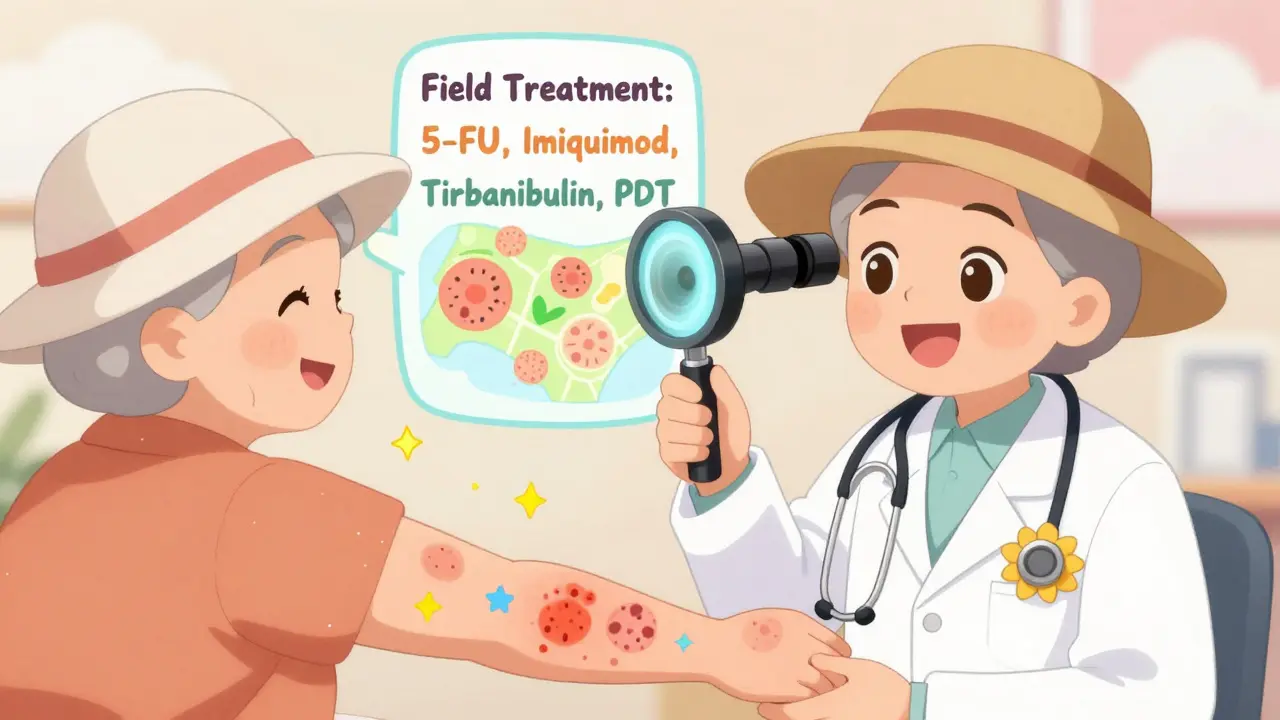
Field Treatments: Treating the Whole Area, Not Just the Spots
If you only have one or two AKs, your doctor might freeze them off with liquid nitrogen. But if you have five, ten, or more - and your skin looks sun-damaged overall - you need a field treatment. This means treating the entire area, not just the bumps. Why? Because there are invisible, damaged cells all around the visible lesions. Left alone, they’ll become new AKs. There are four main types of field treatments:- Topical creams and gels: These are applied daily for days or weeks. 5-fluorouracil (5-FU) is the oldest and cheapest - generic versions cost around $120. It works by killing abnormal cells. But it causes intense redness, peeling, and burning for weeks. Many patients say it feels like a bad sunburn. Still, 75-85% of users see complete clearance after 2-4 weeks.
- Imiquimod: This boosts your immune system to attack the bad cells. Applied 2-3 times a week for up to 16 weeks. It’s less irritating than 5-FU but takes longer. Clearance rates are 54-75%.
- Tirbanibulin (Klisyri): Approved in 2020, this is the newest option. It’s a 5-day treatment for facial AKs. You apply it once a day for five days. It clears 44% of lesions and doesn’t cause as much inflammation. But it costs about $650 per treatment - a big jump from generic 5-FU.
- Photodynamic therapy (PDT): You apply a light-sensitive solution to your skin, wait a few hours, then shine a special blue or red light on it. It destroys damaged cells. One or two sessions are usually enough. It’s effective (44-75% clearance), less messy than creams, and great for larger areas like the scalp or chest.
What Works Best - and Who It Works For
There’s no one-size-fits-all. Your choice depends on your skin type, how many lesions you have, where they are, and how much discomfort you’re willing to handle. For facial AKs, many dermatologists now prefer tirbanibulin because it’s fast and tolerable. For larger areas like the scalp or arms, PDT or 5-FU work better. If you’re on a budget and can handle the side effects, 5-FU is still the gold standard. For older patients with limited life expectancy, some guidelines (like those from the British Association of Dermatologists) say it’s okay to watch and wait - especially if the lesions are mild and not bothering you. But here’s the thing: if you’re healthy and active, treating AKs isn’t optional. It’s prevention. One patient on HealthUnlocked wrote: “Worth the 4 weeks of redness to stop cancer before it starts.” That’s the mindset.Side Effects and What to Expect
No field treatment is gentle. All of them cause inflammation - that’s how they work. You’ll get redness, swelling, crusting, and stinging. Some people stop treatment early because it’s too uncomfortable. In fact, 61% of people on 5-FU need to pause treatment because of severe reactions. But here’s what most don’t expect: the worst days come after the first week. The skin looks worse before it gets better. That’s normal. Your dermatologist should give you a clear timeline - when to expect peak irritation, when to moisturize, when to call them. Don’t panic if your skin looks angry. That’s the healing process.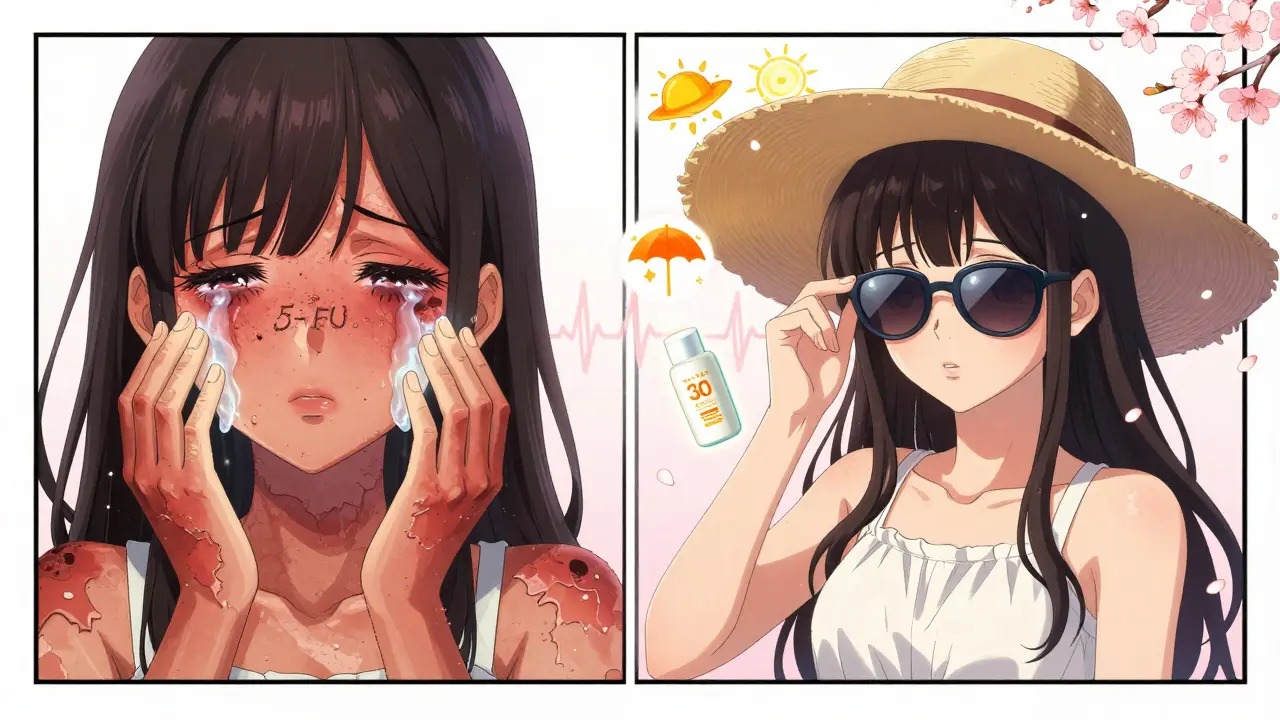
Prevention: The Real Long-Term Solution
Treating AKs is important. But stopping new ones is even more important. The Skin Cancer Foundation found that patients who got proper sun protection counseling reduced new AKs by 37% over two years. That means:- Wearing broad-spectrum SPF 30+ every day - even when it’s cloudy.
- Reapplying every two hours if you’re outside.
- Wearing wide-brimmed hats and UV-blocking sunglasses.
- Avoiding direct sun between 10 a.m. and 4 p.m.
- Checking your skin monthly - especially your face, scalp, ears, and hands.
The Bigger Picture: Why This Matters Now
The global market for AK treatments hit $1.34 billion in 2022. Why? Because the problem is growing. In sunny places like Arizona, 40-60% of people over 40 have AKs. In northern Europe, it’s 15-20%. As the population ages and UV exposure increases - thanks to thinner ozone and more outdoor lifestyles - the Skin Cancer Foundation predicts AK cases will rise 25% by 2030. FDA-approved treatments like 5-FU and ingenol mebutate have shown they can cut SCC development by 34-50% over five years. That’s not just about skin appearance. It’s about saving lives.What to Do Next
If you’ve noticed rough, scaly patches on sun-exposed skin:- Don’t ignore them. Don’t assume they’re just dry skin.
- See a dermatologist. Bring a list of where they are and how long you’ve noticed them.
- Ask if you need a field treatment - especially if you have more than three lesions.
- Ask about prevention. Get a sun safety plan.
- Check your skin monthly. Use the “sandpaper test” - run your fingers over your face, scalp, neck, and hands. If anything feels rough, get it checked.
Comments (11)
Haley Graves
January 14, 2026 AT 22:55
For years I ignored the rough patches on my scalp until my dermatologist pointed them out. I thought it was just dandruff. Turns out, I had eight AKs. Started 5-FU last winter-felt like my face was on fire for six weeks, but my skin hasn’t looked this clear since I was 25. Worth every second of discomfort.
Gloria Montero Puertas
January 15, 2026 AT 20:48
It’s astonishing how many people mistake precancerous lesions for ‘dry skin’-a term so vague it’s practically medical malpractice. The fact that 78% of individuals first detect AKs by touch, not sight, underscores a catastrophic failure in public dermatological literacy. One must wonder: if your skin feels like sandpaper, why are you still using moisturizer instead of seeking professional intervention?
Tom Doan
January 17, 2026 AT 15:00
Interesting that the article mentions tirbanibulin costs $650 per treatment. Meanwhile, 5-FU generics are $120. I’m curious-how many of these expensive new treatments were developed because the old ones were too effective? Not that I’m cynical. Just… observant.
Sohan Jindal
January 18, 2026 AT 19:36
They say sun damage causes this. But who’s really behind all this? Big Pharma. They want you scared. They want you buying creams. They want you going to dermatologists. They don’t want you outside. They don’t want you breathing fresh air. Sunlight is natural. Cancer is a scam. Just eat turmeric and stop trusting doctors.
Frank Geurts
January 20, 2026 AT 14:03
One must observe, with considerable academic rigor, that the epidemiological trajectory of actinic keratoses mirrors broader patterns of anthropogenic environmental degradation, compounded by increasing life expectancy and the erosion of the stratospheric ozone layer. The societal imperative to implement comprehensive photoprotection protocols is not merely clinical-it is existential.
Annie Choi
January 21, 2026 AT 00:48
Field treatments are a game-changer. I had PDT on my scalp last year. Two sessions. No daily cream. No burning. Just a bright light and a weird smell. Now I wear a hat and SPF 50 like it’s my job. Prevention > treatment. Always.
Arjun Seth
January 21, 2026 AT 13:41
People don't care until they get cancer. Then they blame the sun. But the real problem? Too much sugar. Too much stress. Too much screen time. Sunlight is life. Modern medicine is poison. You think a cream fixes your soul? You're wrong. Your body knows. You just forgot to listen.
Mike Berrange
January 23, 2026 AT 13:39
Why does the article not mention that 5-FU is often prescribed off-label for non-AK conditions? Or that the clinical trials for tirbanibulin were funded by the manufacturer? Transparency is missing here. And yet, we’re supposed to trust the ‘gold standard’?
Dan Mack
January 24, 2026 AT 13:39
They’re hiding something. The FDA approved these creams because they’re funded by Big Derm. The real cure? A saltwater soak and fasting. They don’t want you to know that. They want you dependent. You think your dermatologist cares about you? They care about their bonus. Look at the numbers-$1.34 billion market. That’s not medicine. That’s a pyramid scheme with lotion.
Amy Vickberg
January 26, 2026 AT 07:45
Just wanted to say thank you for this post. I was terrified to start 5-FU because of the side effects, but your explanation helped me push through. My skin looks better than ever. And yes, I wear sunscreen now-even on cloudy days. You’re right. This isn’t about vanity. It’s about being here for the people you love.
Nishant Garg
January 27, 2026 AT 18:04
In India, we call these patches 'suraj ke daag'-sun spots. Many dismiss them as aging. But I’ve seen elderly farmers with dozens of lesions, untreated, until one bleeds and won’t heal. Then they go to a clinic. Too late. Prevention is not Western. It’s universal. Sunscreen is not luxury. It’s survival. And yes, we need more education. Not just in clinics. In villages. In schools. In families.