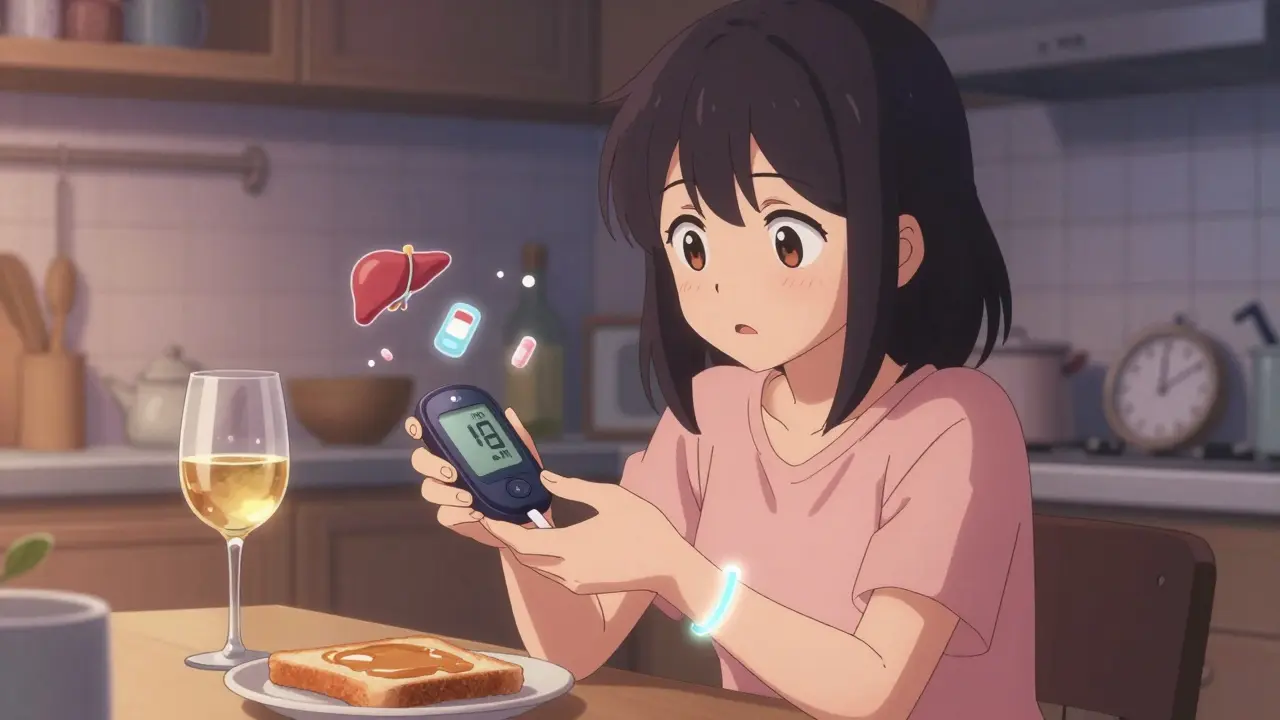
Drinking alcohol with diabetes isn’t just about choosing between beer and wine-it’s about survival. For people with diabetes, alcohol doesn’t just affect your mood or sleep. It can send your blood sugar crashing into a dangerous low that you might not even notice until it’s too late. And here’s the scary part: alcohol can hide the signs of low blood sugar, making it look like you’re just drunk. That’s why knowing the rules isn’t optional-it’s life-saving.
How Alcohol Messes With Your Blood Sugar
Alcohol doesn’t just lower blood sugar. It sabotages your body’s natural defense system. When you drink, your liver stops making glucose to focus on breaking down the alcohol. That’s fine if you’ve just eaten a meal. But if your blood sugar is already low, or if you haven’t eaten, your liver can’t save you. This is especially dangerous for people taking insulin or sulfonylureas-medications that already push blood sugar down. Add alcohol, and you’re stacking the deck against yourself.
Here’s how it plays out: First, sugary drinks like cocktails or sweet wines cause a quick spike in blood sugar. Then, as the alcohol kicks in, your liver shuts down glucose production. Within a few hours, your sugar plummets. And because alcohol dulls your body’s warning signs-shakiness, sweating, dizziness-you might not feel it coming. By the time you realize something’s wrong, you could be confused, disoriented, or unconscious.
What Counts as One Drink?
Not all drinks are created equal. One standard drink means:
- 12 ounces (360 mL) of regular beer (5% alcohol)
- 5 ounces (150 mL) of wine (12% alcohol)
- 1.5 ounces (45 mL) of hard liquor like whiskey, vodka, or gin (40% alcohol)
These are the numbers used by the American Diabetes Association, Diabetes UK, and major hospitals. Anything more than this in one sitting? That’s not moderation-that’s a risk. And here’s the catch: alcohol doesn’t care if you’re tall, short, or fit. The liver processes it at the same rate for everyone. So if you drink two drinks in an hour, your body is still working on the first one when you take the second.
Who Should Avoid Alcohol Completely?
Some people with diabetes shouldn’t drink at all. If you have:
- Diabetic neuropathy (nerve damage)
- Pancreatitis
- Advanced liver disease
- Are pregnant
then alcohol is off the table. Why? Because alcohol makes nerve damage worse, inflames the pancreas, and strains the liver-organs already under stress from diabetes. And if you’re on metformin, heavy drinking (more than four drinks in two hours) can trigger lactic acidosis-a rare but deadly condition. The risk is small, but the consequences are irreversible.

The Safest Drinks for People With Diabetes
Not all alcohol is equal when it comes to blood sugar. Here’s what to reach for:
- Dry red or white wine (under 4g carbs per 5 oz)
- Light beer (under 5g carbs per 12 oz)
- Hard seltzers (most have 2-3g carbs)
- Distilled spirits (vodka, gin, whiskey) mixed with club soda or diet tonic
These options are low in sugar and carbs, meaning they won’t spike your glucose before the drop hits. Avoid anything with syrup, juice, or soda. A margarita? It can have 25g of carbs-more than a candy bar. Sweet wines, liqueurs, and dessert beers? They’re sugar bombs. Even so-called "diabetic" beers are dangerous-they have higher alcohol content to compensate for less sugar, which means more hypoglycemia risk.
When and How to Drink Safely
There’s no such thing as "just one drink" without rules. If you choose to drink, follow this sequence:
- Check your blood sugar before drinking. If it’s below 100 mg/dL, eat first. If it’s above 300 mg/dL, wait until it’s stable.
- Always drink with food-preferably a meal with 15-30g of carbs. Never drink on an empty stomach.
- Sip slowly. Don’t chug. Pace yourself over at least an hour.
- Check your blood sugar again every two hours while drinking.
- Check it again before bed. If it’s below 100 mg/dL, eat a small snack with carbs and protein (like peanut butter on whole grain toast).
- Avoid alcohol within two hours of exercise. Physical activity lowers blood sugar too, and combining it with alcohol doubles your risk of a crash.
And never, ever drink without telling someone you’re diabetic. If you pass out, they need to know it’s not intoxication-it’s hypoglycemia. That’s why medical alert jewelry is recommended by 92% of endocrinologists. It could save your life.
The Hidden Danger: Nighttime Hypoglycemia
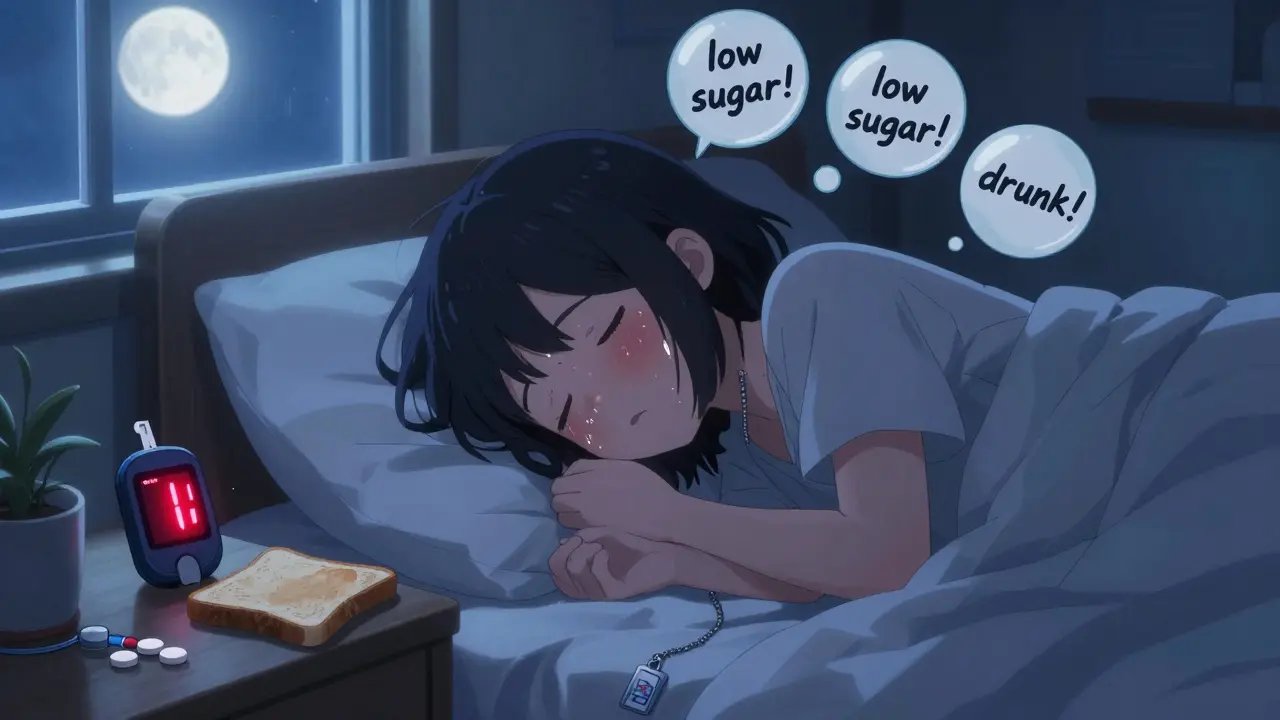
Most alcohol-related lows happen at night. Why? Because you’re asleep. You can’t feel the shaking. You can’t grab glucose tablets. And if you’re alone, no one’s there to notice you’re pale, sweaty, and confused. A 2023 analysis of online diabetes forums found that 61% of emergency cases happened overnight. People woke up with nightmares, heart palpitations, or severe headaches-classic signs of a low blood sugar episode they never saw coming.
That’s why checking your blood sugar before bed is non-negotiable. If you’re using a continuous glucose monitor (CGM), like the Dexcom G7, it now has an alcohol-detection algorithm that warns you of rising hypoglycemia risk. In clinical trials, it cut severe lows by 37%. But even without tech, the rule stays the same: if your sugar is under 100 mg/dL before bed, eat something. Don’t gamble with sleep.
What the Data Says About Risk
Let’s cut through the noise. About 30% of people with type 1 diabetes experience at least one alcohol-induced hypoglycemic episode per year. For type 2, it’s around 15%. That’s not rare. That’s common. And it’s preventable.
People who stick to the rules-eat before, check often, choose low-carb drinks-report 82% fewer lows. On Reddit’s r/diabetes community, hard seltzers have a 4.5/5 rating. Margaritas? 1.8/5. Why? Because seltzers are predictable. Margaritas are a rollercoaster.
And here’s the truth no one talks about: alcohol doesn’t improve insulin sensitivity enough to justify drinking if you don’t already drink. Some studies say one glass of red wine a day helps-but the American Diabetes Association says no one should start drinking just for health. The risks outweigh the benefits.
What to Carry With You
Always have fast-acting glucose on hand. That means:
- Glucose tablets (15g of carbs)
- Glucose gel
- Regular soda (not diet)
Keep it in your wallet, purse, or car. Not in the kitchen. Not in your bag at home. Wherever you might be when you feel off. And make sure someone you’re with knows where it is. If you can’t speak clearly, they need to act.
What’s Changing in 2026?
Guidelines are evolving. The ADA is moving away from fixed numbers like "one drink per day" and toward personalized thresholds based on your CGM data. If your body drops fast after one beer, then one beer is too much for you. If you’re stable after two glasses of dry wine, maybe that’s your limit.
Researchers at Joslin Diabetes Center are testing a new rule: drink only during a two-hour window after a full meal, with no drinking outside that time. Early results show a 28% drop in lows. It’s not official yet-but it’s a sign that the future of safe drinking with diabetes is about timing, not just quantity.
One thing won’t change: alcohol and diabetes don’t mix unless you’re careful. There’s no shortcut. No exception. No "I’ll be fine." Your liver can’t multitask. Your brain can’t always tell the difference between drunk and low. And your life depends on knowing the difference.
Can I drink alcohol if I have type 1 diabetes?
Yes-but with strict rules. People with type 1 diabetes are at higher risk for alcohol-induced hypoglycemia because their bodies don’t produce insulin naturally, and alcohol blocks the liver from releasing glucose. Always check your blood sugar before, during, and after drinking. Never drink without eating. Carry glucose tablets. Tell someone you’re diabetic. And avoid drinking if your blood sugar is below 100 mg/dL.
Why does alcohol cause low blood sugar hours after drinking?
Alcohol tells your liver to stop making glucose so it can focus on breaking down the alcohol. This effect lasts 8-12 hours. Even if your blood sugar was fine when you started drinking, your liver won’t release stored glucose to keep it stable. That’s why lows often happen hours later-especially overnight.
Is red wine good for diabetes?
Some studies show moderate red wine (one glass per day) may slightly improve insulin sensitivity in people with type 2 diabetes. But the American Diabetes Association does not recommend starting to drink for health reasons. The potential benefit is small, and the risk of low blood sugar, weight gain, or liver damage is real. If you already drink, choose dry red wine. If you don’t, don’t start.
Can I drink alcohol while taking metformin?
Light to moderate drinking (1-2 drinks per day) is usually safe with metformin. But heavy drinking-more than four drinks in two hours-can increase the risk of lactic acidosis, a rare but serious condition. Always avoid binge drinking. Stick to the guidelines: eat first, drink slowly, monitor your blood sugar.
What should I do if I feel dizzy after drinking?
Assume it’s low blood sugar-even if you think you’re just drunk. Check your blood sugar immediately. If it’s below 70 mg/dL, consume 15g of fast-acting carbs (glucose tablets, juice, or regular soda). Wait 15 minutes and check again. If you can’t check it yourself, ask someone to help you. Never drive or go to sleep until your sugar is stable.
Are sugar-free mixers safe with alcohol?
Yes, sugar-free mixers like club soda, diet tonic, or sparkling water are safe and recommended. They add no carbs or sugar, so they won’t spike your blood sugar. Avoid regular soda, juice, or syrups-they can add 15-25g of carbs per serving. Always read labels: "sugar-free" doesn’t always mean carb-free.
Can I drink alcohol if I have diabetic neuropathy?
No. Alcohol worsens nerve damage, increases pain, and can lead to more severe complications. If you have diabetic neuropathy, even moderate drinking can accelerate damage to your hands, feet, and organs. The risk is not worth it. Avoid alcohol completely.
How long should I wait after eating before drinking?
Wait at least 30 minutes after finishing a meal before drinking. This gives your body time to start digesting food and stabilizing blood sugar. Drinking too soon after eating can cause a rapid spike and then a faster crash. Best practice: eat a balanced meal with protein, fat, and carbs, then wait before your first drink.
Comments (11)
Brenda K. Wolfgram Moore
February 15, 2026 AT 17:12
Alcohol and diabetes is one of those topics people treat like a game of Russian roulette, and it’s not. One drink can turn into a hospital trip if you’re not paying attention. I’ve seen it happen to a friend with type 1-passed out at a party, paramedics called, they thought he was drunk. Turned out his BG was 42. No one knew he was diabetic. Wear the damn bracelet. It’s not about being dramatic-it’s about surviving.
Linda Franchock
February 17, 2026 AT 03:49
Oh please. "Dry wine is safe"? Tell that to my pancreas. I used to drink two glasses of Pinot Noir every night-thought I was being healthy. Then I started having nighttime lows so bad I’d wake up screaming. CGM saved me. Now I stick to one glass of dry white, always with food, and I check before bed like it’s my job. No more "just one". One is too many if your liver’s already tired.
Prateek Nalwaya
February 17, 2026 AT 11:52
Here’s the thing no one admits: alcohol doesn’t discriminate between type 1 and type 2-it just exploits every weakness you’ve got. My cousin with type 2 drank light beer every weekend, swore he was fine. Then he got pancreatitis. Turns out, "light" doesn’t mean "safe" when your liver’s already doing overtime. I’ve started carrying glucose tabs in my pocket, my car, my backpack. If you’re not prepared, you’re just gambling with your brain cells. And that’s not cool.
Liam Earney
February 18, 2026 AT 08:28
I’ve been living with type 1 for 22 years, and I’ve learned one thing: alcohol doesn’t care how much you know-it only cares how much you’re willing to risk. I used to think I could "handle it"-until I woke up in the ER with a BG of 38, no memory of the night before, and my roommate screaming that I was "just drunk." I’m not drunk. I’m diabetic. And if you’re not checking your levels before bed, you’re not being responsible-you’re being reckless. I don’t drink anymore. Not because I’m afraid-but because I refuse to let my body be a casualty of someone else’s ignorance.
Agnes Miller
February 19, 2026 AT 12:51
Just wanted to say I use hard seltzers now and I’m so much better off. Used to drink margaritas all the time-thought they were "fine" because they had "natural flavors." Turns out "natural flavors" means 20g of sugar and a blood sugar rollercoaster. Now I stick to sparkling water + vodka + lime. No sugar, no crash, no panic. And I always eat a slice of whole grain toast before bed. Small thing. Big difference.
Geoff Forbes
February 21, 2026 AT 05:34
Anyone who says "red wine is good for diabetes" is selling snake oil. The ADA doesn’t recommend it. The science is weak. The risks are real. And yet people still treat it like a health supplement. It’s not. It’s a toxin. Your liver isn’t a superhero. It can’t detox alcohol AND regulate glucose at the same time. Stop romanticizing this. If you don’t drink, don’t start. If you do, you’re already on borrowed time.
Jonathan Ruth
February 22, 2026 AT 05:40
Europeans think they’re so smart drinking wine with meals. Meanwhile Americans are the only ones who actually follow the rules. You think a 5oz glass of wine in Italy is safe? Try doing that after a 12-hour shift with no carbs. You’ll be on the floor before midnight. This isn’t about culture. It’s about biology. Your liver doesn’t care if you’re French. It just stops working. Period.
Oliver Calvert
February 24, 2026 AT 02:09
Check your blood sugar before bed. Always. I don’t care if you think you’re fine. I’ve been doing this for 15 years. I’ve seen too many people wake up with seizures from overnight lows. One time I had to call 911 for a guy who was snoring loudly-turned out he was in hypoglycemic coma. They thought he was passed out drunk. He was 28. He had a CGM. He didn’t turn on the alert. Don’t be that guy.
Philip Blankenship
February 25, 2026 AT 17:35
Just want to say-this post is gold. I’ve been drinking for years with type 2 and thought I was doing okay. Then I started using a CGM and realized I was dropping below 70 every time I had even one drink. No symptoms. No warning. Just... nothing. Now I drink once a month max, always with a solid meal, and I keep glucose tabs in my wallet. It’s not about giving up. It’s about staying alive. And honestly? I feel better now. Less brain fog. Better sleep. No more 3 a.m. panic attacks.
Adam Short
February 26, 2026 AT 17:34
Anyone who says "I can handle it" hasn’t had a real low. I’ve had three hospital visits because I thought I was just drunk. One time I woke up in a police car. They thought I was intoxicated. My wife had to scream "HE’S DIABETIC!" before they gave me glucose. I’m not drinking anymore. Not because I’m weak. Because I’m smart. And if you’re still drinking without a CGM and glucose tabs-you’re playing Russian roulette with your brain.
Kancharla Pavan
February 28, 2026 AT 11:53
You people talk about "moderation" like it’s a virtue. But moderation is a myth when your liver is already broken. I have type 1. I’ve watched my friends die from alcohol-induced lows. One guy was 31. He had a CGM. He didn’t set the alarm. He thought "one drink" was fine. He never woke up. So don’t lecture me about "dry wine" or "light beer." That’s not moderation. That’s denial. If you’re diabetic, you don’t get to decide what’s safe. Your body does. And your body says no.