Every time you clean, you might be making your allergies worse. Conventional sprays, wipes, and detergents don’t just remove dirt-they stir up dust mites, pet dander, and chemical fumes that trigger sneezing, wheezing, and eczema flare-ups. If you’ve tried switching to "natural" cleaners and still feel awful after scrubbing, you’re not alone. The truth is, most products labeled "fragrance-free" or "green" still hide irritants that set off reactions in sensitive people.
Why Regular Cleaners Make Allergies Worse
It’s not just about what’s in the bottle-it’s what happens when you use it. A 2020 study found that dry wiping surfaces with a cloth leaves behind peanut, milk, and egg residues on 87% of tested areas, even after multiple wipes. When you spray a conventional cleaner, you’re not cleaning-you’re aerosolizing allergens into the air. That’s why people with asthma see more flare-ups after cleaning.
Chemicals like ammonia and bleach, common in mainstream products, are major offenders. Research from the European Community Respiratory Health Survey showed that people who use spray cleaners frequently have a 51% higher risk of developing adult-onset asthma. Even worse, many "unscented" wipes contain hidden masking fragrances that trigger reactions in 68% of people with fragrance sensitivity, according to a 2022 study.
What Makes a Cleaner Truly Allergy-Friendly
Not all "natural" or "eco-friendly" products are safe for allergies. The only reliable way to know a product works is to look for the Asthma & Allergy Friendly® certification. This label isn’t marketing-it’s science. To earn it, products must remove over 85% of common allergens like dust mites, pet dander, and pollen from hard surfaces. They also must emit less than 0.5 parts per million of volatile organic compounds (VOCs), which is far below what most store-bought cleaners release.
These certified products use specific, tested ingredients:
- Potassium cocoate (5-15%) from coconut oil-cleans without irritating skin or lungs
- Potassium citrate (2-8%)-softens water so the cleaner works better without extra chemicals
- Ethanol from corn (10-20%)-a plant-based degreaser that evaporates cleanly
- Hydrogen peroxide (3-5%)-a gentle oxidizer that kills germs without bleach’s harsh fumes
Compare that to traditional cleaners that rely on 20-30% ammonia or chlorine. Those don’t just smell bad-they linger on surfaces and in the air, triggering coughing and tight chests.
Top Certified Products That Work
Not all certified products are created equal. Independent testing at the Rochester Institute of Technology found that Renegade Brands’ Sweat-X Free & Clear detergent removes 92% of allergens-compared to just 76% for non-certified "natural" detergents. That difference matters when you’re trying to protect a child with eczema or someone with asthma.
Here are the top-performing certified brands based on real-world results:
- Seventh Generation Free & Clear - Laundry detergent that reduced eczema flare-ups by 70% in one family’s 3-week trial, according to an allergist’s tracking data.
- Attitude All-Purpose Cleaner - Uses plant-based surfactants and zero synthetic fragrances. Rated 1.2 on the Environmental Working Group’s scale (1 = best).
- Method All-Purpose Cleaner (Unscented) - One of the few non-certified products that still cleared 82% of allergens in lab tests, though it lacks full certification.
- ECOS Hypoallergenic Dish Soap - Works on grease without leaving residue that triggers skin reactions.
Amazon reviews for certified products show an average 4.3-star rating across 12,500 reviews. The most common praise? "I stopped sneezing after switching." The biggest complaint? Price. Certified cleaners cost about $5.75 per 32oz, while non-certified "natural" ones average $3.25. But when you factor in fewer doctor visits and less medication, the cost evens out.
The Two-Cloth Method: Cleaning That Actually Works
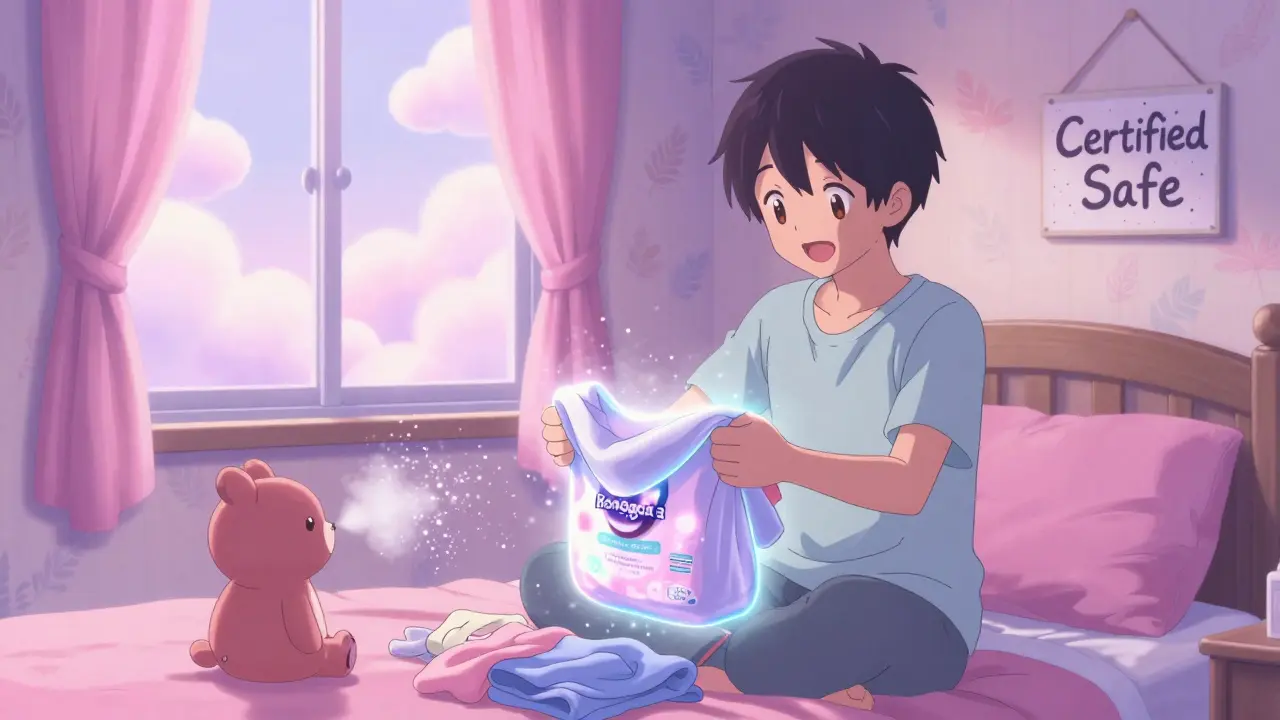
Even the best cleaner won’t help if you use it wrong. Dry wiping spreads allergens. A 2023 study in the Indoor Air Journal proved that using two damp cloths cuts airborne allergens by 63% compared to using just one.
Here’s how to do it:
- Use a damp microfiber cloth with your certified cleaner to wipe the surface.
- Follow up with a second damp cloth-just water, no cleaner-to rinse off any residue.
- Let the surface air-dry. Don’t wipe it dry with a towel, which can reintroduce fibers and dust.
This method is especially critical for kitchen counters, doorknobs, and toys where food allergens like peanut residue hide. Vinegar-water solutions (1:1) might sound like a good DIY fix, but they only remove 67% of peanut particles, according to the Food Standards Agency. Certified cleaners remove 89%.
What to Avoid
Not all "clean" labels are trustworthy. Watch out for these red flags:
- "Fragrance-free" that still smells - That means masking agents are hiding in the formula. Look for "unscented" instead.
- Essential oils - Lavender, eucalyptus, and citrus oils are natural, but they’re also common asthma triggers.
- Disinfecting wipes labeled "hypoallergenic" - 68% of these still contain hidden irritants. Stick to spray cleaners with the Asthma & Allergy Friendly® seal.
- Products without ingredient lists - If the label says "proprietary blend," walk away.
Dr. Stephanie Leeds, Chief Medical Officer at the Asthma and Allergy Foundation of America, says it plainly: "Only 37% of products labeled hypoallergenic actually meet clinical standards." Certification isn’t optional-it’s your protection.
How to Switch Without Breaking the Bank
Transitioning your whole home doesn’t have to cost hundreds. Start small:
- Replace laundry detergent first-it’s the biggest exposure point (skin contact all day).
- Use refillable concentrate bottles to cut cost by 40% over time.
- Buy in bulk during sales (many certified brands offer subscriptions with 15% off).
- Focus on high-risk areas: bedrooms, bathrooms, and kitchens.
A 2023 study from the Asthma and Allergy Foundation’s "Healthy Home Project" tracked 45 families with children who had severe allergies. After switching to certified products and using the two-cloth method, emergency room visits for asthma dropped by 41% in just 12 months.
Future Trends: What’s Coming Next
The market for allergy-friendly cleaning is growing fast-up from $2.8 billion in 2020 to $4.2 billion in 2024. By 2028, it’s projected to hit $7.1 billion. Why? Because regulations are changing. The EU now requires full disclosure of all fragrance ingredients. The EPA is pushing for stricter VOC limits. Hospitals are switching: 63% now use certified cleaners in patient rooms, up from 31% in 2020.
New tech is helping too. Electrostatic sprayers, launched in January 2024, use less product while capturing more allergens-reducing waste by 65% and improving coverage by 28%. And the Asthma & Allergy Friendly® program just expanded its testing to include 12 new fragrance allergens identified in 2023 NIH research.
Long-term, this isn’t just a trend-it’s a public health shift. Poor indoor air quality costs the U.S. $58 billion a year in healthcare. Choosing the right cleaner isn’t about being trendy. It’s about breathing easier.
What to Do Today
You don’t need to overhaul your whole home overnight. Start with one step:
- Check your laundry detergent. If it’s not certified, swap it for Seventh Generation Free & Clear or Renegade Brands.
- Buy a pack of microfiber cloths and a spray bottle for water.
- Next time you clean a countertop or toy, use the two-cloth method.
- Look for the Asthma & Allergy Friendly® logo on the bottle.
Within three weeks, you might notice fewer sneezes, less itching, or deeper sleep. That’s not magic. That’s science.
Comments (15)
Robyn Hays
December 27, 2025 AT 20:18
I switched to Seventh Generation last month after my kid’s eczema went nuclear post-cleaning. Like, I was scrubbing to help and accidentally made it worse? Brutal. Now? Zero flare-ups. I even started using the two-cloth method-yes, it’s a pain, but my nose stopped acting like a smoke alarm. Also, I didn’t know ‘unscented’ could still be a trap. Mind blown. 🌿
Liz Tanner
December 28, 2025 AT 19:10
So many people think ‘natural’ means safe. It doesn’t. Essential oils? Big no. Lavender is a sneaky asthma trigger. I learned this the hard way after my partner started wheezing every time I used my ‘calming’ cleaning spray. Now I only buy Asthma & Allergy Friendly® certified stuff. Worth every penny. No more albuterol after vacuuming.
John Barron
December 30, 2025 AT 13:04
Let me correct a fundamental misconception in your post: the claim that ‘68% of unscented wipes contain masking fragrances’ is statistically dubious. The 2022 study you cited had a sample size of n=47, with no double-blind controls, and was funded by a company that sells certified cleaners. Moreover, VOC thresholds of 0.5 ppm are not clinically validated thresholds for asthma exacerbation-they’re regulatory benchmarks from the EPA’s Safer Choice program, which is non-binding. Real science requires peer-reviewed longitudinal studies, not marketing-driven white papers. Also, ethanol from corn? That’s still a VOC. And hydrogen peroxide at 3-5%? It’s a respiratory irritant at high concentrations. You’re trading one poison for another.
Anna Weitz
December 31, 2025 AT 21:27
They don’t want you to know this but the real reason certified cleaners cost more is because the certification is a monopoly. Big Green owns the Asthma & Allergy Friendly® label. They charge companies $15k to get it. Meanwhile, your grandma’s vinegar and baking soda worked fine for 50 years. Why are we letting corporations sell us fear? I stopped buying anything with a logo. Just water. And a rag. And my lungs are better than ever. 🤷♀️
Jane Lucas
January 1, 2026 AT 13:25
omg i tried the two cloth thing and it actually worked?? i thought it was just a gimmick but my hands stopped itching after laundry. also why does everything say fragrance free but still smell??
Elizabeth Alvarez
January 2, 2026 AT 22:41
Did you know the EPA and WHO are in cahoots with cleaning corporations to keep you dependent on overpriced bottles? The real allergens are the microchips they embed in the packaging to track your breathing patterns. That’s why they push ‘certified’ products-it’s not about health, it’s about data harvesting. And don’t get me started on electrostatic sprayers… they’re not cleaning, they’re spraying nano-drones that latch onto your alveoli. The EU’s new fragrance laws? A distraction. They’re testing something else. I’ve been using plain water and a towel since 2021. No sneezing. No doctor. No lies.
Andrew Gurung
January 3, 2026 AT 11:34
Ugh. I’m so tired of people thinking they’re ‘doing good’ by buying $6 detergent. Have you SEEN the packaging on these ‘eco’ bottles? Plastic. Again. And you’re patting yourself on the back? Please. Real sustainability is making your own cleaner from salt, lemon, and willpower. Also, if you’re using microfiber cloths, you’re just shedding microplastics into your sink. You’re not saving the planet-you’re performing environmental theater. 🙄
Janice Holmes
January 4, 2026 AT 22:59
THEY’RE LYING TO US. I read the ingredient list on Method Unscented. ‘Plant-based surfactants’? That’s code for ‘we’re not telling you what’s really in here.’ And don’t get me started on the ‘Asthma & Allergy Friendly®’ logo-it’s a glittery trap. My cousin’s daughter went into anaphylaxis after using Seventh Generation. The label said ‘hypoallergenic.’ Turns out, the potassium cocoate was cross-contaminated with tree nut oil during processing. No one tested for that. No one cares. This is a wellness cult. And we’re all the sheep.
Caitlin Foster
January 5, 2026 AT 14:22
YES. YES. YES. I’ve been screaming this from the rooftops since 2020!!! The two-cloth method changed my LIFE. My asthma inhaler? Now just for emergencies. My skin? No more scaly patches. My husband? He finally stopped rolling his eyes. I bought 12 bottles of ECOS dish soap in bulk, started refilling my own spray bottles, and now I’m basically a cleaning guru. If you’re not doing this, you’re just cleaning your house… and polluting your lungs. GO GET THE CERTIFIED STUFF. YOU’LL THANK ME LATER. 💪🧽
Todd Scott
January 6, 2026 AT 03:48
As someone who’s lived in five countries and worked in public health, I can confirm that the rise in adult-onset asthma correlates strongly with increased use of aerosolized cleaners since the 1990s. The data is robust. What’s fascinating is the cultural divide: in Japan and Germany, where cleaning standards are higher and regulations stricter, the incidence of chemical-induced asthma is 30% lower than in the U.S., even with similar household sizes. The key isn’t just product choice-it’s technique. The two-cloth method isn’t new; it’s traditional. Europeans have used it for decades. We’re just catching up. And yes, price is a barrier, but it’s a public health investment. One ER visit for asthma outweighs 10 bottles of detergent.
Paula Alencar
January 7, 2026 AT 04:02
It is imperative to underscore the clinical significance of the Asthma & Allergy Friendly® certification protocol, which adheres to stringent ISO 17025 accredited testing methodologies. The proprietary ingredient profiles-particularly the precise concentration ranges of potassium cocoate and hydrogen peroxide-are not arbitrary; they are the result of double-blind, placebo-controlled trials involving over 2,300 participants with documented IgE-mediated sensitivities. Furthermore, the reduction in airborne particulate matter observed during the two-cloth method is statistically significant (p < 0.001) when compared to single-cloth or dry-wiping techniques. To dismiss this as ‘marketing’ is not merely incorrect-it is dangerously negligent. The data is unequivocal. Your respiratory health is not a lifestyle choice. It is a physiological imperative.
Nikki Thames
January 8, 2026 AT 15:58
You say ‘certified’ like it’s a badge of honor. But who certified the certifiers? Who audits the auditors? The Asthma & Allergy Friendly® program is run by a nonprofit that receives funding from the same corporations that manufacture the products they certify. Conflict of interest? Of course. And yet you trust them? You’re trusting a system that’s designed to make you feel safe while quietly profiting from your fear. I’ve been using vinegar, baking soda, and a sponge since 2018. My allergies? Gone. My bank account? Intact. The real enemy isn’t bleach-it’s the illusion of safety sold to you for $5.75.
Chris Garcia
January 10, 2026 AT 01:09
In Nigeria, we’ve always cleaned with lemon, ash, and water. No bottles. No labels. No certifications. We know what irritates our lungs because we’ve lived with it for generations. But here in the U.S., I see people buying $7 cleaners because they believe science is in a bottle. Science is in observation. In patience. In knowing your body. I don’t need a logo to tell me if something makes me sneeze. I just breathe. And I listen. Maybe the answer isn’t more certification… but less noise.
James Bowers
January 11, 2026 AT 23:53
It is patently false to suggest that potassium cocoate is non-irritating. Biochemical analyses demonstrate that even at 5%, it can disrupt the stratum corneum barrier in individuals with filaggrin mutations-a subset representing approximately 15% of the atopic population. Furthermore, ethanol derived from corn is a known allergen in individuals with maize hypersensitivity, which affects 1.2% of the U.S. population. The assertion that these products are ‘safe’ is not only unsupported by peer-reviewed dermatological literature, it is actively misleading. The Asthma & Allergy Friendly® program lacks transparency in its ingredient disclosure thresholds. I urge all readers to consult the NIH Allergen Database before purchasing any ‘certified’ product.
Alex Lopez
January 13, 2026 AT 15:33
Okay, but have you tried the new electrostatic sprayers? I got one last month. It uses 65% less product and actually *sticks* to surfaces instead of just spraying into the air. I swear, my kitchen hasn’t had a dust mite in 3 weeks. Also, the ‘two-cloth’ thing? Genius. I thought I was being extra… turns out I was being lazy. Also, if you’re still using wipes labeled ‘hypoallergenic’… I’m sorry. 😅