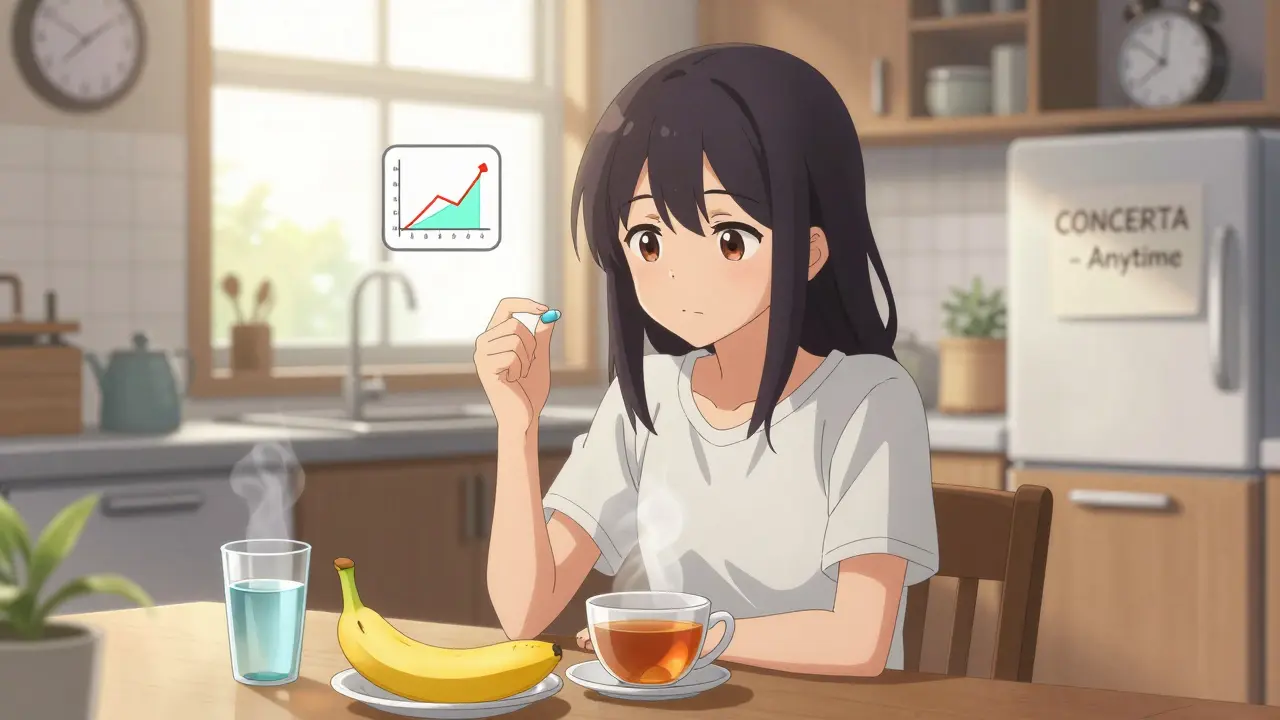
Medication Timing Guide
How your breakfast affects your medication
Select your medication to see how food timing impacts effectiveness. This guide is based on scientific studies of extended-release formulations.
Your Medication Results
Recommendation
When you take your morning medication, does it matter if you eat breakfast first? For many people on extended-release drugs, the answer is yes-and not just a little. A skipped meal, a delayed breakfast, or even switching from toast to a bagel can change how well your medicine works. This isn’t about diet trends or fasting fads. It’s about science, pharmacology, and real-life symptom control.
Take ADHD medications, for example. Millions of adults and children rely on extended-release stimulants like CONCERTA and ADDERALL XR to stay focused through school, work, and daily tasks. But here’s what most people don’t know: one of these works the same whether you eat or not. The other? It can drop in effectiveness by 40% if you take it after breakfast.
How Food Changes What Your Body Does to Medicine
Extended-release pills aren’t magic. They’re designed to release medication slowly over hours, so you don’t have to take a pill every few hours. But how they do that matters a lot when food gets involved.
CONCERTA uses something called OROS-Osmotic Release Oral System. Think of it like a tiny pump inside the pill. It pushes the medicine out steadily, no matter what’s in your stomach. Whether you eat a full pancake breakfast or take it on an empty stomach, the release stays steady. Studies show less than 5% difference in drug levels.
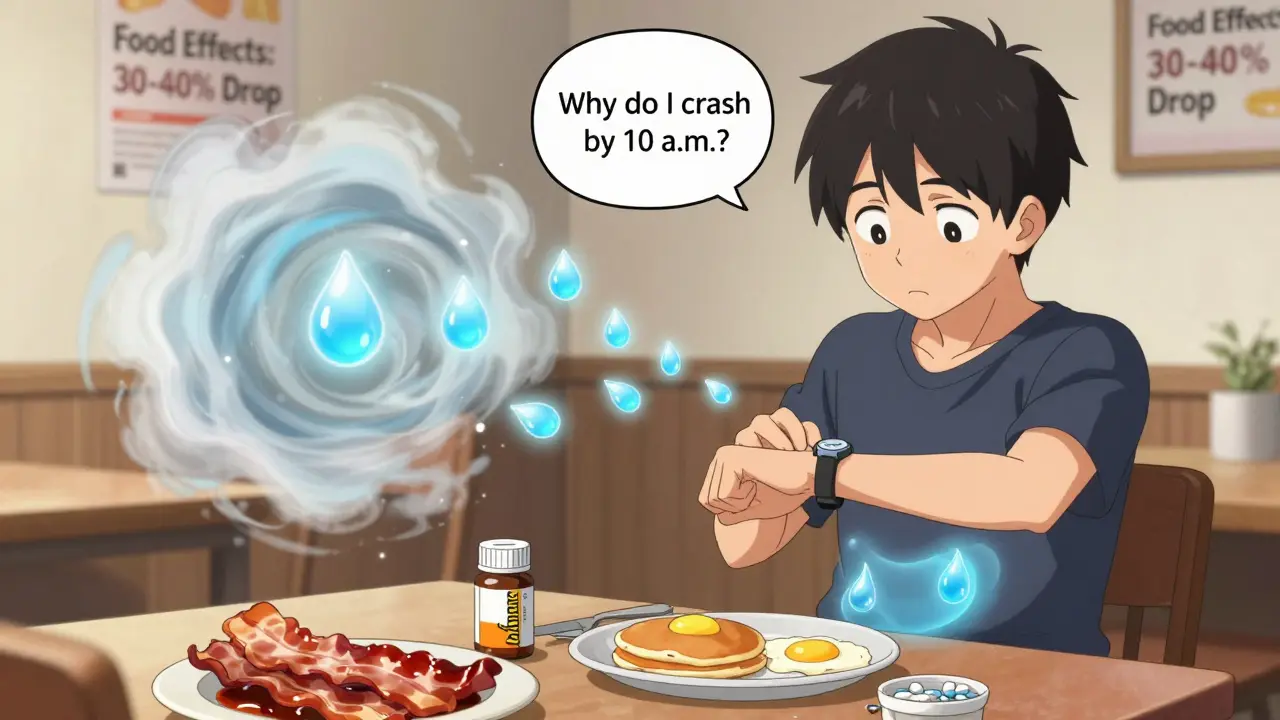
ADDERALL XR? Different story. It’s made of tiny beads that dissolve at different times. But those beads need the right environment to work right. Food-especially fatty food-slows down how fast your stomach empties. It changes the pH and how bile flows. All of this messes with how those beads release their medicine. A 2002 study found that when people took ADDERALL XR after a high-fat breakfast, the amount of drug in their blood during the first 8 hours dropped by 30-40%. That’s not a small blip. That’s the difference between feeling focused until lunch… and crashing by 10 a.m.
Why This Isn’t Just About ADHD
ADHD meds are the most talked-about example, but they’re not alone. Many extended-release drugs are sensitive to food.
- Levothyroxine (for thyroid function): Absorption drops by 25-50% if taken with food. That means your thyroid levels could stay too low, even if you’re taking the right dose.
- Semaglutide (for diabetes and weight loss): Must be taken at least 30 minutes before your first bite. Eat too soon? You lose up to 70% of the effect.
- Simvastatin (cholesterol): Works better at night because your body makes cholesterol while you sleep. Take it in the morning? You might not get the full benefit.
- Atorvastatin: Not as picky. Its longer half-life makes it more forgiving.
That’s why blanket advice like “take your pill with food” or “take it on an empty stomach” doesn’t work. You need to know which pill you’re taking-and how it behaves.
Real People, Real Consequences
On Reddit, a user named PharmaStudent2020 wrote: “I switched from ADDERALL XR to CONCERTA because my focus vanished on school days. I ate breakfast. On weekends, I skipped it. My focus was fine. I thought I was going crazy.”
Another user, TeacherWithADHD, said: “I need to function in class. With CONCERTA, I eat breakfast and still stay sharp. With ADDERALL XR? I had to choose between eating and staying awake.”
On Drugs.com, 62% of CONCERTA users report consistent effects all day. Only 48% of ADDERALL XR users say the same. That gap isn’t random. It’s built into the design.
A 2022 survey by CHADD (Children and Adults with ADHD) found that 68% of patients had better symptom control when they stuck to a consistent routine-especially around meals. And 42% said their mornings improved when they followed food timing rules.
What Should You Do?
Here’s the practical part. If you take an extended-release medication:
- Know which one you’re on. Is it CONCERTA? Then food timing matters less. Is it ADDERALL XR? Then consistency is key.
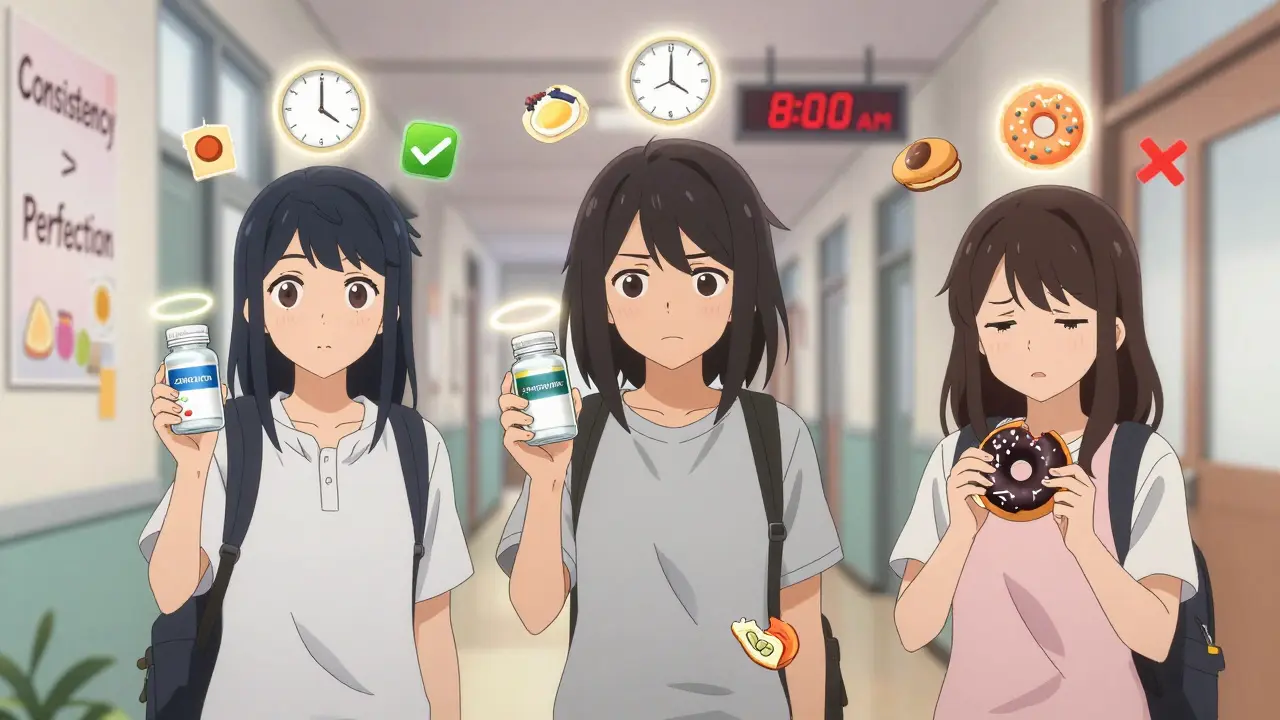
- Pick a routine and stick to it. Either always take it before breakfast, or always after. Don’t switch. One day with food, one day without? That’s how inconsistent symptom control starts.
- If you’re on ADDERALL XR or similar, time it right. Take it 30 minutes before eating-or wait 2 hours after. Don’t guess. Measure.
- Don’t assume your doctor told you. Many don’t. In one study, only 37% of patients received clear food-timing instructions during their first prescription. That’s a gap.
- Track your symptoms. For one week, rate your focus, energy, and side effects hourly. Use a simple 1-10 scale. You’ll see patterns. Maybe you’re fine with food. Maybe you’re not.
For kids who hate taking pills before school? A small, low-fat snack-like a banana or a few crackers-might be better than a full breakfast. It won’t interfere like a greasy meal, but it’ll ease stomach upset.
Why This Is Getting More Important
The market for extended-release drugs hit $148 billion in 2022. And pharmaceutical companies are paying attention. Nearly all new extended-release CNS drugs submitted to the FDA since 2018 include food-effect data. Why? Because patients and doctors demand reliability.
CONCERTA’s market share in pediatric ADHD jumped to 62% in 2022-partly because it doesn’t care if you eat. ADDERALL XR? Down to 38%. That’s not just branding. That’s science winning.
Even bigger: The FDA just released draft guidance in 2023 saying doctors should explicitly counsel patients on food timing. And apps like MedMinder now include food-timing alerts with 92% accuracy. This isn’t a niche concern anymore. It’s becoming standard care.
Looking ahead, research is moving toward personalized timing. One study at UCSF is using wearable EEGs and glucose monitors to see how your body’s natural rhythm affects drug absorption. In a few years, your pill might come with a recommendation based on your genes, your sleep, even your breakfast habits.
Bottom Line
Medication isn’t just about the dose. It’s about timing. And timing includes food.
If you’re on an extended-release drug, don’t treat your breakfast like a casual choice. Treat it like part of your treatment plan. Because for some medications, what you eat in the morning can make the difference between a productive day and a crash by lunch.
Consistency beats perfection. Pick a routine. Stick to it. And if you’re unsure? Ask your pharmacist. They’re trained to know which pills care about food-and which don’t.
Does breakfast timing affect all extended-release medications the same way?
No. Different formulations work differently. CONCERTA (osmotic system) is largely unaffected by food. ADDERALL XR (bead-based) can lose up to 40% of its early absorption if taken after a high-fat meal. Other drugs like levothyroxine and semaglutide are also highly sensitive. Always check the specific guidelines for your medication.
Can I take my medication with a light snack instead of a full breakfast?
For medications sensitive to food, like ADDERALL XR, a small, low-fat snack (100-200 calories, like a banana or toast without butter) is often better than a full meal. It reduces nausea without significantly interfering with absorption. Avoid high-fat foods like bacon, eggs, or pastries if you’re on a food-sensitive drug.
What if I forget to take my medication before breakfast?
If you’re on a food-sensitive drug like ADDERALL XR, wait at least 2 hours after eating before taking it. Don’t double the dose. If you’re on CONCERTA, it’s fine to take it after breakfast-just be consistent. The goal isn’t perfection; it’s predictability. If this happens often, talk to your doctor about switching to a food-insensitive option.
Why don’t doctors always tell patients about food effects?
Many prescribers assume patients know or overlook this detail because it’s not always included in prescribing labels. Studies show only about one-third of patients receive clear food-timing instructions. This is changing, but you should ask. Bring up food timing during your first prescription visit-it’s a critical part of your treatment.
Is there a way to test if my medication is working properly with my routine?
Yes. Track your symptoms for one week using a simple scale: rate your focus, energy, and side effects every 2 hours. Use the Adult ADHD Self-Report Scale (ASRS v1.1) or just write notes. If you notice big drops after meals, food timing is likely the issue. You can also ask your doctor about a blood test to check drug levels-though this isn’t routine, it’s an option if problems persist.
Comments (11)
Jason Pascoe
February 13, 2026 AT 00:54
I've been on CONCERTA for 5 years and never realized how much food timing mattered until I switched to ADDERALL XR. One day I ate a bacon-egg-and-cheese sandwich before my pill and crashed hard by 10 a.m. Like, 'why am I staring at my coffee like it owes me money' levels of crash. Now I take it 45 mins before breakfast with just a banana. Game changer.
Also, my pharmacist actually told me this. Who knew they knew this stuff?
Sonja Stoces
February 14, 2026 AT 09:06
LMAO this post is so basic. Like, wow, food affects absorption?? Newsflash: water is H2O.
Also, CONCERTA’s market share is up? Bro, that’s because Big Pharma pushed it harder. ADDERALL XR is cheaper and works fine if you’re not a lazy eater. Stop acting like this is some groundbreaking revelation. Also, your '40% drop' stat? That was from a 2002 study with 12 people. LOL.
Annie Joyce
February 15, 2026 AT 12:16
Okay but can we talk about how wild it is that we treat pills like fine wine?
I’m on levothyroxine and I used to take it with my coffee (because caffeine = adulting) and my TSH was all over the place. My endo looked at me like I’d just confessed to mooning the moon. Now I take it with a glass of water at 6 a.m., wait 45 mins, THEN I brew my coffee. It’s like a ritual.
And yes, I still feel like a weirdo for not eating breakfast until noon. But my thyroid? It’s chill now. 🙌
Rob Turner
February 15, 2026 AT 12:55
I love how this thread is basically a masterclass in pharmacology meets real life.
As a Brit who moved to the US and switched from sultana toast to Pop-Tarts, I can confirm: food timing isn't just science-it's survival.
Also, I once took my simvastatin after a full fry-up and woke up feeling like I’d been hit by a bus. Turned out my liver was basically throwing a protest. Now I take it at bedtime with a biscuit. No drama.
Pharmacists are the unsung heroes of modern life. We should give them medals.
Luke Trouten
February 16, 2026 AT 15:48
There's something deeply human about how we underestimate the mundane details of our own biology. We treat medication like a simple command-take this, it works-but the body is a complex, context-sensitive system.
The fact that a single meal can alter drug absorption by 40% isn't just pharmacological-it's philosophical. It reminds us that health isn't about willpower, but about alignment.
Consistency isn't discipline. It's respect.
Gabriella Adams
February 18, 2026 AT 11:47
I’m a high school teacher with ADHD and I’ve seen this play out in real time. One student took ADDERALL XR after a breakfast burrito and fell asleep during Shakespeare. Another took CONCERTA with a granola bar and aced her presentation.
It’s not about being 'good' or 'bad' with food. It’s about matching your routine to your medication’s chemistry.
My advice? Write it down. Use your phone calendar. Set two alarms: one for 'take pill' and one for 'eat'. You’ll thank yourself later.
Kristin Jarecki
February 18, 2026 AT 17:30
The FDA’s 2023 draft guidance is a critical step forward. Clinicians have long been undertrained on food-drug interactions, and patients are left to navigate this on their own.
It’s not just about ADHD. It’s about hypertension meds, antifungals, antivirals, immunosuppressants-all of which have documented food effects.
Standardizing counseling protocols isn’t optional. It’s ethical. Patients deserve to know how their medication behaves. Period.
Jonathan Noe
February 18, 2026 AT 21:37
You guys are overthinking this. I take ADDERALL XR with a bagel and coffee every day. I’ve been doing it for 8 years. I’m fine. My focus is solid. My boss says I’m the most productive person on the team.
So yeah, maybe the study says 40% drop-but maybe that’s just for people who don’t have discipline. I have discipline. I’m not one of them.
Rachidi Toupé GAGNON
February 20, 2026 AT 01:03
Bro. I took my CONCERTA after a poutine. No crash. No drama. Just chill vibes.
Maybe it’s the butter. Maybe it’s the gravy. Maybe it’s the fact that I’m Canadian and we don’t panic over food timing.
Point is: if you’re stable, don’t fix it. 🇨🇦
Jim Johnson
February 20, 2026 AT 17:53
I used to be the guy who forgot his meds until lunch. Then I started using MedMinder. Now I get a notification at 7 a.m.: 'Take your pill. Wait 30 min. Eat toast.'
My focus went from 'sporadic' to 'I’m crushing my deadlines'.
My wife says I’m not the same person. I say I’m the person I was supposed to be. All it took was a stupid little routine.
Start small. One meal. One pill. One day. You’ll be shocked how much it changes.
Vamsi Krishna
February 20, 2026 AT 20:07
This is why I hate Western medicine. You take one pill, you eat one meal, and suddenly your entire life becomes a pharmacological equation.
In India, we just take the medicine and eat when we’re hungry. We don’t need to track glucose levels or set alarms. Our bodies know.
Also, why are you all so obsessed with breakfast? Eat when you’re hungry. Stop treating your body like a lab rat.