Every year, more than 90% of vision loss from diabetes could be prevented-if people just got their eyes checked on time. Yet in the U.S. alone, nearly 40% of adults with diabetes skip their annual eye screening. Why? Some live too far from an eye specialist. Others dread the blurry vision after dilation drops. A lot just don’t realize how fast damage can happen-even when their blood sugar seems under control.
When Should You Get Screened? It Depends on Your Diabetes Type
If you have type 1 diabetes, your first eye exam should happen within five years after diagnosis. That’s not a suggestion-it’s a medical must. For type 2 diabetes, the clock starts the day you’re diagnosed. Many people don’t know they have diabetes until they’re already showing signs of eye damage. That’s why the American Diabetes Association (ADA) says: get checked right away. After that first exam, the rules get more detailed. If your eyes are clear and your HbA1c is below 7%, you might only need a screening every two years. But if you’ve had even mild retinopathy, you’re back to annual exams. And if your condition is worsening-say, you’ve got diabetic macular edema or proliferative retinopathy-you’ll need to be seen every few months. Skipping these appointments isn’t just risky; it’s dangerous. The Wisconsin Epidemiologic Study found that people who miss screenings have a 23 times higher chance of losing vision.Why Annual Screenings Are Non-Negotiable
Diabetic retinopathy doesn’t hurt. Not at first. No pain. No warning signs. Just slowly leaking blood vessels, swelling in the retina, and tiny blind spots you won’t notice until it’s too late. By the time you see blurriness or floaters, the damage is often advanced. That’s why screening isn’t about checking for symptoms-it’s about catching problems before you feel them. And here’s something most people don’t know: even if your blood sugar is perfect, you’re not off the hook. A 2023 study showed African American patients develop severe retinopathy 2.3 years earlier than white patients with the same HbA1c levels. That means race, genetics, and other hidden factors play a role. One-size-fits-all advice doesn’t work. That’s why guidelines stress individualized care-even if your numbers look good, your eyes still need checking.What Happens During a Diabetic Eye Screening?
Traditional screening means drops in your eyes to widen the pupils. Then, a specialist takes high-res photos of your retina or looks directly through a magnifying lens. It’s quick, but the side effects? Blurry vision for hours. Driving afterward? Not possible. Some people miss work. Others skip the whole thing because they can’t afford the time-or the inconvenience. But here’s the real question: Do you need dilation every time? Not always. Newer digital imaging tools can capture detailed retinal photos without dilation. These images get sent to an eye doctor remotely. That’s teleophthalmology. And it’s not science fiction-it’s now part of the ADA’s 2025 guidelines as a valid alternative to in-person exams.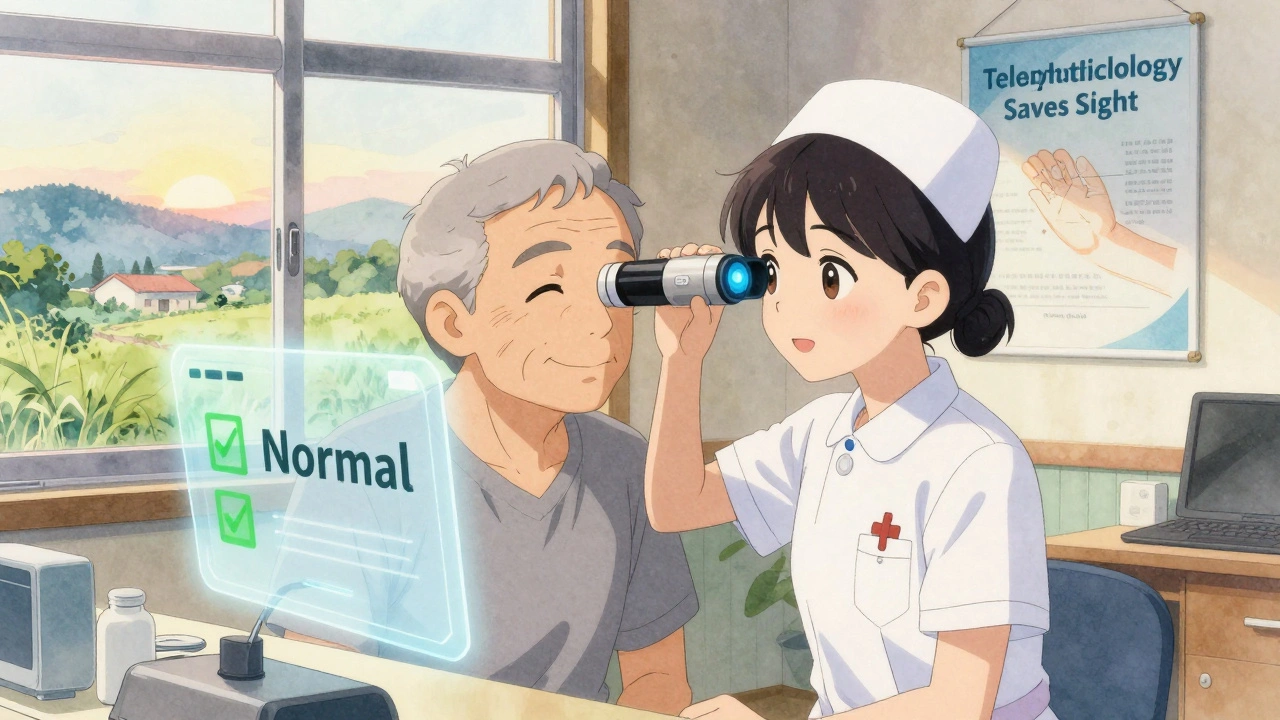
Teleophthalmology: The Game-Changer for Rural and Underserved Areas
In rural South Africa, India, or remote parts of the U.S., getting to an eye specialist might mean a three-hour drive. That’s why teleophthalmology is making a huge difference. A program in Tamil Nadu, India, screened 15,000 people using just a camera and a smartphone. The results matched in-person specialists 98.5% of the time. In the U.S., the Veterans Health Administration saw a 32% jump in screening rates after rolling out teleophthalmology across 136 clinics. People got screened during their regular diabetes checkups-no extra trip, no dilation drops. One patient told the ADA community: “I missed my eye exam for three years because the nearest specialist was 75 miles away. Now I get it done during my insulin appointment.” But it’s not perfect. These systems cost about $28,500 to set up per site. And not all insurance plans cover them-only 63% of private insurers did in 2024. Worse, clinics serving Medicaid patients are 47% less likely to offer teleophthalmology than those with mostly private insurance. That’s not progress-that’s a gap widening.AI Is Now Part of the Screening Process
You don’t need a human eye doctor to read the first round of images anymore. FDA-approved AI tools like LumineticsCore (formerly IDx-DR) can analyze retinal photos and flag signs of moderate or worse retinopathy with 87% accuracy. These systems are already used in 22% of Medicare diabetes screenings-up from just 8% in 2022. The AI doesn’t replace the doctor. It filters. If the AI says “normal,” you might not need to see a specialist right away. If it flags something, you’re referred for a full exam. This cuts down wait times and helps clinics handle more patients without hiring more specialists. But here’s the catch: AI only sees the retina. It can’t detect glaucoma, cataracts, or other eye issues that might also affect people with diabetes. That’s why AI screening is an add-on-not a full replacement-for comprehensive eye exams.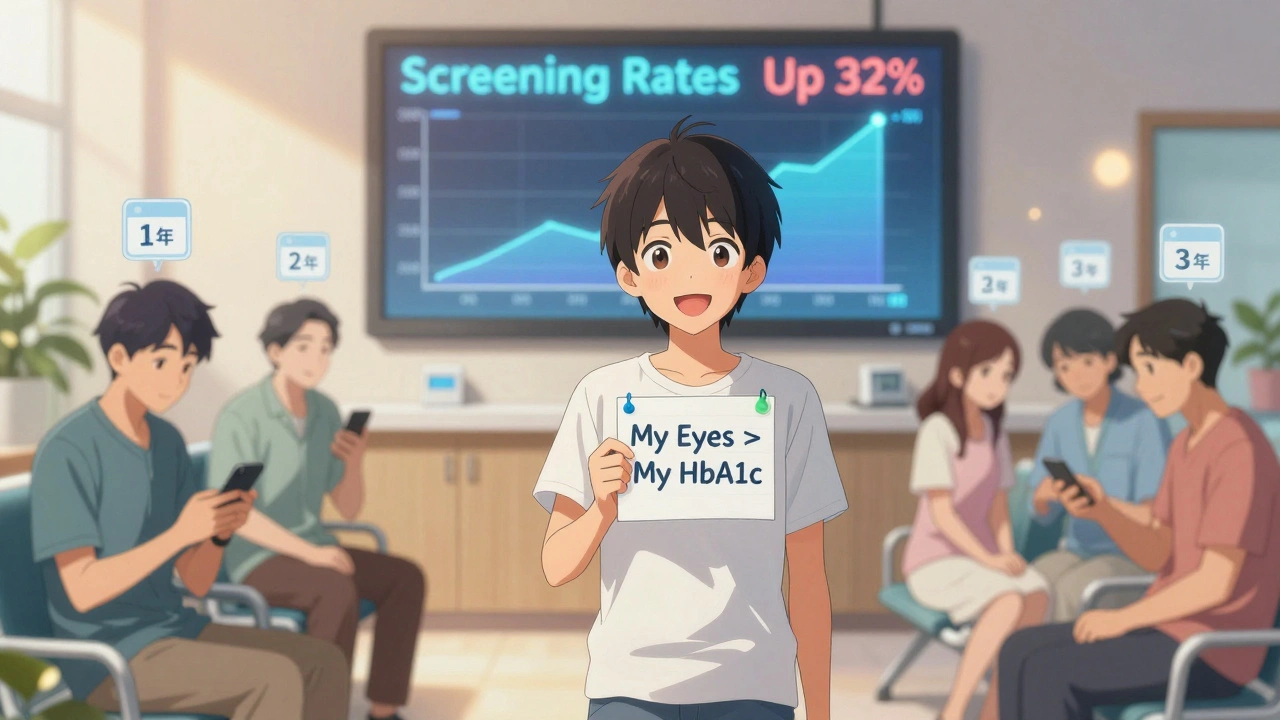
Barriers to Getting Screened-And How to Beat Them
The biggest reason people skip screenings? Transportation. A 2023 survey by the National Federation of the Blind found 68% of patients said getting to the appointment was the main problem. Another 42% said the dilation drops ruined their day. Solutions are already working. Kaiser Permanente cut missed appointments by 27% using automated SMS reminders sent 21, 14, and 7 days before the exam. Some clinics now offer same-day screenings during diabetes visits. Others partner with pharmacies to do basic retinal scans. If you’re struggling to get screened, ask your primary care doctor: “Can we do a retinal photo here today?” Many clinics now have the equipment. If they say no, ask why-and push back. You’re not being difficult. You’re protecting your vision.What’s Next? Personalized Screening Intervals
The future isn’t “once a year.” It’s “when you need it.” Researchers at T1D Exchange are building a risk calculator that looks at 17 factors-HbA1c, blood pressure, duration of diabetes, kidney function, and more-to predict who’s at low risk. For those patients, screenings could stretch to every three years. That’s huge. Less stress. Less cost. Less disruption. But this only works if the system is fair. If low-income patients are left out because their clinics can’t afford the tech, then we’re not solving the problem-we’re just making it worse.Bottom Line: Don’t Wait for Symptoms
Your eyes don’t scream when they’re in trouble. They whisper. And if you ignore the whisper, you’ll wake up one day with no vision left. Annual screening saves sight. Teleophthalmology makes it easier. AI makes it faster. But none of it matters if you don’t show up. If you have diabetes, your eye screening isn’t optional. It’s as important as your HbA1c test. Schedule it. Push for it. Demand it. Your future self will thank you.How often should I get a diabetic eye screening?
If you have type 1 diabetes, get your first exam within 5 years after diagnosis, then annually. If you have type 2 diabetes, get screened at diagnosis, then annually-unless your eyes are completely healthy and your HbA1c is under 7%. In that case, your doctor may extend it to every two years. If you have any signs of retinopathy, you’ll need more frequent exams-every 3 to 6 months or even more often if it’s worsening.
Can I skip my eye exam if my blood sugar is under control?
No. Even with perfect blood sugar levels, you can still develop diabetic retinopathy. Genetics, race, blood pressure, and how long you’ve had diabetes all play a role. A 2023 study showed African American patients develop severe eye damage 2.3 years earlier than white patients with the same HbA1c. Your eyes need checking regardless of your numbers.
Is teleophthalmology as good as seeing an eye doctor in person?
For detecting diabetic retinopathy and macular edema, yes-teleophthalmology is just as accurate. Studies show over 98% agreement between remote readings and in-person specialists. But it doesn’t replace a full eye exam. It won’t catch glaucoma, cataracts, or other eye diseases. If the remote scan finds a problem, you’ll still need to see an eye doctor for a complete evaluation.
Does insurance cover teleophthalmology?
Medicare and Medicaid cover it, but private insurers are slower. Only 63% of private plans covered teleophthalmology in 2024. Check with your insurer before scheduling. If they say no, ask your doctor to appeal-it’s becoming standard care. Many clinics now bill it under the same code as in-person screenings.
Can AI replace an eye doctor for diabetic screening?
AI can analyze retinal images and flag signs of moderate or worse diabetic retinopathy with about 87% accuracy. It’s FDA-approved and used in clinics across the U.S. But it doesn’t replace your eye doctor. It helps prioritize who needs to be seen. If the AI says “normal,” you may not need a specialist right away. If it flags a problem, you’ll still need a full exam. AI sees the retina only-it can’t check for other eye conditions.
Why do I need dilation drops? Can’t I skip them?
Dilation gives the doctor a full view of your retina. Without it, they might miss early signs of damage. But you don’t always need them. New digital cameras can capture high-quality images without dilation, especially in teleophthalmology setups. Ask your provider: “Can we do a non-dilated retinal photo today?” Many clinics now offer this option. If they say no, push for it-it’s less disruptive and just as effective for diabetes screening.
What if I live in a rural area and can’t get to an eye specialist?
You’re not alone. Nearly half of rural patients miss screenings because of distance. But teleophthalmology is changing that. Ask your primary care clinic if they offer retinal imaging. Many now have cameras you can use during your regular diabetes visit. The images are sent to a specialist remotely. You get screened without leaving town. If they don’t offer it, ask them to start. It’s cost-effective and saves lives.
Comments (13)
Haley P Law
December 9, 2025 AT 07:02
I missed my screening for 3 years because the nearest specialist was 75 miles away 😭 Now I get it done during my insulin appointment and I swear I cried when the AI said 'no signs of retinopathy'. This tech saved my sight. 🙏
Nikhil Pattni
December 9, 2025 AT 09:06
You know what's funny? People act like teleophthalmology is some new miracle but in Tamil Nadu we've been doing this since 2018 with smartphones and basic cameras. 15,000 people screened. 98.5% accuracy. And yet in the U.S. they're still arguing about insurance coverage. It's not the tech that's broken, it's the system. We need to stop pretending this is a medical issue and admit it's a class issue. The poor get ignored until they go blind. Again.
Arun Kumar Raut
December 10, 2025 AT 12:37
I work in a rural clinic in India. We use a simple camera, no dilation, no doctor needed right there. We send the pics, get results in 48 hours. People come for their sugar check and get their eyes checked too. No extra trip. No blurry vision. No excuses. If your clinic doesn't offer this, ask them why. It's not hard. It's not expensive. It's just not prioritized. Your eyes matter. Don't wait.
precious amzy
December 11, 2025 AT 18:15
One must question the epistemological foundations of AI-driven diagnostics. If an algorithm trained on predominantly white, urban datasets flags retinopathy with 87% accuracy, what does that say about the ontological erasure of non-Western ocular pathologies? The commodification of vision under neoliberal healthcare infrastructure is not innovation-it is algorithmic colonialism dressed in FDA approval.
Carina M
December 12, 2025 AT 05:14
It’s appalling that anyone would consider replacing a trained ophthalmologist with a machine. The retina is not a JPEG. It’s a living tissue, shaped by decades of biological complexity. To reduce it to binary flags and machine learning outputs is not just irresponsible-it’s a moral failure of the medical-industrial complex.
William Umstattd
December 14, 2025 AT 04:08
Let me be perfectly clear: if you skip your diabetic eye screening because you 'don't have time' or 'it's inconvenient,' you are not just being lazy-you are choosing blindness. Every year, 90% of vision loss is preventable. That’s not a statistic. That’s a choice. And you? You’re choosing to lose your sight. Wake up.
Angela R. Cartes
December 15, 2025 AT 20:36
I mean… AI? Really? 😒 I got my retina scanned last year and the tech said 'normal' but my vision still got weird. Turns out I had early cataracts. AI didn't catch that. So now I'm just… waiting for the next thing to go wrong. 🙄
Andrea Beilstein
December 17, 2025 AT 12:46
I think we've forgotten that the eye is not just a window to the soul but a mirror to systemic neglect. When we say 'teleophthalmology is the future' we're really saying we're too busy to look people in the eye. Literally. We outsource care to machines because we've outsourced compassion to efficiency. And now we wonder why people don't trust the system
Shubham Mathur
December 18, 2025 AT 08:21
In my village, we have a camera, a phone, and a clinic worker who knows how to use them. No dilation. No 3-hour drive. No waiting months. We screen 20 people a week. The AI flags 3. The specialist sees them. Everyone else gets a text: 'Your eyes are fine.' Simple. Effective. Human. Why is this so hard in America? You have the money. You have the tech. You just don't care enough.
Iris Carmen
December 19, 2025 AT 00:26
i just got my eyes checked last week and they didnt even dilate me?? i was like wait wut?? but they took pics and sent em off and i got a text in 2 days saying all good. like… why do we still do dilation if we dont have to??
Gilbert Lacasandile
December 19, 2025 AT 22:09
I really appreciate how this post breaks down the options. I’ve been avoiding screenings because of the dilation, but now I’m going to ask my doctor if we can do the non-dilated photo. I think a lot of people don’t even know that’s an option. Thanks for making it clear.
Darcie Streeter-Oxland
December 20, 2025 AT 13:06
The notion that teleophthalmology can replace in-person examinations is, frankly, preposterous. The subtleties of retinal morphology require the nuanced observation of a trained clinician, not an algorithm trained on a dataset that likely excludes the very populations most at risk. This is not progress-it is institutionalized negligence under the guise of innovation.
Sarah Gray
December 21, 2025 AT 04:44
If your HbA1c is under 7%, you're not 'low risk'-you're just statistically lucky. Genetics, epigenetics, socioeconomic stress, and systemic inflammation don't care about your lab values. Anyone who thinks they're 'off the hook' because their glucose is 'perfect' is dangerously misinformed. This isn't a checklist. It's a lifelong vigilance.