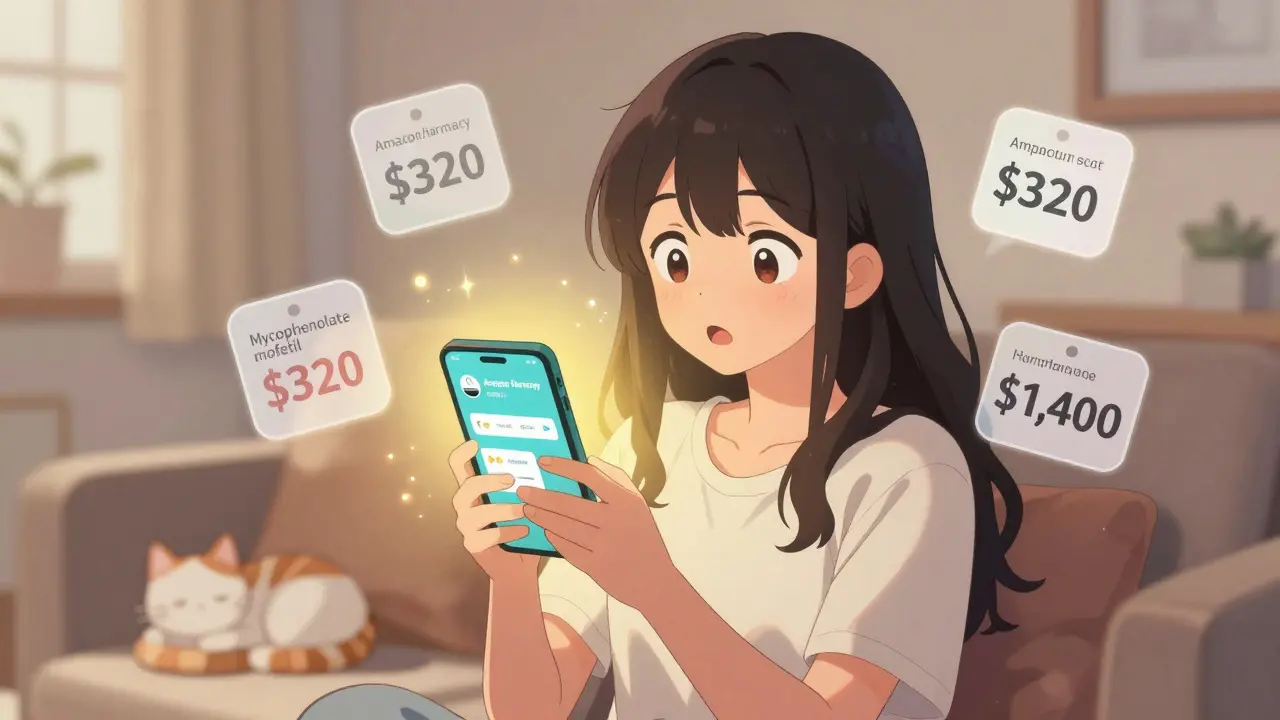
When you need a prescription filled, do you automatically go to your local pharmacy and let your insurance handle it? Or do you stop and ask: Could I save more by paying cash online? For millions of people, especially those without insurance or with high deductibles, the answer is yes. But it’s not as simple as flipping a switch. Direct-to-consumer (DTC) pharmacies like Amazon Pharmacy, Mark Cuban Cost Plus Drug Company, and Costco’s online service are changing how people buy generic drugs - but they’re not always cheaper than insurance. Here’s what actually happens when you compare the two.
What Are Direct-to-Consumer Pharmacies?
DTC pharmacies sell medications directly to you, no insurance required. They cut out the middlemen - pharmacy benefit managers (PBMs) - who often hide the real cost of drugs behind complex rebates and negotiated rates. Instead, these companies use transparent pricing: cost + a fixed fee. Mark Cuban Cost Plus Drug Company, for example, adds just 15% to the actual manufacturing cost. Amazon Pharmacy and Costco do something similar. You pay upfront, and you know exactly what you’re paying. No co-pays. No surprise bills. Just a price tag.
This model exploded after 2020. Before that, most people had no idea how much their generic drugs actually cost. Now, with tools like GoodRx and these online pharmacies, you can compare prices in seconds. But here’s the catch: not every drug is available everywhere. And not every price is better than your insurance.
How Much Can You Save on Expensive Generics?
Let’s talk about the drugs that break the bank: the expensive generics. These are medications like mycophenolate mofetil (used after organ transplants) or lenalidomide (for certain cancers). These drugs can cost over $1,000 a month at a regular pharmacy - even with insurance.
A 2024 study in the Journal of General Internal Medicine looked at 88 of the most expensive generic drugs. The results? For these high-cost meds, DTC pharmacies saved patients an average of $231 per prescription. That’s a 76% drop in price compared to what you’d pay at a retail pharmacy using GoodRx. In some cases, the same drug dropped from $1,400 to $320.
Amazon Pharmacy had the lowest price on 47% of these expensive generics. Mark Cuban Cost Plus Drug Company came in second at 26%. Costco? Only 13%. But here’s the real kicker: one in five of these expensive drugs weren’t available at any DTC pharmacy at all. If you’re on one of those, you’re stuck with your insurance - or paying full retail.
What About Common Generics? The Real Story
Now, let’s flip the script. What about the everyday pills? The ones most people take: lisinopril for blood pressure, metformin for diabetes, atorvastatin for cholesterol? These are cheap already - sometimes under $10 at your local pharmacy.
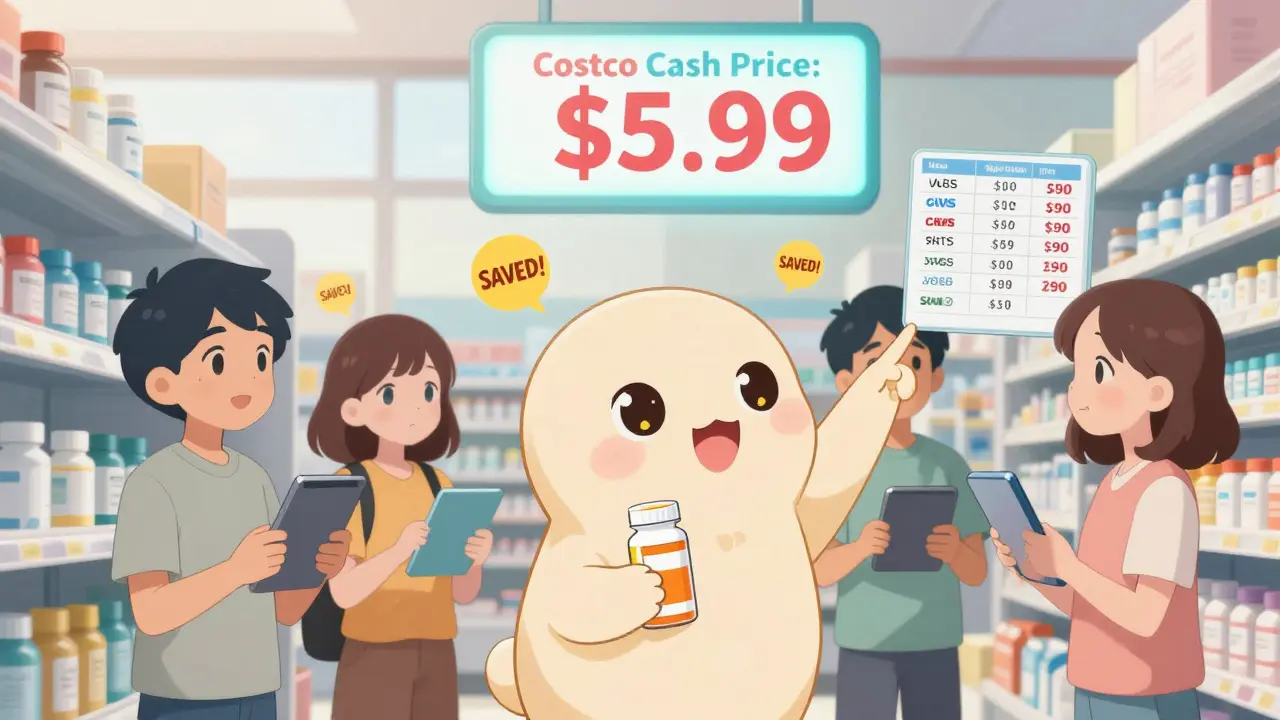
The same study found that for these common generics, the average savings with DTC pharmacies was just $19 per prescription. That’s still a 75% drop - but does it matter? Maybe not. Because here’s what’s happening: Costco’s cash price for a 30-day supply of most common generics is under $20. And Walmart, Target, and even your local CVS often match that.
When researchers compared prices across five major DTC platforms for common generics, Costco led with 31% of the lowest prices. Amazon was close behind at 27%. Walmart had 20%. Mark Cuban Cost Plus Drug Company? Only 10%. That means if you’re buying common drugs, you’re better off checking your local pharmacy’s cash price before even opening an app.
Why Insurance Sometimes Wins - Even When It Feels Like It Shouldn’t
Here’s where it gets messy. A 2023 study from CVS Health, published in JAMA Network, looked at 79 neurological generics - drugs like gabapentin, carbamazepine, and levetiracetam. They found something shocking: if everyone switched to DTC pharmacies, out-of-pocket spending would actually increase by $82 million.
Why? Because for many of these drugs, insurance plans - especially Medicare Part D - negotiate prices so low that your co-pay is $5 or $10. Meanwhile, Mark Cuban Cost Plus Drug Company only carried 33 of the 79 drugs studied. And of those, only two were cheaper than what insured patients paid.
That’s not a fluke. Many insurance plans have tiered formularies. If your drug is on Tier 1 (preferred generics), you pay next to nothing. But if you buy it cash online? You might pay $30. That’s not saving - that’s overpaying.
And here’s the reality: if you’re on a plan with a $5 co-pay for a generic, you’re already getting one of the best deals in healthcare. DTC pharmacies can’t compete with that. Not unless they have the exact drug, at the exact dose, at a lower price - which they often don’t.
Which DTC Pharmacy Should You Use?
There’s no single winner. It depends on what you need.
- For expensive generics: Start with Amazon Pharmacy. It has the widest selection and lowest prices for the most costly drugs. Then check Mark Cuban Cost Plus Drug Company. If you can’t find it there, try Health Warehouse.
- For common generics: Skip the apps. Go to Costco. Their cash prices are consistently low. Walmart and CVS often match them. If you’re a Sam’s Club or Costco member, you’re already ahead.
- For specialty or rare drugs: Don’t bother. One in five of the most expensive drugs aren’t available anywhere online. You’ll need to work with your insurance or ask your doctor for alternatives.
And remember: none of these pharmacies have the same drug list. A drug that’s $15 at Amazon might be $45 at Costco. Or vice versa. You have to check each one - every time you refill.
The Hidden Cost: Time and Effort
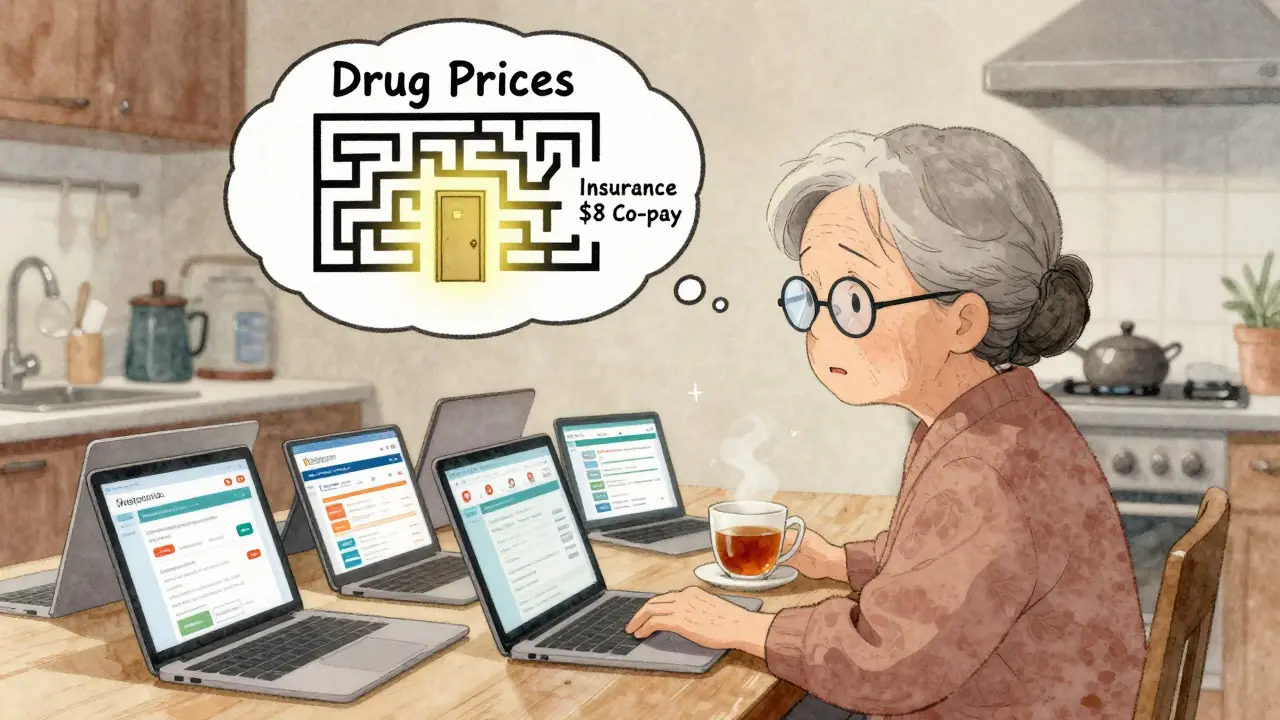
Here’s what nobody talks about: shopping for drugs online takes time. You need to:
- Know the exact name and dose of your medication
- Check prices across 3-5 different websites
- Verify shipping times
- Confirm the pharmacy is licensed
- Make sure your insurance won’t cover it later (some plans don’t reimburse cash purchases)
For someone managing five chronic conditions, that’s five separate price checks every month. That’s hours of your life. And if you’re elderly, disabled, or working two jobs? You don’t have that time.
Dr. Hatim Lalani, lead author of the 2024 study, put it bluntly: “There are no simple, accurate tools to help patients find the lowest cost across all pharmacies.” That’s the real problem. The system is broken - not because DTC pharmacies are bad, but because there’s no central way to compare them all.
Should You Drop Insurance and Go Cash-Only?
No. Not unless you’re fully uninsured.
If you have insurance - even a high-deductible plan - your plan likely already pays for most generics at a rate lower than DTC pharmacies. You’re not saving money by bypassing it. You’re just paying more out-of-pocket.
But if you’re uninsured, underinsured, or your insurance doesn’t cover a drug? Then DTC pharmacies are a lifeline. For expensive drugs, they can cut your bill by 70-90%. For common ones, they’re worth checking - but don’t assume they’re cheaper than your local pharmacy’s cash price.
The best strategy? Use both. Let your insurance cover what it can. Then, for drugs it doesn’t cover - or where the co-pay is too high - go online. Compare. Buy. Save.
The Future: Will This Get Easier?
Right now, the system is a mess. But change is coming. Researchers are pushing for tools that show you the lowest price across all pharmacies - insurance and cash - in real time. Imagine a single app that tells you: “Your insurance covers this for $8. But Amazon has it for $6. And Costco for $5.” That’s the future.
Until then, you’re on your own. But you’re not powerless. You have more control over your drug costs than ever before. The key is to stop assuming. Start checking. Every time.
Are DTC pharmacies safe to use?
Yes - if you stick to well-known platforms like Amazon Pharmacy, Costco, Walmart, and Mark Cuban Cost Plus Drug Company. These are licensed, regulated pharmacies. Avoid random websites that don’t require a prescription or look suspicious. Always check for a .pharmacy domain or a Verified Internet Pharmacy Practice Sites (VIPPS) seal.
Can I use DTC pharmacies if I have Medicare?
Yes, but with caution. Medicare Part D doesn’t reimburse purchases made outside your plan’s network. So if you buy a drug online and pay cash, it won’t count toward your deductible or out-of-pocket maximum. But if the cash price is lower than your co-pay, you might still save money. Just don’t expect your plan to cover it later.
Why don’t DTC pharmacies carry all medications?
Because they’re not designed to be full-service pharmacies. They focus on high-demand, high-savings generics. Expensive or niche drugs - especially those with low sales volume - aren’t worth the inventory cost. That’s why one in five of the most costly generics aren’t available anywhere online. If your drug isn’t listed, your insurance is likely your only option.
Is Mark Cuban Cost Plus Drug Company always the cheapest?
No. It’s only the cheapest on about 26% of expensive generics and 10% of common ones. Amazon Pharmacy consistently undercuts it on expensive drugs. Costco wins on common ones. Mark Cuban’s strength is transparency, not always the lowest price.
Do I need a prescription to buy from DTC pharmacies?
Yes. All legitimate DTC pharmacies require a valid prescription from a licensed provider. Never buy from a site that sells prescription drugs without one. That’s illegal and dangerous.
If you’re paying cash for prescriptions, you’re already taking control. The next step? Make it smart. Don’t guess. Compare. Check. Save.
Comments (15)
Tom Forwood
February 11, 2026 AT 01:30
just bought my metformin from amazon pharmacy last month for $7.50. my insurance wanted $42. i didn’t even bother checking goodrx. just typed it in, clicked buy, and it showed up in 2 days. no drama. no forms. just money saved. why are we still overpaying??
John McDonald
February 12, 2026 AT 12:44
you guys are missing the point. if you’re on medicare, your $5 copay isn’t a gift-it’s a negotiated rate. going cash means you’re not counting toward your out-of-pocket max. i used to buy everything online until i realized i was stuck at $1,200 deductible every year. now i use insurance for everything. even if it’s $12, it counts. and that’s worth more than $5 saved.
Chelsea Cook
February 12, 2026 AT 13:00
oh wow, so the solution to america’s healthcare crisis is… checking three websites before you buy a pill? genius. i’m sure grandma on her fixed income has time to compare amazon, costco, and mark cuban like she’s shopping for a new couch. 🤡
Andy Cortez
February 14, 2026 AT 06:11
am i the only one who thinks this whole dtc thing is a scam? amazon? really? they’re gonna give a damn about your blood pressure meds? they just want you hooked on their ecosystem so you buy more junk. and mark cuban? he’s just trying to look like a hero before he sells it to big pharma. trust me. it’s all a trap.
Jacob den Hollander
February 16, 2026 AT 03:39
i just want to say thank you for writing this. i’m a single dad with two kids and three chronic conditions. i used to spend 3 hours every month just calling pharmacies, checking prices, and hoping i didn’t get charged extra. now i have a spreadsheet. it’s not pretty, but it works. i found that for my gabapentin, costco is $12, amazon is $14, but my insurance copay is $8. so i use insurance. for my insulin? amazon is $55 vs $320 at the pharmacy. i use amazon. it’s not perfect, but it’s something. you’re not alone.
Andrew Jackson
February 17, 2026 AT 03:10
It is a disgrace that the American public has been reduced to haggling over pharmaceuticals like market vendors in a third-world bazaar. The very notion that one must compare prices across five private corporations to obtain life-sustaining medication is an indictment of our entire socio-economic structure. The Founding Fathers did not envision a republic where health is a commodity bartered by algorithm. This is not freedom. This is feudalism with Wi-Fi.
Angie Datuin
February 18, 2026 AT 07:36
i’ve been using costco for years. their cash prices are always the same as my insurance copay, so i just use costco. no hassle. no tracking. no apps. i’m a member anyway. why overcomplicate it?
Random Guy
February 19, 2026 AT 07:31
so let me get this straight… you’re telling me i need to become a part-time pharmacist just to afford my antidepressants? i’m 24, work two jobs, and still can’t afford to sleep. this isn’t innovation. this is exploitation wrapped in a ‘you’re empowered!’ bow.
Tasha Lake
February 19, 2026 AT 11:25
the real issue is formulary tiering and PBM opacity. even if you’re on insurance, if your drug is non-preferred tier 2, your copay is inflated by the PBM’s rebate structure. dtc bypasses that, but only if the drug is stocked. the systemic flaw is the lack of universal price transparency, not the dtc model. we need a public price registry-like the VA’s formulary-accessible via api. then everyone wins.
Karianne Jackson
February 19, 2026 AT 12:36
i just take my pills. i don’t care about all this. if it costs less, i use it. if it’s the same, i don’t care. why do we make everything so hard??
Patrick Jarillon
February 21, 2026 AT 09:54
you think this is about savings? nah. this is a covert operation. big pharma and amazon are working together. they let you buy cheap drugs online so you stop complaining about insurance prices. meanwhile, they’re raising prices on everything else. it’s psychological manipulation. they want you to feel like you’re winning… while they own the whole damn game.
Randy Harkins
February 23, 2026 AT 06:02
you’re all doing amazing! 🙌 seriously, the fact that you’re researching this and taking control? that’s huge. healthcare is confusing, but you’re figuring it out. keep going. you’re not alone. i’m rooting for you 💪❤️
Tori Thenazi
February 23, 2026 AT 18:02
...and what about the people who don’t have internet? or can’t read? or don’t have a smartphone? or live in rural america where the nearest costco is 80 miles away? this isn’t empowerment-it’s a luxury for the tech-savvy. the rest of us? we’re just stuck paying $150 for a pill that should cost $5. someone’s making money off our suffering. and it’s not mark cuban.
Elan Ricarte
February 25, 2026 AT 01:32
holy fuck this is wild. i thought i was saving money with amazon until i checked my insurance’s pharmacy network and realized they had my drug for $3.75. i was about to pay $14. i almost got scammed by convenience. now i triple-check everything. and i hate that i have to. this system is designed to make you feel stupid for trying to survive.
Camille Hall
February 25, 2026 AT 23:46
i’m a nurse. i’ve seen patients cry because they’re choosing between insulin and rent. i’ve handed out samples, called pharmacies myself, even drove people to costco. this article? it’s not just helpful-it’s necessary. thank you for making this clear. no one should have to be a detective just to breathe.