
Every year, millions of people around the world take medicines that don’t work-or worse, make them sick. Fake drugs aren’t just a problem in faraway countries. They’re in pharmacies, online stores, and even hospitals. In low- and middle-income countries, 1 in 10 medical products is counterfeit or substandard, according to the World Health Organization. The stakes? Lives. And the tools to stop this are changing fast.
What’s Really in Your Pill Bottle?
Counterfeit drugs look real. They have the right color, shape, and logo. But inside? They might have no active ingredient. Or too much. Or toxic chemicals like floor cleaner or rat poison. In 2025, a U.S. pharmaceutical company lost $147 million after a QR code authentication system was copied. Fraudsters printed fake labels, and the system couldn’t tell the difference. That’s the problem with simple codes: they’re easy to replicate.Serialization: The New Standard
The biggest shift in the fight against fake drugs? Serialization. That means every single pill bottle, box, or vial gets its own unique digital ID-like a fingerprint. By November 2025, the U.S. Drug Supply Chain Security Act (DSCSA) will require every prescription drug to have this traceable code. The EU’s Falsified Medicines Directive already does the same. This isn’t optional. It’s law. These codes aren’t just barcodes. They’re linked to secure databases that track the product from the factory to the pharmacy. If a box shows up out of sequence, the system flags it. This cuts recall times by nearly 60%. A warehouse manager in Germany told Reddit users it took 14 months and €2.3 million to get their system running. But now, they catch 99% of fake batches before they reach shelves.NFC: The Smartphone That Checks Your Medicine
Imagine tapping your phone on a medicine box-and instantly knowing if it’s real. That’s NFC technology. Unlike QR codes, NFC uses encrypted chips embedded in the packaging. These chips can’t be copied. They talk directly to your phone’s built-in NFC reader. No app needed. Just tap. And it takes less than two seconds. In Latin America, a pharmacy chain rolled out NFC authentication in early 2025. Within six months, fake drug incidents dropped by 98%. Pharmacists now verify over 1,200 boxes a day. Each check adds just 3-5 seconds to the process. And the accuracy? 99.98%. That’s better than most airport scanners. NFC is growing fast. Forty-three percent of the top 50 pharmaceutical companies adopted it last year. It works on Android 8.0+ and iOS 11+, which cover 89% of smartphones in use today. And it’s secure. Cryptographic keys change every time a product is verified. No two checks are the same.Blockchain: The Unbreakable Ledger
Blockchain isn’t just for crypto. In pharma, it’s becoming the backbone of supply chain trust. Every time a drug moves-from manufacturer to distributor to pharmacy-it’s recorded on a shared, tamper-proof digital ledger. Temperature changes? Recorded. Time stamps? Recorded. Who handled it? Recorded. Think of it like a digital trail. If a shipment of insulin was exposed to heat during transport, the blockchain logs it. The pharmacy knows before they dispense it. Companies like De Beers used this for diamonds. Now, pharma is doing the same. But it’s not simple. Setting up a blockchain system takes 18 to 24 months. It needs integration with ERP and warehouse systems. SAP users report compatibility issues. TraceLink works well but has a steep learning curve. Still, for global supply chains, it’s becoming non-negotiable. Regulators demand it. Patients deserve it.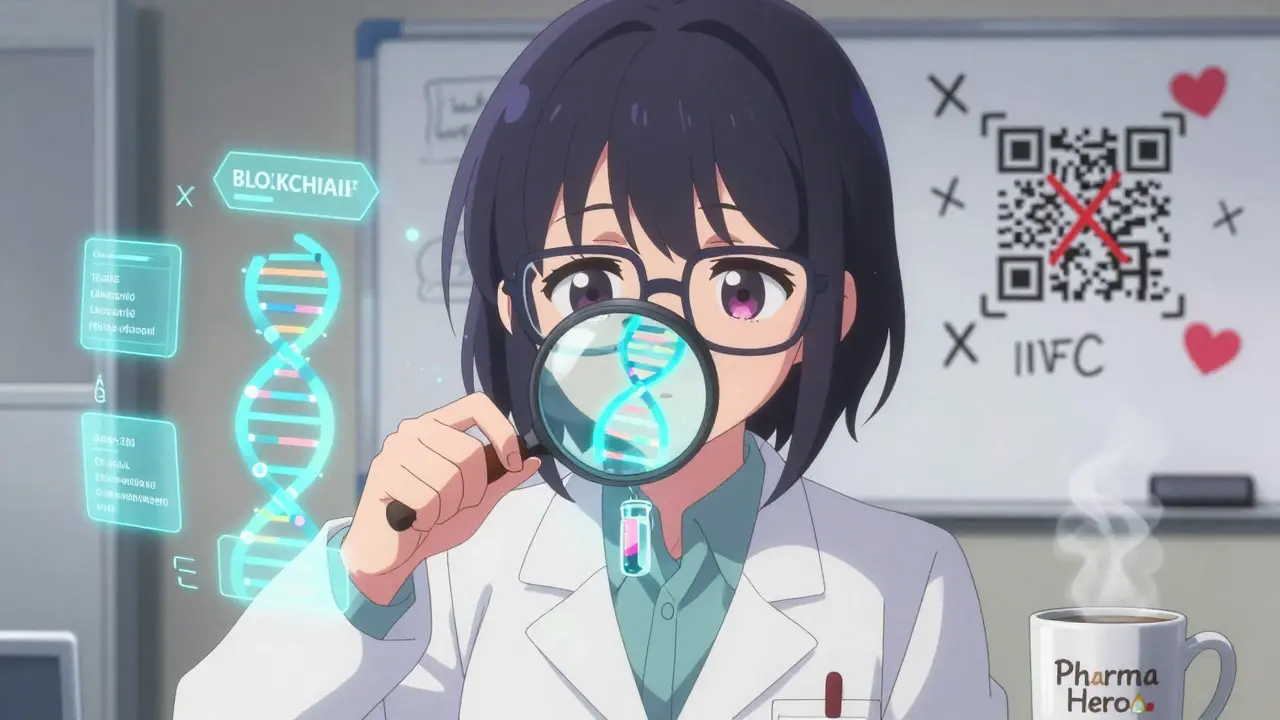
DNA and Forensic Markers: The Ultimate Secret
Some companies are going beyond digital. They’re putting biology into packaging. DNA-based authentication uses synthetic DNA strands-unique to each batch-mixed into the ink or label. These strands are invisible to the eye. To verify, you need a lab scanner. It reads the DNA like a genetic barcode. It’s the most secure method available. No one can copy it without the original DNA sequence. But it’s expensive. Each unit costs $0.15 to $0.25 to mark. Compare that to $0.02-$0.05 for standard serialization. That’s why it’s mostly used for high-value drugs like cancer treatments or rare disease therapies. There’s also thermochromic ink that changes color with heat. UV inks that glow under special light. Holograms that shift when you tilt the box. These are overt and covert features-meant to be seen by pharmacists, patients, or customs agents. Together, they create layers of defense.AI Vision: The Robot That Sees Fakes
Factories are now using AI-powered cameras to spot fakes before they leave the building. These systems analyze packaging texture, font spacing, color gradients, and even tiny imperfections in printing. In controlled tests, they catch 99.2% of fakes. In real-world conditions? That drops to 94.3%-still better than human eyes. The challenge? Lighting. Packaging materials. Reflections. A fake bottle under a fluorescent lamp might look real to the camera. But AI keeps learning. In 2025, deployments jumped 68%. The goal? Real-time inspection on production lines, catching counterfeits before they’re packed.Why QR Codes Are Failing
QR codes were the first big digital solution. Cheap. Easy. Widely adopted. But here’s the truth: 78% of pharmaceutical QR codes fail security audits. Why? Because they’re just images. Anyone can scan one, take a screenshot, print it, and stick it on a fake box. No encryption. No authentication. Just a picture. The $147 million recall in Q3 2025? That happened because the company used a basic QR code without cryptographic protection. Fraudsters didn’t even need to hack the system. They just printed a label. If you’re using QR codes today, ask: Is it encrypted? Is it linked to a live database? Can it be verified offline? If not, it’s not protection-it’s a warning sign.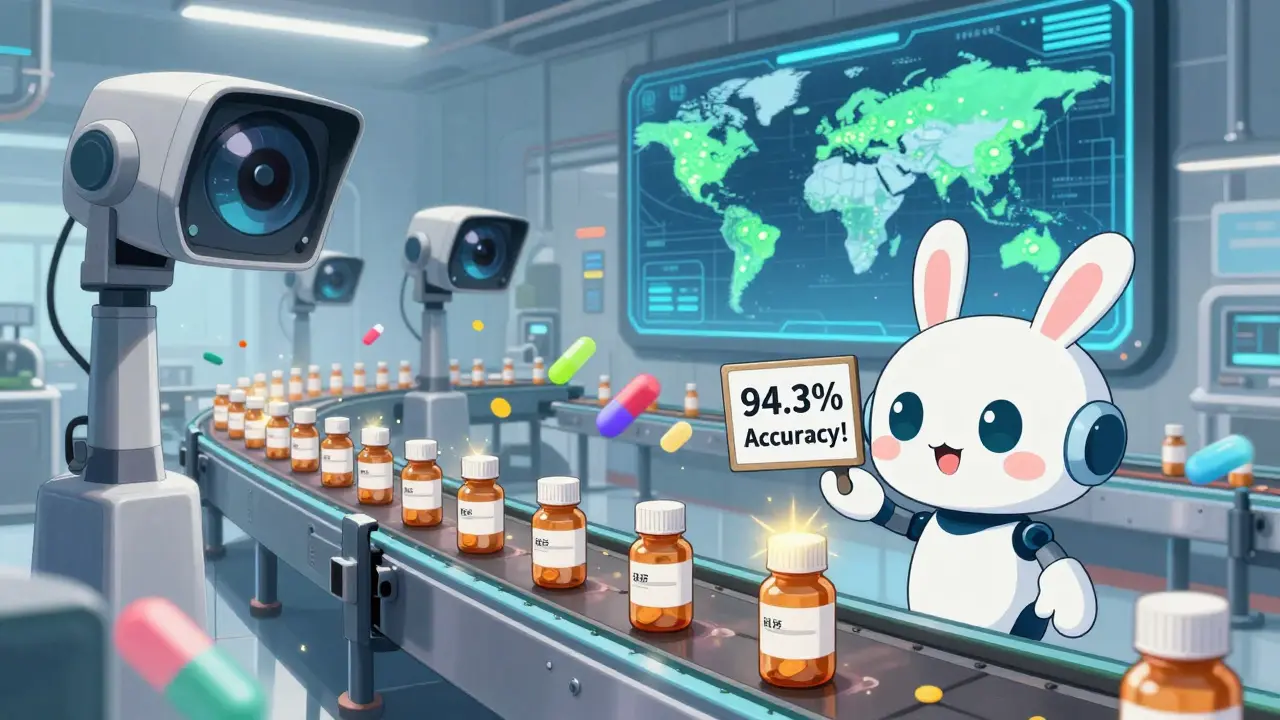
Comments (10)
Kiranjit Kaur
December 22, 2025 AT 05:47
Wow, this is actually giving me hope 😊 I live in India and we see fake meds all the time-some even have the wrong language on the label! NFC sounds like a game-changer. My aunt took a fake blood pressure pill last year and ended up in the ER. If this tech can stop that, we need it everywhere. 🙏
Kathryn Weymouth
December 22, 2025 AT 10:57
The DNA-based markers are fascinating. I work in a forensic lab, and the idea of embedding synthetic DNA into packaging is brilliant-it’s essentially biometric authentication for pharmaceuticals. The cost barrier is real, but for oncology drugs or insulin, it’s worth every penny. We’re already using similar tech for high-value forensic evidence. This is just an extension of that principle.
Jamison Kissh
December 22, 2025 AT 18:24
It’s ironic. We’ve built entire digital infrastructures to verify pills, but we still let people buy medicine from random websites without a prescription. The real problem isn’t just counterfeit drugs-it’s the erosion of trust in medical systems. If people didn’t feel forced to buy online because pharmacies are too expensive or inaccessible, maybe we wouldn’t need all this tech in the first place. The solution isn’t just better labels-it’s better healthcare access.
Sam Black
December 24, 2025 AT 09:38
As someone who’s worked in pharma logistics for 18 years, I’ve seen the shift from paper logs to blockchain. The real win isn’t the tech-it’s the cultural change. Before, everyone assumed someone else was checking. Now? Everyone’s accountable. That’s the invisible upgrade. And yes, SAP integration sucks. But once you get past that, the audit trails are beautiful. Like watching a river of trust flow through a broken system.
Art Van Gelder
December 25, 2025 AT 23:15
Let’s be real-this whole anti-counterfeit crusade is basically pharma’s way of saying, ‘We’re not just selling medicine, we’re selling peace of mind.’ And honestly? That’s smart. People don’t care about serialization or NFC. They care that their grandma’s heart pill won’t kill her. The holograms, the DNA, the AI cameras? They’re not just security. They’re theater. And theater that saves lives? Sign me up. I just hope the cost doesn’t get passed on to patients in the Global South. We can’t build a fortress of safety that only the rich can afford.
Cara Hritz
December 26, 2025 AT 08:22
QR codes are so last decade like why are we even still talking about them?? I saw a fake one on Amazon last week and it looked 100% legit until I tapped it and it went to a site selling weight loss gummies. Like… come on. Why do companies still use these??
Julie Chavassieux
December 26, 2025 AT 23:32
AI vision systems catch 94.3% of fakes… but what about the 5.7% that slip through? That’s not a number-that’s a child. A mother. A father. And we’re celebrating a 94% success rate like it’s a graduation ceremony? We need perfection. Not ‘good enough.’
Sai Keerthan Reddy Proddatoori
December 27, 2025 AT 14:26
Let’s be honest-this is all a distraction. The real problem is the U.S. and EU forcing developing nations to adopt expensive tech while their own drug prices are insane. China and India make 80% of the world’s meds. Why are we blaming them for counterfeits when our own greed created the black market? This isn’t about safety-it’s about control.
Candy Cotton
December 28, 2025 AT 11:48
As a former FDA compliance officer, I must emphasize: The DSCSA is not merely a recommendation-it is a legally binding mandate under Title 21 of the U.S. Code. Noncompliance constitutes a federal offense. Any entity failing to implement serialization by November 2025 is in direct violation of statutory requirements, and may be subject to civil penalties, injunctions, and criminal prosecution. This is not a suggestion. It is the law. And the law does not negotiate.
Johnnie R. Bailey
December 29, 2025 AT 15:29
One thing no one’s talking about: the environmental cost of all this. NFC chips, blockchain servers, DNA markers-they all need energy, rare minerals, plastic. The EU’s Digital Product Passport is great, but if every pill bottle now has a microchip and a QR code and a biodegradable label and a carbon footprint tracker… are we solving one crisis by creating another? Maybe the real innovation isn’t in the packaging-it’s in reducing the need for so much of it in the first place. Simpler supply chains. Local production. Less shipping. Less waste. Less tech. Maybe the best anti-counterfeit tool isn’t a scanner-it’s a community pharmacy down the street.