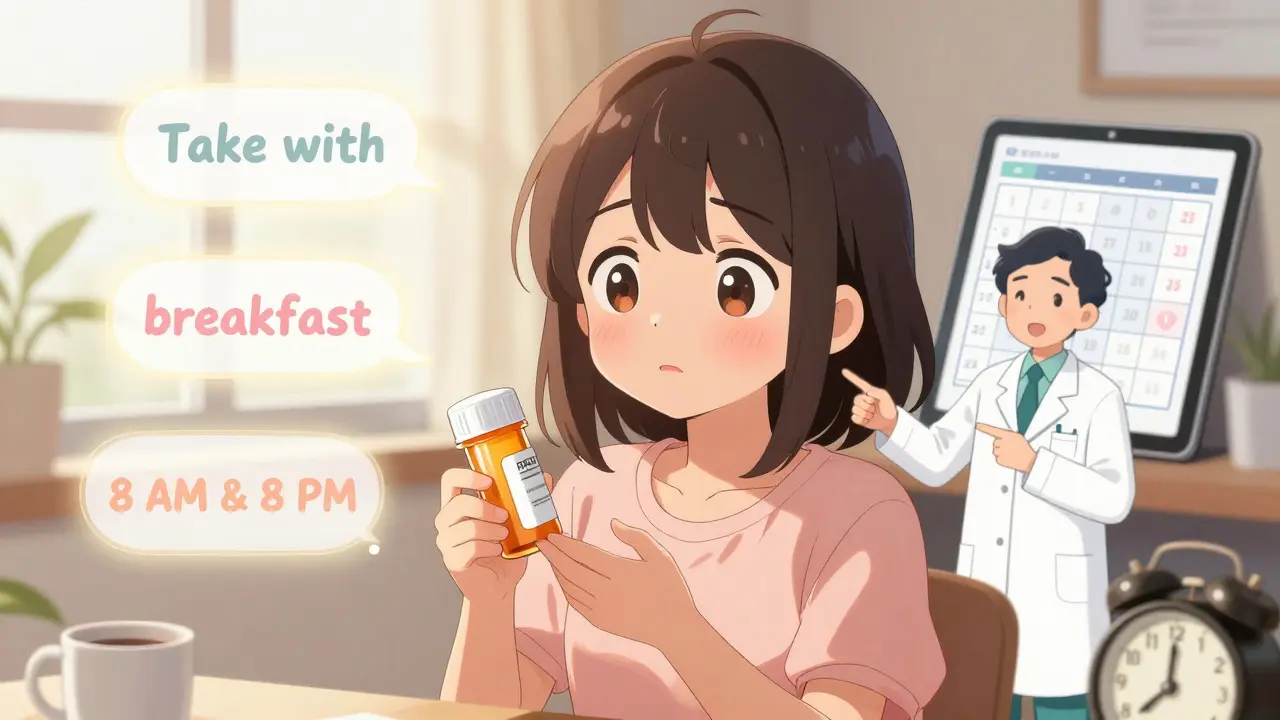
Getting a prescription filled shouldn’t feel like solving a puzzle. Yet, millions of people stare at their medication bottles every day, confused by terms like "twice daily," "as needed," or "take on an empty stomach." If you’ve ever wondered whether "twice daily" means 8 AM and 8 PM-or if "take as needed" has a hidden limit-you’re not alone. Misreading these instructions isn’t just inconvenient; it’s dangerous. In fact, nearly half of all medication errors tied to prescription labels come from confusion over timing and frequency.
What "Twice Daily" Really Means
Many prescriptions say "take twice daily" or "b.i.d." But what does that actually mean? If you’re a nurse, pharmacist, or someone who’s read the FDA guidelines, you know it should mean roughly every 12 hours. But in real life? Most people don’t do that. A 2021 study at Massachusetts General Hospital found that patients who got labels saying "Take 1 tablet with breakfast and 1 tablet with dinner" were 35% more likely to take their medicine correctly than those who just saw "Take 2 tablets daily." Why? Because "with breakfast" and "with dinner" ties the dose to a daily routine. It’s not abstract. It’s tied to something you already do. The FDA has been pushing for this change since 2014. Vague terms like "twice daily" are being phased out in favor of explicit timing. That means your label should now say:- Take 1 tablet at 8:00 AM and 1 tablet at 8:00 PM
- Take 1 tablet with morning meal and 1 tablet with evening meal
- Take 1 tablet when you wake up and 1 tablet before bed
Why "As Needed" Can Be Risky
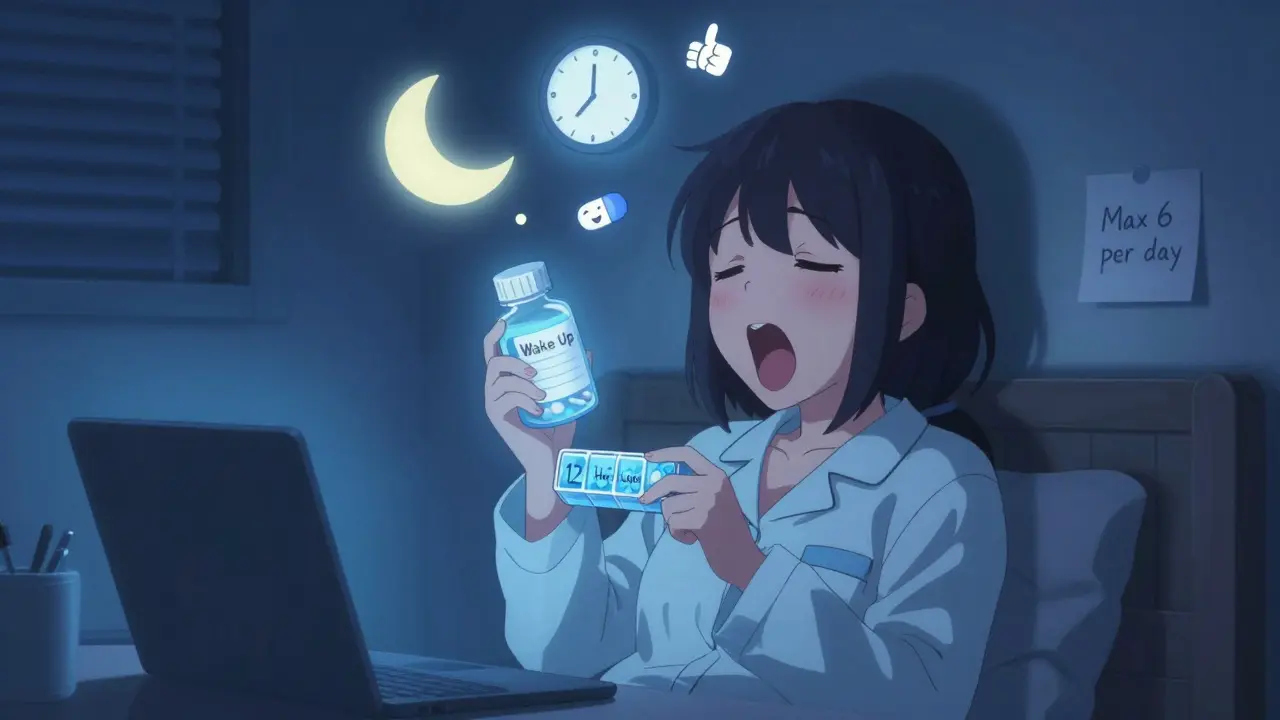
Painkillers, anti-anxiety meds, and sleep aids often come with "take as needed" instructions. Sounds simple, right? But here’s the catch: there’s almost always a maximum daily limit. A 2023 Consumer Reports survey found that 68% of people who took "as needed" pain medication didn’t know the maximum number of pills they could take in a day. That’s dangerous. Taking 4 extra acetaminophen tablets over 24 hours can cause liver failure. Taking too much ibuprofen can lead to stomach bleeding or kidney damage. Always look for the line that says: "Do not exceed ___ tablets in 24 hours." If it’s not there, ask your pharmacist. If you’re still unsure, write it down on your pill bottle with a permanent marker. For example: "Max 6 pills per day, no more than 2 every 6 hours."Units of Measure: mL vs. Teaspoons
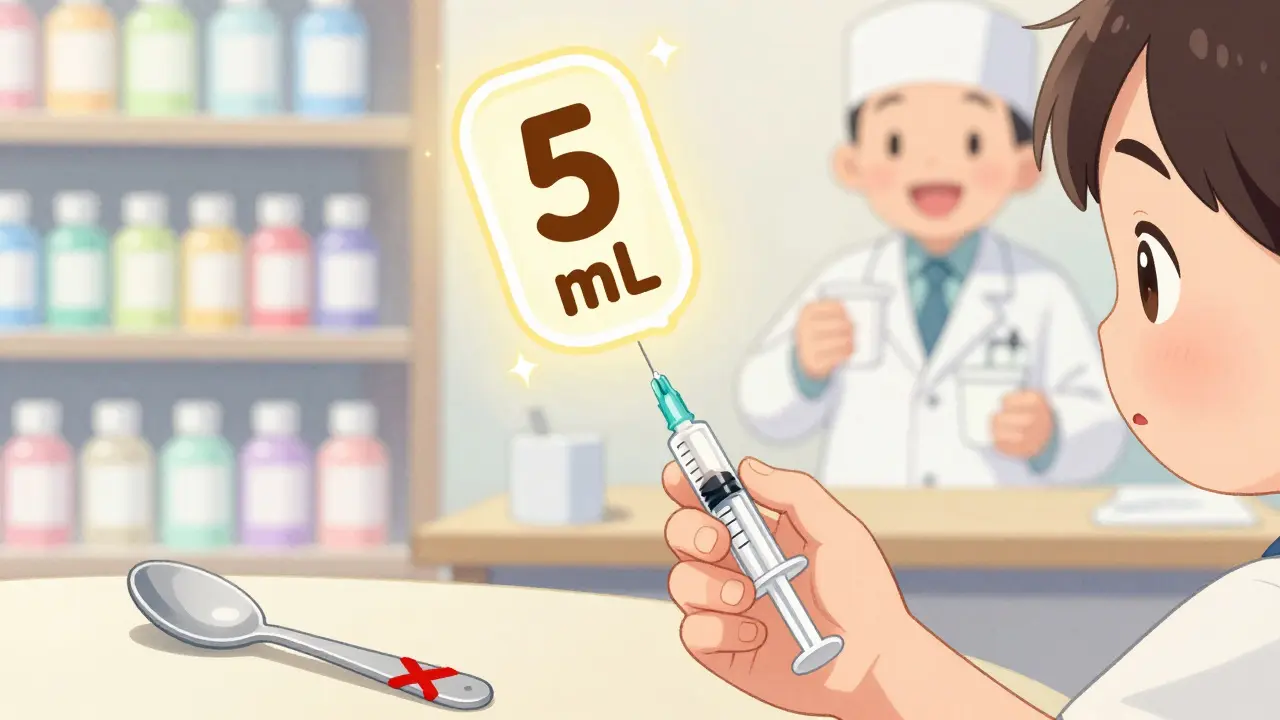
Liquid medications are one of the biggest sources of dosing errors. Why? Because people still use kitchen spoons. The FDA and U.S. Pharmacopeia have banned "teaspoon" and "tablespoon" on prescription labels since 2010. The only approved unit is milliliters (mL). But a 2021 FDA audit found that 64% of liquid medication labels still used old terms like "1 tsp." Here’s the math you need to know:- 1 teaspoon = 5 mL
- 1 tablespoon = 15 mL
- 1 measuring spoon from the pharmacy = exactly 5 mL
Timing and Food: What "Take With Food" Really Means
Some pills say "take with food." Others say "take on an empty stomach." This isn’t just a suggestion-it affects how well your body absorbs the drug. For example, levothyroxine (a thyroid hormone) must be taken on an empty stomach, at least 30-60 minutes before breakfast. If you take it with coffee, cereal, or calcium supplements, your body absorbs less than half the dose. That means your thyroid levels stay low, and you keep feeling tired, cold, and depressed-even though you’re "taking your medicine." On the flip side, metformin (for diabetes) causes stomach upset if taken on an empty stomach. Taking it with your morning meal reduces nausea by up to 70%, according to clinical trials. Here’s what to look for:- Take on an empty stomach: Wait 30-60 minutes before eating. Avoid coffee, milk, or supplements for 2 hours after.
- Take with food: Eat something light (toast, yogurt, fruit) when you take it. Don’t wait hours.
- Take with a full glass of water: Helps absorption and prevents irritation.
Why Abbreviations Like "b.i.d." Are Dangerous
You might see "b.i.d." or "t.i.d." on your prescription. These are Latin abbreviations: "b.i.d." means twice daily, "t.i.d." means three times daily. But here’s the problem: only 37% of U.S. adults understand what they mean. The American Medical Association banned their use in patient-facing materials in 2021. If you see them, ask your pharmacist to translate them into plain English. A 2020 study showed that patients with low health literacy were nearly 5 times more likely to misread these abbreviations. That’s not a small risk. That’s a life-threatening one.Shift Workers and Odd Schedules
What if you work nights? Or your schedule changes every week? "Take with breakfast" doesn’t work if you sleep during the day. A 2022 study found that 22% of night-shift workers misinterpreted "morning" and "evening" instructions. They took their 8 AM pill at 8 PM because that’s when they woke up. The solution? Talk to your pharmacist. Ask: "Can you write this for my schedule?" For example:- "Take 1 tablet when you wake up and 1 tablet 12 hours later."
- "Take 1 tablet before your first meal of the day and 1 tablet before your last meal."
What to Do If You’re Still Confused
You don’t have to figure this out alone. Here’s what to do:- Before leaving the pharmacy, ask: "Can you explain how to take this?"
- Read the label out loud to the pharmacist. If they don’t correct you, you might be misunderstanding.
- Take a photo of the label and send it to your doctor’s office. Many now have nurse lines for quick questions.
- Use a pill organizer with time labels (morning, afternoon, evening, bedtime).
- Set phone alarms labeled "Take Metformin" or "Take Blood Pressure Pill."
What’s Changing in 2026
By the end of 2026, every pharmacy in the U.S. must follow new federal rules:- All labels must use explicit timing (no "twice daily").
- All liquid medications must show only mL, never teaspoons.
- All prescriptions must include a visual schedule grid showing doses across the week.
- Some states, like California, already require pictograms showing someone swallowing a pill at specific times.
Final Tip: Always Double-Check
Even if you’ve taken a medicine for years, re-read the label every time you refill it. Pharmacies change labels. New versions come out. Your dose might have changed without you knowing. If something feels off-if the pill looks different, the timing seems strange, or the instructions don’t match what your doctor said-stop. Call your pharmacy. Call your doctor. Don’t take it until you’re sure. Your health isn’t a guessing game. These instructions are there to keep you safe. Make sure you’re reading them right.What does "twice daily" mean on a prescription label?
"Twice daily" means two doses per day, ideally spaced about 12 hours apart. But because people often misinterpret this, the FDA now recommends labels say "Take 1 tablet in the morning and 1 tablet in the evening" instead. This ties the dose to daily routines, improving adherence by up to 35%.
Can I use a kitchen spoon to measure liquid medicine?
No. Kitchen spoons vary in size and can lead to dangerous overdoses or underdoses. Always use the dosing syringe, cup, or dropper that comes with the medicine. The only approved unit on prescription labels is milliliters (mL). One teaspoon equals exactly 5 mL.
Why do some pills say "take with food" and others "take on an empty stomach"?
Food affects how your body absorbs medication. Some drugs, like levothyroxine, are blocked by food and must be taken 30-60 minutes before eating. Others, like metformin, cause stomach upset and work better with food. Always follow the label. If unsure, ask your pharmacist.
What do "b.i.d." and "t.i.d." mean on my prescription?
"b.i.d." means twice daily (bis in die). "t.i.d." means three times daily (ter in die). But only 37% of U.S. adults understand these abbreviations. The FDA and American Medical Association recommend avoiding them entirely. Ask your pharmacist to explain in plain English.
What should I do if I miss a dose?
Check the label or ask your pharmacist. For most medications, if you miss a dose and it’s less than half the time until the next one (e.g., you’re supposed to take it every 12 hours and you miss it by 4 hours), take it as soon as you remember. If it’s close to the next dose, skip it. Never double up unless instructed. Taking too much can be deadly.
Can I change my dosing schedule if I work nights?
Yes. Pharmacists can adjust instructions for shift workers. Instead of "take with breakfast," they can write "take when you wake up" or "take with your first meal of the day." Always tell your pharmacist about your schedule. They’re trained to help you adapt safely.
Is "take as needed" safe?
Only if you know the maximum daily limit. Many "as needed" medications-like painkillers or sleep aids-have strict caps (e.g., "Do not exceed 4 tablets in 24 hours"). If the label doesn’t say, ask your pharmacist. Exceeding the limit can cause liver failure, stomach bleeding, or overdose.
Comments (8)
Neil Thorogood
January 25, 2026 AT 07:59
So let me get this straight - we’re telling people to stop using ‘twice daily’ and start saying ‘take at 8 AM and 8 PM’... but half the population still thinks ‘as needed’ means ‘whenever I feel like it’? 🤦♂️ I’ve seen my grandma take 6 ibuprofen at 3 AM because ‘my knee was screaming.’ At least the new labels have pictograms now. I’ll take a little cartoon of a person swallowing a pill over Latin abbreviations any day. 🏥💊 #MedicationLiteracy
Jessica Knuteson
January 26, 2026 AT 16:47
Timing is a social construct. The body doesn’t care if you take it at 8 AM or 8 PM. What matters is consistency. The real problem isn’t the label - it’s the assumption that humans are predictable. We’re not. We sleep late. We forget. We binge. The system is designed for a mythical average person who never misses a meal or a nap.
Robin Van Emous
January 27, 2026 AT 11:50
I just want to say thank you to the pharmacists who take the extra time to explain this stuff. I’m from a country where medicine labels are written in 12 different languages, and I didn’t know what 'b.i.d.' meant until I was 28. It’s not just about clarity - it’s about dignity. Everyone deserves to understand what they’re putting in their body. Please, if you’re confused, ask. No judgment. We’ve all been there.
Angie Thompson
January 27, 2026 AT 13:02
OMG I just realized I’ve been using a kitchen spoon for my kid’s antibiotics for TWO YEARS 😱 I’m so glad I read this! I ran to the pharmacy today and got a dosing syringe - they gave me one for free AND a sticker that says ‘NO KITCHEN SPOONS’ 🙌 I’m gonna hang it on my fridge. Also, I set alarms labeled ‘Take Amoxicillin 🦠’ and now my dog barks when it goes off. We’re a team now. #ParentingWin #MedicationMatters
Skye Kooyman
January 28, 2026 AT 16:32
My mom took her thyroid med with coffee for 10 years. She didn’t know it was useless. She just thought she was tired because she was old. Now she takes it before breakfast and drinks coffee an hour later. Her energy’s back. Simple fix. Why don’t more people ask?
Sally Dalton
January 29, 2026 AT 16:29
okay so i just got my new prescription and the label says 'take with food' but it didnt say what food so i had a bag of chips and now i feel weird?? is that okay?? also the pill looks different than last time?? i called the pharmacy and they said its fine but im still scared 😭 can someone tell me im not overreacting??
eric fert
January 30, 2026 AT 20:09
Let’s be real - this whole ‘clear labeling’ initiative is just corporate theater. The FDA doesn’t care if you live in a trailer park in West Virginia or a high-rise in Manhattan. They care about liability. They don’t fix the root problem - that people can’t afford to see their doctors, can’t read the labels even if they’re written in crayon, and still have to choose between medicine and rent. This is a Band-Aid on a hemorrhage. And don’t get me started on how ‘take with food’ means nothing if your only food is a 99-cent burrito from the gas station. The system is broken. Labels won’t fix it.
Curtis Younker
February 1, 2026 AT 19:37
You guys, I work swing shifts and I used to take my blood pressure meds at random times - sometimes in the morning, sometimes at 2 AM. Then I started using a pill organizer with AM/PM/Evening/Bedtime labels and set phone alarms that say ‘BLOOD PRESSURE TIME 🚨’ - it changed my life. My numbers went from 150/95 to 120/80 in three months. I’m not a genius. I just followed the instructions. If you’re struggling, you’re not alone. Just ask. Your pharmacist is literally paid to help you. Don’t be shy. You’ve got this.