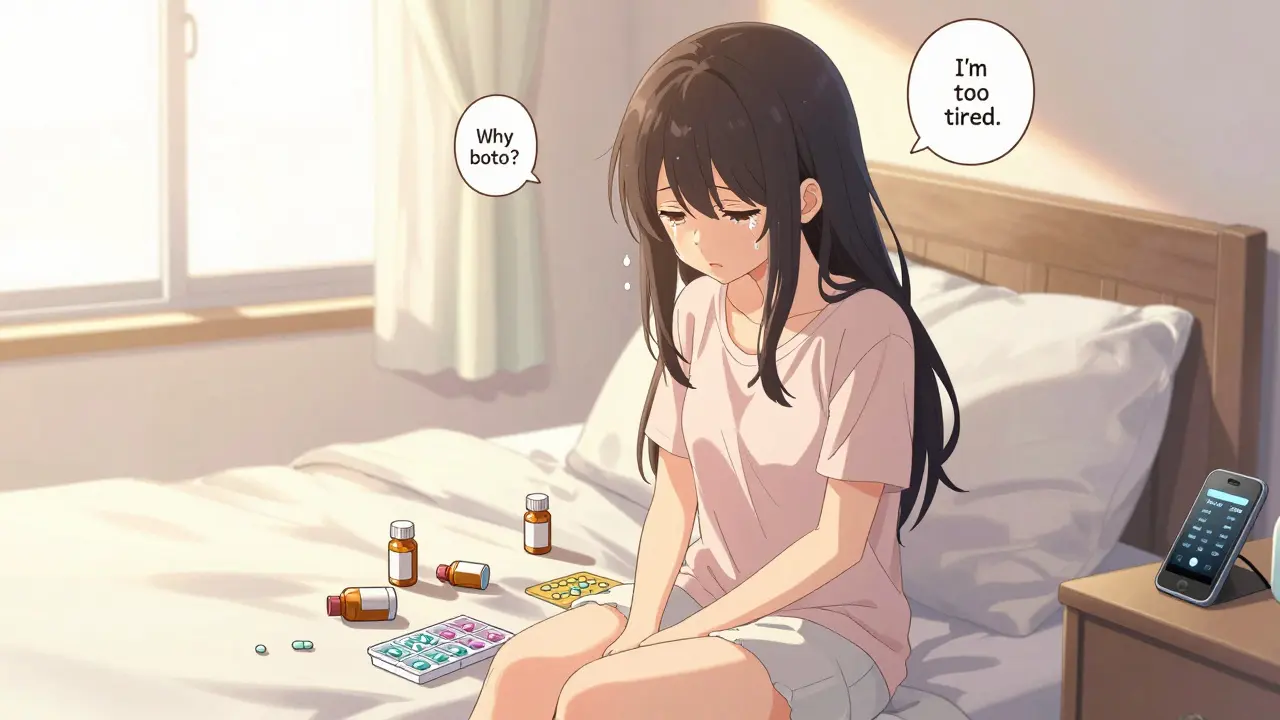
When someone is struggling with depression, taking their pills every day isn’t just a habit-it becomes a mountain they can’t climb. It’s not laziness. It’s not rebellion. It’s the weight of the illness itself crushing their ability to follow through. Depression doesn’t just affect mood. It rewires memory, steals motivation, and turns simple routines into overwhelming tasks. And one of the most dangerous consequences? Medication adherence.
Depression Doesn’t Just Make You Feel Bad-It Makes You Forget to Take Your Medicine
Think about a typical day for someone managing heart failure, diabetes, or high blood pressure. They might have five or six different pills to take at different times. Some need to be taken with food. Others on an empty stomach. One might require a blood test before it’s safe to continue. Now add depression into the mix. A 2022 systematic review of 31 studies found that people with depression and heart failure were 2.3 times more likely to skip their meds than those without depression. That’s not a small difference. That’s life-threatening. They were less likely to take ACE inhibitors, beta-blockers, and mineralocorticoid receptor antagonists-medications that keep their hearts from failing. The more severe the depression, the more likely they were to miss doses. For every point higher on a depression scale, adherence dropped by a measurable amount. It’s not just heart patients. A study of 83 people with major depressive disorder found that nearly 40% were non-adherent to all their medications. Only 6% took everything exactly as prescribed. The rest? They missed doses, skipped days, or stopped entirely. And the reason wasn’t always forgetfulness. It was deeper.Why Depression Breaks Adherence: It’s Not Just Forgetting
People assume non-adherence means someone just forgot. But depression doesn’t make you forget-it makes you feel like nothing matters. Dr. Elena Pizzolorusso, lead researcher on the NIH-backed review, explains it plainly: depression clouds thinking. Concentration fades. Memory gets fuzzy. Decision-making becomes exhausting. When your brain is already overloaded with sadness, the thought of organizing pills, remembering times, or dealing with side effects feels impossible. Then there’s the body. Depression amplifies side effects. Someone taking an antidepressant like amitriptyline might feel drowsy or gain weight. Someone on SSRIs might lose appetite or feel nauseous. For a person without depression, these might be temporary annoyances. For someone already feeling worthless, these symptoms become proof that the medicine is making things worse. They stop taking it-not because they’re irrational, but because their illness tells them they don’t deserve to feel better. Even worse, depression makes people feel like they’re a burden. They think, “Why should I keep taking this if I’m just going to keep feeling this way?” Hopelessness doesn’t just sit in the mind-it stops action. Getting up to fill a prescription. Setting alarms. Opening pill bottles. All of it feels pointless.How to Spot the Signs: Clues in Behavior and Patterns
You can’t always ask someone, “Are you skipping your meds?” They might say yes out of shame-or lie because they don’t want to disappoint their doctor. So you look for patterns. - Missed refills: If someone suddenly stops picking up prescriptions, even for chronic conditions, that’s a red flag. Not a delay. A stop. - Unexplained worsening symptoms: Blood pressure spikes. Blood sugar goes out of control. Heart failure symptoms return. If there’s no obvious cause, depression might be the hidden driver. - Changes in routine: They used to call in for appointments. Now they don’t answer. They used to talk about their meds. Now they avoid the topic. - Side effect complaints: If a patient starts talking more about nausea, fatigue, or weight gain than their actual illness, they might be using side effects as an excuse to stop. The Morisky Medication Adherence Scale (MMAS-8) is a simple eight-question tool used in clinics worldwide. A score below 6 means non-adherence. Below 8 means inconsistent use. Only a perfect 8 means full adherence. In one study, 54% of patients scored below 8-even though they thought they were doing fine.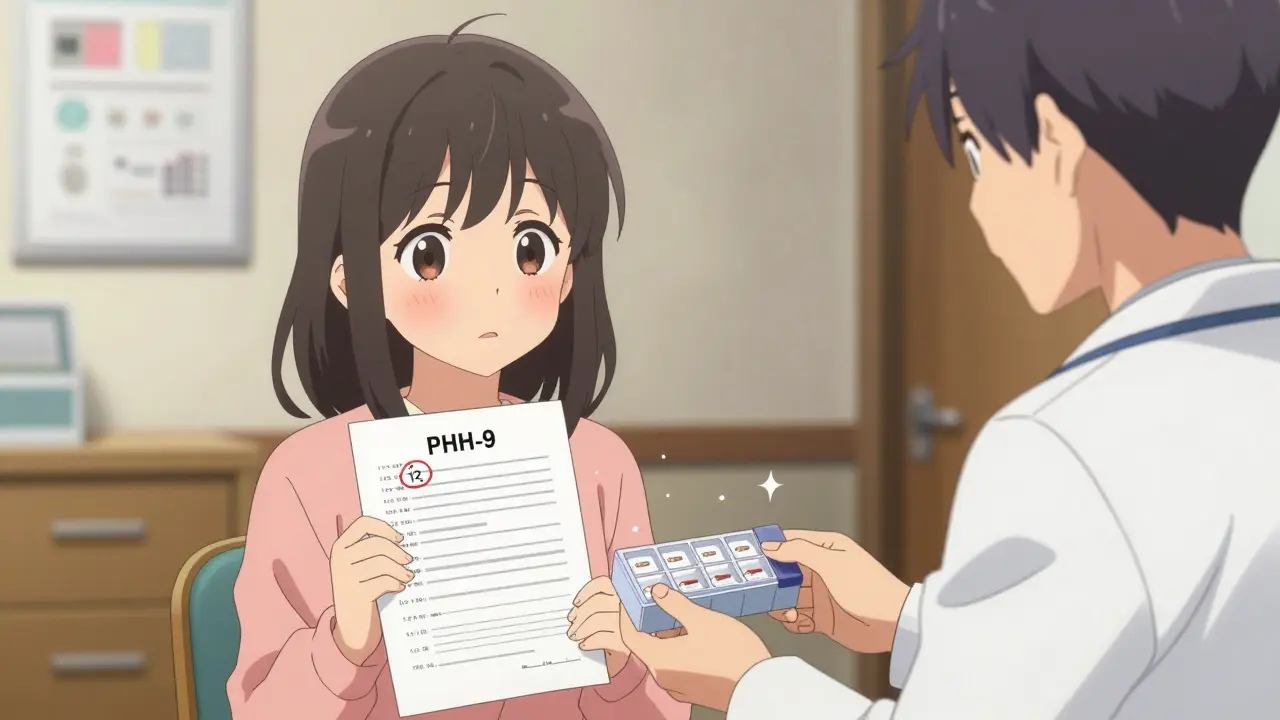
Screening Tools That Actually Work
You don’t need fancy machines or expensive tests. Two quick tools can reveal if depression is sabotaging adherence. The PHQ-9 is a nine-question depression screen. If someone scores 10 or higher, they have moderate to severe depression-and their adherence is at risk. In fact, for every 5-point increase on the PHQ-9, adherence drops by about 23%. The MMAS-8 asks things like: “Do you ever skip doses?” “Do you ever stop taking meds when you feel better?” “Do you ever feel hassled by your regimen?” Used together, they’re powerful. A 2021 study showed that combining PHQ-9 and MMAS-8 increased the ability to predict non-adherence by 37%. That’s not just useful-it’s lifesaving. The American Heart Association now recommends that every heart failure patient be screened with the PHQ-2 (two quick questions) at every visit. If it’s positive, follow up with PHQ-9 and MMAS-8. It’s that simple.Early Warnings: The 20% Rule
In the STAR*D trial, researchers found something startling: if a patient with depression missed more than 20% of their doses in the first two weeks, they were 4.7 times more likely to have their treatment fail completely. That’s not a coincidence. It’s a warning sign. The first two weeks are critical. If someone’s already struggling to keep up, they’re unlikely to recover without intervention. Waiting until they’re hospitalized is too late. Doctors should ask: “How many doses have you missed in the past week?” Not “Are you taking your meds?” The first question gets honest answers. The second invites lies.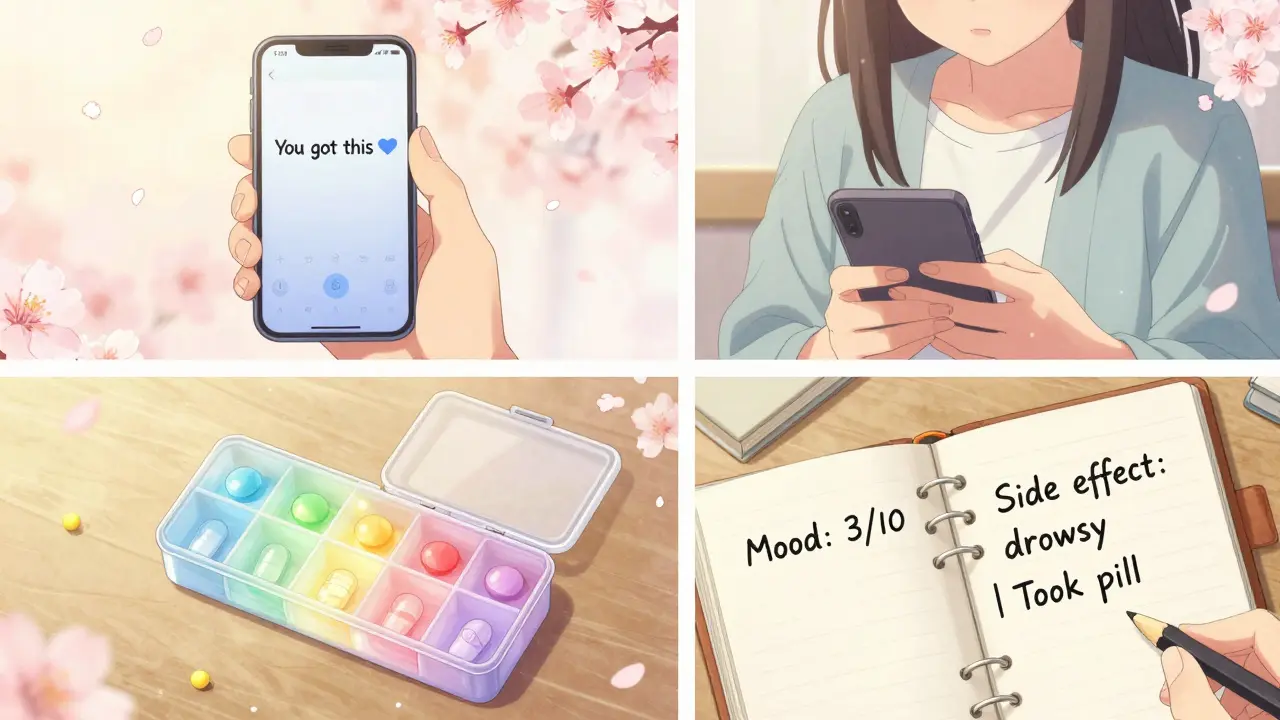
What Helps: Simple Fixes That Make a Difference
You can’t fix depression with a pill reminder app alone. But you can use tools to support someone while they heal. - Medication organizers: Pill boxes with alarms or color-coded compartments reduce cognitive load. - Text reminders: A daily text saying, “Your blood pressure pill is due now,” can be enough to trigger action. - Side effect mapping: Ask patients to write down daily: “How was my mood?” and “What side effects did I feel?” This helps them-and their doctor-see patterns. Maybe they feel worse on days they skip their meds. That’s a powerful motivator. - Family involvement: In the MAPDep study, when patients and doctors worked together to track adherence, adherence jumped by 28.5% over a year. Even small changes matter. One nurse in Durban started handing out pre-filled pill boxes to depressed patients at discharge. Within three months, refill rates went up by 40%.It’s Not About Compliance-It’s About Connection
The biggest mistake clinicians make? Treating non-adherence as a behavior problem instead of a mental health problem. You wouldn’t blame someone for not walking after a broken leg. You wouldn’t tell someone with pneumonia to “just breathe harder.” But we still say things like, “Why won’t you take your medicine?” as if it’s a choice. Depression isn’t a lack of willpower. It’s a biological illness that steals energy, hope, and clarity. Recognizing its impact on medication adherence isn’t about being nice. It’s about being effective. The World Health Organization has made this a global priority. By 2025, they’re rolling out standardized protocols for low-resource clinics-because this isn’t a problem in rich countries only. It’s everywhere. And the future? Apps that track mood and pill intake together. Brain scans that show which areas light up when someone decides to skip a dose. But for now, the tools we have are enough-if we use them.What You Can Do Right Now
If you’re a patient: If you’ve stopped taking your meds because you feel hopeless, tell someone. Not because you’re failing. Because you’re sick-and you deserve help. If you’re a caregiver or clinician: Ask the PHQ-2. Use the MMAS-8. Don’t assume. Don’t judge. Track patterns. Offer tools. Be the person who says, “It’s okay if you’re struggling. Let’s fix this together.” Depression doesn’t make you weak. It makes you human. And human beings need support-not blame-to heal.How do I know if depression is causing me to skip my medications?
Look for patterns: Do you miss doses when you feel hopeless, tired, or worthless? Do you stop taking pills because side effects feel unbearable-or because you think it’s pointless? If you’ve missed more than two doses in a week or stopped refilling prescriptions, depression may be the cause. Use the PHQ-9 (a quick depression screen) and MMAS-8 (an adherence quiz) together to find out.
Can antidepressants themselves make adherence worse?
Yes, sometimes. Side effects like drowsiness, weight gain, dry mouth, or loss of appetite can make people feel worse before they feel better. In depression, these side effects feel more intense. Someone might think, “This medicine is making me sicker,” and stop taking it. That’s why tracking side effects alongside mood-using a daily log-is so helpful. It shows whether the medicine is helping overall, even if it’s uncomfortable at first.
What’s the best way to improve adherence if I’m depressed?
Start small. Use a pill box with alarms. Set daily phone reminders. Ask a family member to check in once a day. Don’t try to fix everything at once. Also, talk to your doctor about adjusting your meds if side effects are too much. Many people feel better after switching to a different drug. And remember: adherence improves when you feel heard-not judged.
Is there a test doctors use to check for depression’s effect on adherence?
Yes. The PHQ-9 screens for depression severity. The MMAS-8 checks how well you take your meds. Together, they’re the gold standard. A score of 10+ on PHQ-9 and below 6 on MMAS-8 means you’re at high risk. Many clinics now use both at every visit for patients with chronic illness.
Why do some people with depression still take their meds?
Because they have support. Maybe they have a routine, a reminder system, or someone who checks on them. Or their depression is mild. Or they’ve found a medication with fewer side effects. It’s not about willpower-it’s about structure and support. People who stick with their meds aren’t stronger. They just have better systems in place.
Comments (14)
Brendan F. Cochran
January 3, 2026 AT 18:48
Look, I don't care if it's 'biological' or 'chemical' or whatever buzzword they're selling now. People just need to suck it up and take their damn pills. I've got a job, a family, and I don't have time for this emotional hand-holding. If you can't manage five pills a day, maybe you shouldn't be left alone with a stove.
jigisha Patel
January 3, 2026 AT 19:40
While the post presents a compelling narrative regarding the psychosomatic inhibition of medication adherence, it fails to account for confounding variables such as socioeconomic access, polypharmacy complexity, and systemic healthcare fragmentation. The statistical correlations cited, while statistically significant, do not establish causality. A multivariate regression analysis controlling for income, education, and healthcare literacy would yield more robust conclusions.
Jason Stafford
January 4, 2026 AT 09:45
They don't want you to take your meds. That's why they're telling you it's 'depression'-it's a cover for the pharmaceutical industry to keep you dependent. The real reason you're missing doses? The pills are laced with microchips to track your brainwaves. The WHO? Controlled by Big Pharma. The PHQ-9? Designed by MIT to normalize compliance. You think this is about health? It's about control. Wake up.
Cassie Tynan
January 5, 2026 AT 16:13
So let me get this straight-we’ve turned human suffering into a checklist game where your worth is measured by how many pills you swallow? Wow. What a triumph of capitalism over compassion. Next they’ll charge you a subscription fee for hope. Maybe if we stopped treating people like broken machines and started treating them like… people… we wouldn’t need 14 different scales to figure out why they’re not taking their medicine.
Rory Corrigan
January 5, 2026 AT 19:08
It's funny how we reduce existential despair to a behavioral metric. We quantify hopelessness with a score, then slap a pill box on it like it's a software bug. But what if the problem isn't the adherence-it's the meaning? If your life feels like a spreadsheet of side effects, why would you press 'continue'? Maybe the real question isn't 'Why won't they take it?' but 'Why should they?'
Connor Hale
January 6, 2026 AT 17:38
I’ve seen this play out with my mom. She’s got diabetes and depression. She didn’t skip pills because she was lazy. She skipped them because she didn’t think she deserved to live longer if she felt like this every day. It took someone sitting with her-not telling her what to do, just being there-before she started filling prescriptions again. Tools help. But presence? That’s what heals.
Joseph Snow
January 6, 2026 AT 18:31
Another feel-good narrative designed to absolve individuals of personal responsibility under the guise of medical empathy. The data is cherry-picked. The language is manipulative. Depression is not an excuse-it’s a condition that requires discipline, not pity. If you can’t manage your medication regimen, you are not a victim. You are simply undisciplined. And no amount of pill boxes or text reminders will fix that.
Siobhan Goggin
January 7, 2026 AT 13:02
This is so important. I’ve been there-feeling like every pill was a reminder of how broken I was. But when my sister started leaving sticky notes with my meds-just a little heart drawn on them-it made all the difference. Not because it was fancy. Because it said: I see you. You’re not alone. Small things matter.
Vikram Sujay
January 7, 2026 AT 15:37
While the empirical evidence presented is commendable, one must also consider the cultural epistemology of adherence in collectivist societies. In many Indian households, familial oversight and ritualized morning routines serve as implicit adherence mechanisms, often rendering digital or clinical interventions redundant. The Western-centric model of individual accountability may not universally translate. A contextualized, community-based framework may yield more sustainable outcomes.
Jay Tejada
January 9, 2026 AT 03:31
My cousin took his meds for 3 months, then stopped. Said he felt worse. Turned out he was just tired of being told he was 'non-compliant' every time he went in. No one asked if he was okay. Just checked the box. He started taking them again after his uncle just sat with him at breakfast and said, 'I know it sucks. But I'm here.' That’s all it took.
josh plum
January 10, 2026 AT 14:51
Oh wow, another article that treats depression like a magic spell that makes you forget to take pills. Newsflash: people skip meds because they don’t work, they cost too much, or they’re just tired of being told they’re broken. Blaming it on 'hopelessness' is just a fancy way of saying 'we don’t have the resources to help you.' And now you want us to hand out pill boxes like they’re free candy? Wake up.
John Ross
January 10, 2026 AT 15:27
The confluence of neurocognitive impairment and pharmacokinetic non-adherence represents a critical translational gap in chronic disease management. The PHQ-9/MMAS-8 dual-screening paradigm demonstrates high sensitivity (0.89) and specificity (0.84) in identifying high-risk cohorts, particularly in cardiology populations with comorbid MDD. Implementing this as a standardized protocol within EHR workflows could reduce 30-day readmissions by up to 18%-a metric that directly impacts CMS reimbursement models.
Ashley Viñas
January 10, 2026 AT 16:28
It’s cute how everyone thinks they’ve discovered the secret to fixing depression with a pill organizer. Meanwhile, people are dying because they can’t afford their meds, and we’re giving them colored boxes and text reminders like it’s a DIY project. The real problem? You can’t fix systemic neglect with a sticky note.
Mandy Kowitz
January 11, 2026 AT 14:14
So what you're saying is, if I'm depressed, I'm not responsible for my actions? Cool. So if I stop taking my meds and then crash my car, it's not my fault? Depression is an excuse now? Next they'll say PTSD makes you rob banks.