
Every year, hundreds of thousands of people end up in the hospital not because their illness got worse, but because the medicines meant to help them clashed in dangerous ways. It’s not always about taking too much or the wrong drug. Sometimes, it’s about when you take them. Timing your medications correctly can stop harmful interactions before they start - no need to stop a life-saving drug, no need to swap prescriptions. Just adjust the clock.
Why Timing Matters More Than You Think
Most people assume drug interactions mean one pill cancels out another. But that’s only half the story. The real danger often comes from timing. When two drugs are taken together, they can interfere with how your body absorbs, breaks down, or uses them. This isn’t random. It’s predictable. And it’s preventable. Take antacids and antibiotics like ciprofloxacin. If you take them at the same time, the antacid binds to the antibiotic in your stomach and stops it from being absorbed. Studies show absorption drops by up to 90%. But if you wait just two hours after the antacid before taking the antibiotic, it works just fine. No side effects. No loss of effectiveness. Just better timing. The same goes for thyroid medication like levothyroxine. If you take it with iron, calcium, or even your morning coffee, your body absorbs less than half of the dose. That means your thyroid levels stay low, you stay tired, and your doctor might keep raising your dose - thinking it’s not working. But the real problem? Timing. Wait four hours after taking levothyroxine before taking iron or calcium supplements, and absorption jumps back to 95%. These aren’t rare cases. About 20-30% of all documented drug interactions are time-dependent. That means if you’re on five or more medications - which 45% of adults over 65 are - you’re likely dealing with one or more of these hidden timing traps.Common Medication Pairs That Need Space
Some combinations are so well-documented, doctors and pharmacists expect them. Here are the top five you should know:- Fluoroquinolone antibiotics (ciprofloxacin, levofloxacin) + antacids or iron: Separate by at least 2 hours. Antacids with aluminum, magnesium, or calcium block absorption.
- Levothyroxine + calcium, iron, or multivitamins: Wait 4 hours. Even soy milk or fiber supplements can interfere. Take it first thing in the morning on an empty stomach.
- Tetracycline antibiotics + dairy products: Don’t take with milk, yogurt, or cheese. Wait 2-3 hours. Calcium binds to tetracycline and stops it from working.
- Bisphosphonates (alendronate, risedronate) + food or other pills: Take on an empty stomach with a full glass of water. Wait 30 minutes before eating, drinking, or taking anything else. Otherwise, you absorb almost nothing.
- Clarithromycin + colchicine: This one can be deadly. Separate by at least 2 hours. Clarithromycin slows down how fast your body clears colchicine, leading to muscle damage or kidney failure if taken together.
What Timing Won’t Fix
Not all interactions can be solved by waiting. If two drugs affect the same enzyme in your liver - like warfarin and metronidazole - timing won’t help. Metronidazole blocks the enzyme (CYP2C9) that breaks down warfarin. No matter when you take them, warfarin builds up in your blood. That increases bleeding risk dangerously. In cases like this, you need a different strategy: reduce the dose of one drug, switch to a safer alternative, or monitor blood levels closely. Timing only works for absorption-based interactions - where one drug physically blocks the other in the gut. For metabolic interactions, it’s a dead end. That’s why it’s critical to know the difference. A pharmacist can tell you which type you’re dealing with. If you’re unsure, ask: “Is this about my stomach absorbing the drug, or my liver breaking it down?”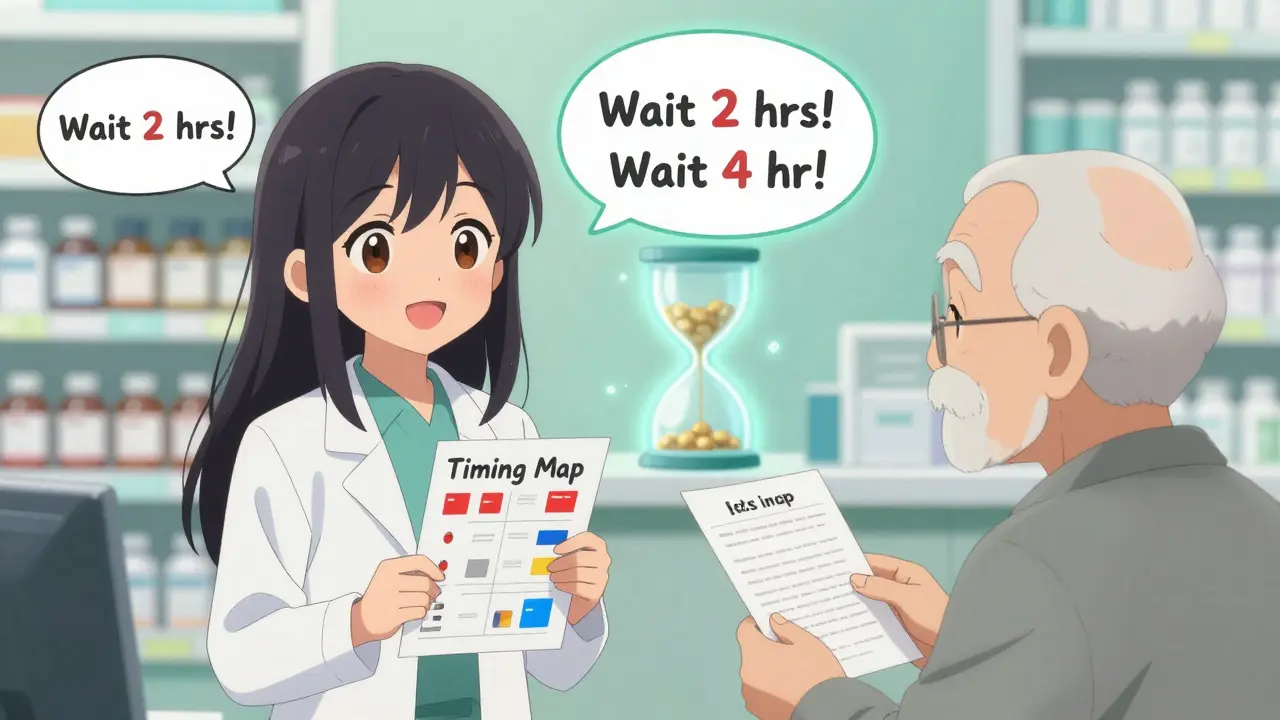
How to Make Timing Work in Real Life
Knowing what to do is one thing. Doing it every day is another. Especially if you’re taking eight different pills at different times. Here’s how real people make it work:- Use a pill organizer with separate compartments. A four-compartment daily organizer (morning, noon, evening, night) cuts timing errors by 43%, according to the Agency for Healthcare Research and Quality. Label each section clearly: “Thyroid - 7 AM,” “Antibiotic - 12 PM,” “Calcium - 6 PM.”
- Set phone alarms with names, not just times. Don’t just set “12 PM.” Set “Ciprofloxacin - 12 PM - wait 2 hrs before antacid.” Apps like Medisafe let you add custom notes and send reminders. In a 2021 trial, this improved adherence by 57%.
- Keep a simple written schedule. Write it out by hand. Tape it to your bathroom mirror or fridge. Include the wait time. Example: “Iron - 8 AM. Wait 4 hrs before levothyroxine.”
- Ask your pharmacist for a “timing map.” Many pharmacies now offer free medication reviews. Bring your list. Ask: “Which of these need space? How much?” They’ll give you a printed plan.
The Hidden Cost of Getting It Wrong
Ignoring timing isn’t just risky - it’s expensive. The Dutch Medicines Evaluation Board found that 18% of preventable adverse drug events in Europe happen because timing wasn’t explained properly. In the U.S., improper timing leads to unnecessary hospital visits, extra lab tests, and higher drug costs. Consider this: a patient on levothyroxine who takes it with calcium might need a higher dose. That means more pills, more side effects, and more doctor visits. But if they just wait four hours, they stay stable on the original dose. No extra cost. No extra risk. And for older adults? It’s even more critical. Polypharmacy patients - those on five or more meds - are three times more likely to have a time-dependent interaction. Yet, only 28% of outpatient clinics consistently write timing instructions on prescriptions. That’s a gap. And it’s dangerous.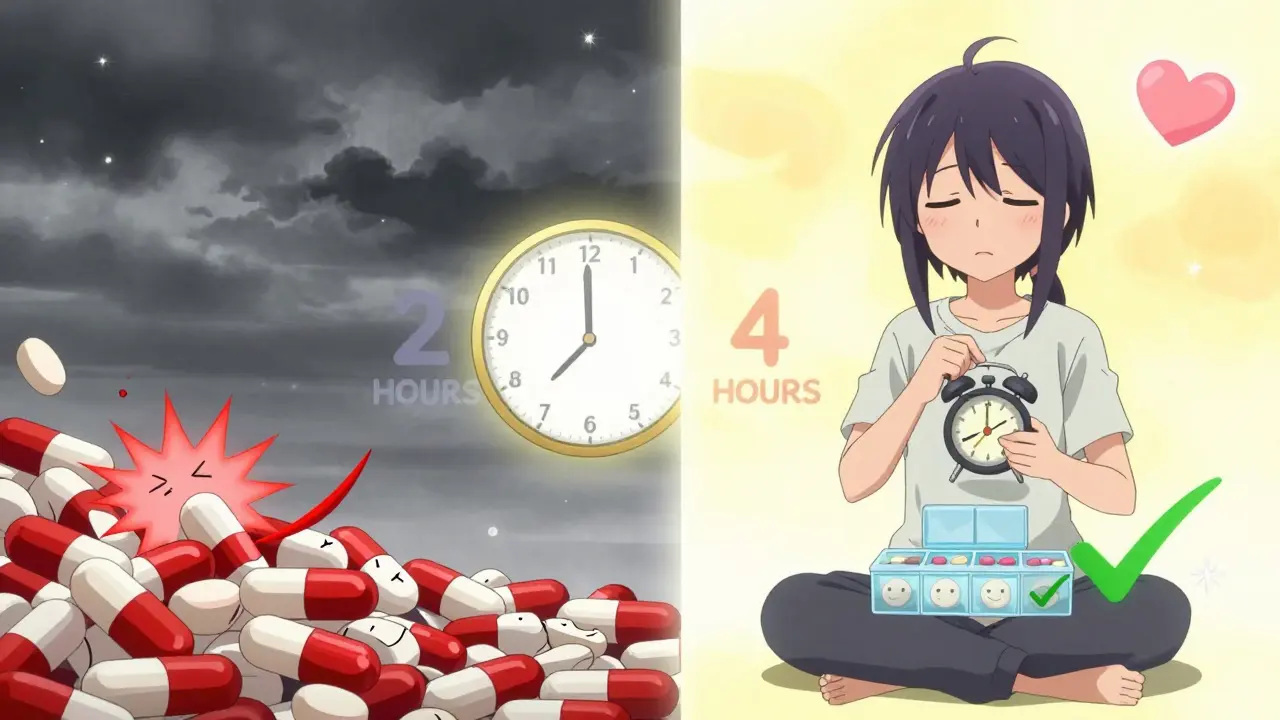
What’s Changing Now
The system is catching up. In 2023, Epic Systems rolled out AI-powered timing alerts in their hospital software. These don’t just flag interactions - they suggest personalized separation times based on kidney function, age, and even what time of day the drug is usually taken. Beta tests showed a 38% drop in false alerts. The FDA is pushing drugmakers to include timing instructions on labels. In 2018, only 12% of labels had them. Now, it’s nearly 40%. And by 2024, they’re testing whether genetic testing can help tailor timing - like adjusting wait times for people who metabolize drugs faster or slower. Hospitals like Kaiser Permanente cut drug-interaction hospitalizations by 29% after they made timing protocols standard. That’s thousands of avoidable emergencies prevented.Your Next Steps
You don’t need to be a doctor to protect yourself. Here’s what to do right now:- Write down every medication, supplement, and vitamin you take. Include doses and times.
- Ask your pharmacist: “Which of these need to be spaced apart?” Don’t assume they’ll tell you. Ask.
- Check the top five high-risk pairs above. Are any on your list?
- Set up a simple system. Use alarms, a pill box, or a printed schedule. Make it visible.
- Don’t skip doses to make timing easier. If you can’t fit it in, talk to your doctor about alternatives - don’t just stop.
Can I take all my pills together if I’m in a hurry?
No. Taking multiple medications together increases the risk of interactions, especially if any are antibiotics, thyroid meds, or supplements like iron or calcium. Even if you feel fine, your body may not be absorbing the drugs properly. It’s not worth the risk. Use alarms or a pill organizer to space them out.
What if I forget to wait the full time between pills?
If you take them too close together by accident, don’t double up later. Just wait until your next scheduled dose. For example, if you took levothyroxine at 7 AM and ate breakfast at 7:30 AM, don’t take another dose at 11 AM. Wait until tomorrow and restart your schedule. Skipping one dose is safer than risking an interaction.
Do over-the-counter drugs and supplements count?
Yes. Many interactions happen with OTC products. Antacids, calcium supplements, iron pills, even St. John’s wort or magnesium can interfere with prescription drugs. Always include everything you take - vitamins, herbal teas, pain relievers - when you talk to your pharmacist.
Can my doctor change my meds to avoid timing issues?
Sometimes. For example, if you’re on ciprofloxacin and need an antacid, your doctor might switch you to azithromycin, which doesn’t interact with antacids. But not all drugs have alternatives. Timing is often the best option because it lets you keep all your medications without losing effectiveness.
How do I know if an interaction is time-dependent or metabolic?
Ask your pharmacist. Time-dependent interactions usually involve absorption - like pills binding in the stomach. Metabolic ones involve liver enzymes - like warfarin and antibiotics. If the interaction is listed as “avoid concurrent use” without a time gap, it’s likely metabolic. If it says “separate by X hours,” it’s time-dependent.
Comments (15)
jefferson fernandes
January 14, 2026 AT 08:52
Let me tell you something real: timing isn’t just advice-it’s survival. I’ve seen elderly patients on eight meds crash because someone told them ‘just take it all at once.’ No. One guy took levothyroxine with his calcium supplement at breakfast and ended up in the ER with a heart rhythm gone wild. Four hours apart? That’s not a suggestion. That’s science. And if your pharmacist doesn’t explain this like your life depends on it (it does), find a new one.
Acacia Hendrix
January 15, 2026 AT 07:32
It’s fascinating how pharmacokinetic bioavailability modulation remains grossly under-communicated in primary care settings. The absorption-based pharmacodynamic antagonism between divalent cations and fluoroquinolones is textbook-yet clinicians still default to ‘take with food’ without contextualizing gastric pH or chelation dynamics. The 90% absorption drop isn’t anecdotal-it’s quantified in double-blind crossover trials. We’re not talking about ‘maybe’ here. We’re talking about therapeutic failure masked as non-compliance.
Adam Rivera
January 17, 2026 AT 01:40
My grandma started using a color-coded pill box after this post went viral in our family group chat. Red = wait 2 hours, blue = wait 4. She used to forget everything. Now she’s got it taped to her coffee maker. She even made me a little card for my meds. I laughed at first… then realized I’d been taking my antibiotics with yogurt for six months. Oops. Thanks for the nudge, OP.
Rosalee Vanness
January 18, 2026 AT 18:51
Oh my god, I’ve been doing this wrong for years. I take my thyroid med at 7 a.m., then grab my multivitamin with my oatmeal at 7:15. I thought I was being healthy. Turns out I’ve been sabotaging my energy, my mood, my entire damn life. I just set an alarm for 11 a.m. to take my iron. And I’m gonna buy one of those fancy pill organizers with the little compartments. I’m not just fixing my meds-I’m reclaiming my mornings. This feels like the first real win I’ve had in years. Thank you for writing this like you actually care.
lucy cooke
January 19, 2026 AT 07:43
Timing. The silent ballet of biochemistry. We think we’re in control-pills in hand, coffee in mouth, life unfolding-but really, we’re just pawns in a molecular game of chess played by our own organs. The stomach isn’t just a bag-it’s a courtroom. And every drug is a witness trying to testify. But if you serve calcium right after levothyroxine? The witness is gagged. Silence. No verdict. No healing. Just… waiting. And we wonder why we’re tired.
John Tran
January 19, 2026 AT 08:32
so i read this and i was like wow but then i realized i take my bisphosphonate with my morning coffee and then eat breakfast 10 mins later… and i’ve been doing that for 3 years. is it too late? i mean, like, did i just waste my bones? i feel like my spine is made of wet cardboard now. also i think i took my cipro with yogurt once. oh god. help.
Trevor Davis
January 19, 2026 AT 09:55
Look, I get it. You’re tired. You’re overwhelmed. You’ve got eight pills and a toddler screaming for Cheerios. But here’s the truth: your body doesn’t care how busy you are. It doesn’t care if you’re running late for work. It just wants you to follow the damn rules. And if you can’t? Then get help. A pharmacist. A nurse. A family member. Don’t just wing it. Your life isn’t a game of chance. It’s a system. And systems need structure.
mike swinchoski
January 20, 2026 AT 10:35
Why are we even talking about this? If you’re on that many meds, you’re probably already dying. Just stop taking everything and eat kale. Problem solved.
James Castner
January 22, 2026 AT 09:24
What strikes me most isn’t the science-it’s the silence. We live in an age of hyper-information, yet the most critical, life-saving details about our own bodies are buried in fine print, whispered by pharmacists who are rushed, or ignored entirely because ‘it’s too complicated.’ But here’s the paradox: the solution isn’t complexity-it’s simplicity. Alarms. Labels. One extra minute. A printed sheet taped to the fridge. The most advanced medicine in the world is not a drug-it’s awareness. And awareness, my friends, is a discipline. Not a gift. A choice. And we owe it to ourselves to choose it, every single day.
Randall Little
January 23, 2026 AT 06:50
Wait-so if I take my calcium at 6 p.m., and my levothyroxine at 7 a.m., that’s 11 hours apart. Am I doing it right? Or am I just being overly cautious? Also, does decaf coffee count? I’ve been drinking it with my thyroid med because ‘it’s not real caffeine.’ Is that a lie I’ve been telling myself?
laura Drever
January 25, 2026 AT 02:03
So what? People die from bad timing. Big deal. The system’s broken. You think a pill organizer fixes healthcare? You’re delusional. Also, typo in ‘ciprofloxacin’-it’s spelled wrong in the list. Just saying.
Jesse Ibarra
January 26, 2026 AT 07:37
Anyone else notice how this whole post is just fear-mongering dressed up as ‘science’? You’re telling people to space out meds like they’re doing brain surgery, but half these interactions are theoretical. I’ve been taking my antibiotics with milk for 15 years and I’m fine. You’re creating anxiety where none is needed. Stop scaring people into compliance. Trust your body.
Robin Williams
January 27, 2026 AT 04:54
bro i just started taking my thyroid med and i thought the ‘take on empty stomach’ meant ‘dont eat right after’ not ‘wait 4 hours before your multivitamin’ 😭 i just ate a protein bar at 7:15. am i doomed? also i love this post. it’s like someone finally spoke my language.
Scottie Baker
January 28, 2026 AT 10:25
My mom took her blood pressure med with grapefruit juice for 8 years. She didn’t even know it was a thing. Then she had a stroke. Not because of the med. Because of the juice. And now she’s in a wheelchair. I’m not saying this to be dramatic. I’m saying it because I saw it. And if you’re reading this and you’re on meds? Stop guessing. Ask. Write it down. Don’t wait until it’s too late.
Pankaj Singh
January 30, 2026 AT 06:07
USA only thinks about timing. In India, we take all pills together. If it kills you, you were weak. No time for alarms. No time for organizers. Life is not a spreadsheet. You survive or you don’t. This post is privileged nonsense.