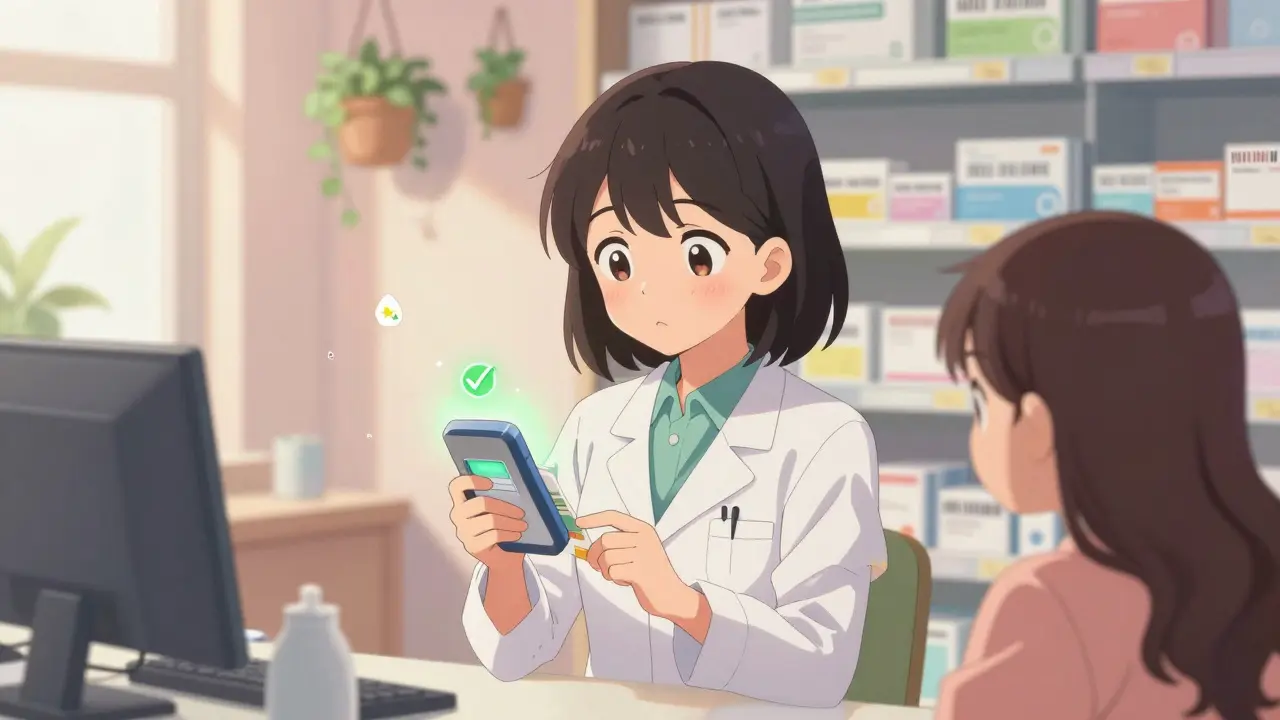
Every year, counterfeit drugs kill tens of thousands of people worldwide. In low- and middle-income countries, 1 in 10 medicines is fake or substandard. These aren’t just weak versions of real pills-they can contain rat poison, cement, or no active ingredient at all. If you’re a patient, caregiver, or healthcare worker, knowing how to verify drug authenticity isn’t optional. It’s life-or-death.
Why Fake Drugs Are So Dangerous
Counterfeit medicines don’t just fail to work. They can make you sicker. The FDA warns that fake drugs may contain the wrong ingredients, toxic substances, or incorrect dosages. A patient taking fake antibiotics might not recover from an infection, leading to sepsis. Someone taking fake malaria medication could die within days. In South Africa, where I live, counterfeit antiretrovirals and tuberculosis drugs have been found in informal markets. These aren’t theoretical risks-they’re happening right now.How Authentication Works: The Two Main Systems
There are two major global systems designed to stop fake drugs before they reach you: serialization and spectral analysis. Serialization means every medicine package gets a unique digital code-like a fingerprint. This code is printed as a 2D barcode (usually a Data Matrix) and linked to a secure database. When you scan it at the pharmacy, the system checks: Is this code real? Has it been used before? Is the product still within its expiration date? The European Union’s Falsified Medicines Directive (FMD), launched in 2019, made this mandatory for all prescription drugs. Every pack has a 12-digit serial number, a batch number, and an expiry date. Pharmacies scan each one before handing it to you. If the system says “invalid,” the drug is held and reported. In the U.S., the Drug Supply Chain Security Act (DSCSA) also uses serialization-but only between wholesalers, distributors, and pharmacies. It doesn’t require verification at the point of patient dispensing. That’s a major gap. A fake drug can slip through if no one checks it when you pick it up.Official Tools to Check Your Medications
You don’t need a lab to verify most medicines. Here are the official tools you can use right now:- EU FMD Verification System: Available in all 27 EU countries. Use your pharmacy’s scanner or, in some places, a smartphone app linked to the national database. The system confirms authenticity in under 3 seconds.
- U.S. DSCSA Verification System: Used by pharmacies and distributors. Not accessible to the public yet-but that’s changing. The FDA plans to require patient-level verification by 2027.
- WHO’s e-Verification System (e-VS): A free platform for low-resource countries. Available in 37 African nations. You can send the batch and serial number via SMS to verify a drug. But don’t rely on it if your network is weak-accuracy drops to 68% in rural areas.
- USP-FDA Spectral Library: Launching in 2025, this will give pharmacists and regulators access to reference spectra for 1,200 essential medicines. You won’t be able to use it at home, but your pharmacist might soon have a handheld device that scans your pill and matches it to a known signature.
On-Dose Authentication: Tiny Tech, Big Protection
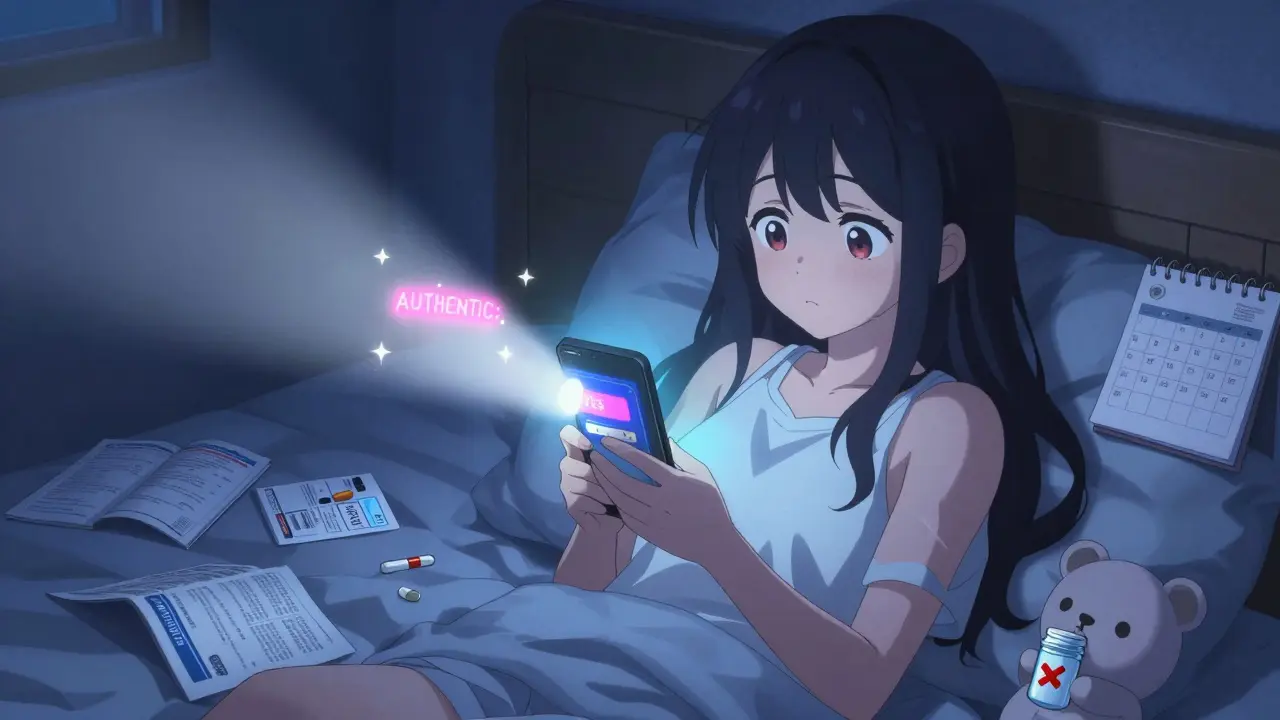
Some drugs now have invisible markers baked right into the tablet or capsule. These are called Physical Chemical Identifiers (PCIDs). They might be microscopic pigments, unique flavors, or even synthetic DNA tags. These can’t be copied by counterfeiters because they’re created during manufacturing using proprietary chemistry. Pfizer and other top manufacturers are already using these. The FDA calls them “highly reliable.” They’re accurate up to 99.9%-far better than QR codes or holograms. But you can’t see them. You need a special reader. For now, this tech is only on high-value drugs like cancer treatments or HIV meds.Handheld Scanners: What Pharmacists Use in the Field
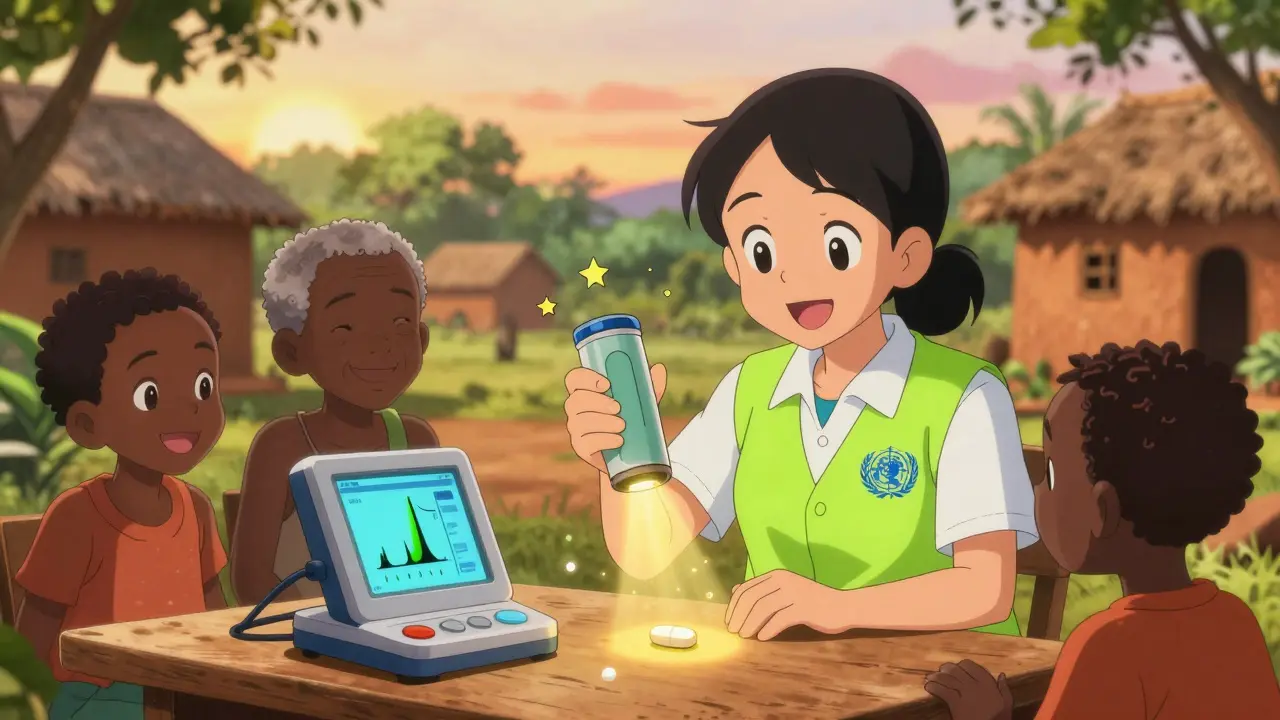
In places like Ghana or Kenya, community health workers carry handheld NIR (near-infrared) or Raman spectrometers. These devices shine light on a pill and measure how it reflects. Every medicine has a unique “spectral fingerprint.” The device compares it to a database and says “authentic” or “suspicious.” Studies show these devices are 87-92% accurate in real-world use. But they cost $5,000-$15,000 each. Training takes 28 hours. They’re not for consumers-but they’re becoming more common in public clinics.What You Can Do Right Now
You don’t have to wait for new tech. Here’s what you can do today:- Check the packaging: Look for tampering-broken seals, mismatched fonts, blurry printing. Fake drugs often have typos or wrong colors.
- Compare with a known authentic version: If you’ve taken this drug before, does the new pack look the same? Even small changes matter.
- Use official verification channels: If you’re in the EU, scan the barcode. If you’re in an African country with e-VS, send the code via SMS. Don’t guess.
- Buy only from licensed pharmacies: Avoid street vendors, unverified online sellers, or pharmacies that don’t ask for a prescription.
- Report suspicious drugs: Contact your national medicines regulator. In South Africa, that’s SAHPRA. In the U.S., it’s the FDA’s MedWatch program.
Why Some Systems Fail
Even the best tech can’t fix human error. A 2018 study found that 72% of counterfeit detection failures were due to staff missing alerts, ignoring warnings, or misreading screens. In NHS pharmacies, 43% of staff initially confused counterfeit alerts with “already dispensed” messages. That’s why some hospitals now use colored lights and audio alerts-green for OK, red with a beep for fake. Another problem? System downtime. Pharmacies report an average of 2.3 hours of system outages per month. If the verification server is down, do you still dispense? That’s a tough call. That’s why backup procedures and training are just as important as the tech.What’s Coming Next
The future is faster, smarter, and more accessible:- By 2027, the FDA will require U.S. pharmacies to verify drugs at the point of sale-closing the current gap.
- AI will analyze verification data in real time to spot unusual patterns-like a fake batch appearing in three different countries at once.
- Blockchain systems are being tested by Pfizer and others. They track every step from factory to patient, with 99.8% accuracy.
- Smartphone apps are being developed that will let you scan your pill and get instant results using the USP spectral library.
Bottom Line: Trust, But Verify
You can’t assume your medicine is safe just because it came from a pharmacy. Even in wealthy countries, fake drugs slip through. The tools exist. The systems are proven. What’s missing is awareness. If you’re taking life-saving medication-HIV drugs, insulin, chemotherapy, antibiotics-take five minutes to verify it. Ask your pharmacist: “Is this checked through the official system?” If they don’t know, it’s time to find a better one. The fight against counterfeit drugs isn’t just for regulators or manufacturers. It’s for you. Your life depends on it.How can I tell if my medicine is fake just by looking at it?
Look for signs like poor print quality, mismatched colors, misspelled names, or broken seals. Fake drugs often have blurry barcodes, wrong fonts, or packaging that looks cheaper than the real version. Compare it to a previous pack-if something looks off, don’t take it.
Can I use my phone to scan a drug’s barcode and verify it?
In the European Union, yes-many countries have apps linked to the FMD database. In the U.S., not yet. The DSCSA system doesn’t allow public access. But by 2027, the FDA plans to roll out patient-facing verification tools. For now, only licensed pharmacies can scan and verify.
What should I do if I think I’ve been given a fake drug?
Stop taking it immediately. Contact your pharmacist or doctor. Then report it to your national medicines regulator-SAHPRA in South Africa, the FDA in the U.S., or your country’s equivalent. Keep the packaging and any receipts. This helps authorities track the source.
Are online pharmacies safe for buying medicines?
Most are not. The WHO estimates that 50% of medicines sold online are fake. Only buy from pharmacies that require a prescription, display a physical address, and are licensed by your country’s health authority. Look for the VIPPS seal in the U.S. or the EU common logo for online pharmacies.
Do all countries have drug verification systems?
No. Only 100% of EU countries, 78% of U.S. pharmacies, and fewer than 35% of low-income countries have full systems in place. Many rely on SMS-based checks, which fail in areas with poor mobile coverage. The WHO is working to expand access, but progress is slow.
Is there a way to verify drugs at home without special equipment?
Not reliably. While you can check packaging and use official SMS systems in some countries, true verification requires scanning a serial code against a secure database. Handheld scanners and spectral devices are too expensive and complex for home use. If you’re unsure, always consult a licensed pharmacist.
Comments (8)
Kent Peterson
December 16, 2025 AT 18:39
Let’s be real-this whole ‘verification’ system is just a fancy way for Big Pharma to charge more and control the supply chain. The EU’s FMD? A bureaucratic nightmare that does nothing for the average person. And don’t get me started on the FDA’s 2027 ‘plan’-we’re talking about people dying now, not waiting for another federal delay. If you’re waiting for a scanner or an app to save you, you’re already dead.
Evelyn Vélez Mejía
December 17, 2025 AT 17:13
The erosion of pharmaceutical integrity is not merely a logistical failure-it is a metaphysical betrayal of the social contract between healer and healed. When a pill, the very vessel of hope, becomes a vessel of poison, we confront the ontological fragility of modern medicine. The spectral fingerprint, that silent signature of chemical essence, is not merely data-it is the last vestige of trust in an age of algorithmic alienation. To verify is to affirm being itself.
Nishant Desae
December 18, 2025 AT 21:17
I really appreciate this post, it's so important especially in places like India where so many people buy medicines from local shops without knowing what they're getting. I've seen friends take fake antibiotics and get worse instead of better. The WHO e-VS system is a godsend in rural areas-even if the SMS doesn't always work, it's better than nothing. I think we need more community health workers with those handheld scanners, maybe even donated by NGOs. Everyone deserves to know their medicine is real, no matter where they live. Keep sharing this kind of info, it helps so much!
Pawan Chaudhary
December 19, 2025 AT 14:54
Hey, this is awesome info! I just shared it with my uncle who’s on insulin-he’s been buying from a local pharmacy that doesn’t ask for a script. Now he’s gonna check the packaging and call his doctor. Small steps, right? I’m so glad someone took the time to lay this out so clearly. Seriously, this could save lives. Thanks for doing this!
Linda Caldwell
December 20, 2025 AT 01:14
Scan it. Report it. Don’t wait. Your life isn’t a gamble.
Anna Giakoumakatou
December 20, 2025 AT 10:03
Oh, wonderful. Another article that tells us to ‘trust but verify’-as if the average person has access to a $15,000 Raman spectrometer or a blockchain-enabled pharmacy. How quaint. The real tragedy isn’t the counterfeit pills-it’s that we’ve been conditioned to believe that the solution lies in more tech, not in dismantling the corporate monopoly that lets this happen in the first place. Bravo, FDA. Another victory for performative safety.
Erik J
December 21, 2025 AT 11:49
Just wondering-how many of the handheld scanners in Ghana or Kenya are actually functional long-term? I’ve read reports of devices breaking down due to heat, humidity, or lack of calibration tools. If the tech fails in the field, does the system still hold?
BETH VON KAUFFMANN
December 23, 2025 AT 05:54
Let’s cut through the fluff: serialization is a compliance theater. The DSCSA doesn’t require patient-level checks because it’s designed to protect distributors, not consumers. The ‘spectral library’? A glorified fingerprint database for pharmacists who already have the training. And don’t even get me started on ‘PCIDs’-they’re proprietary, unverifiable, and only available on drugs that cost $10,000 a dose. This isn’t public health-it’s a luxury feature for the insured. The rest of us? We’re expected to squint at barcodes and hope.