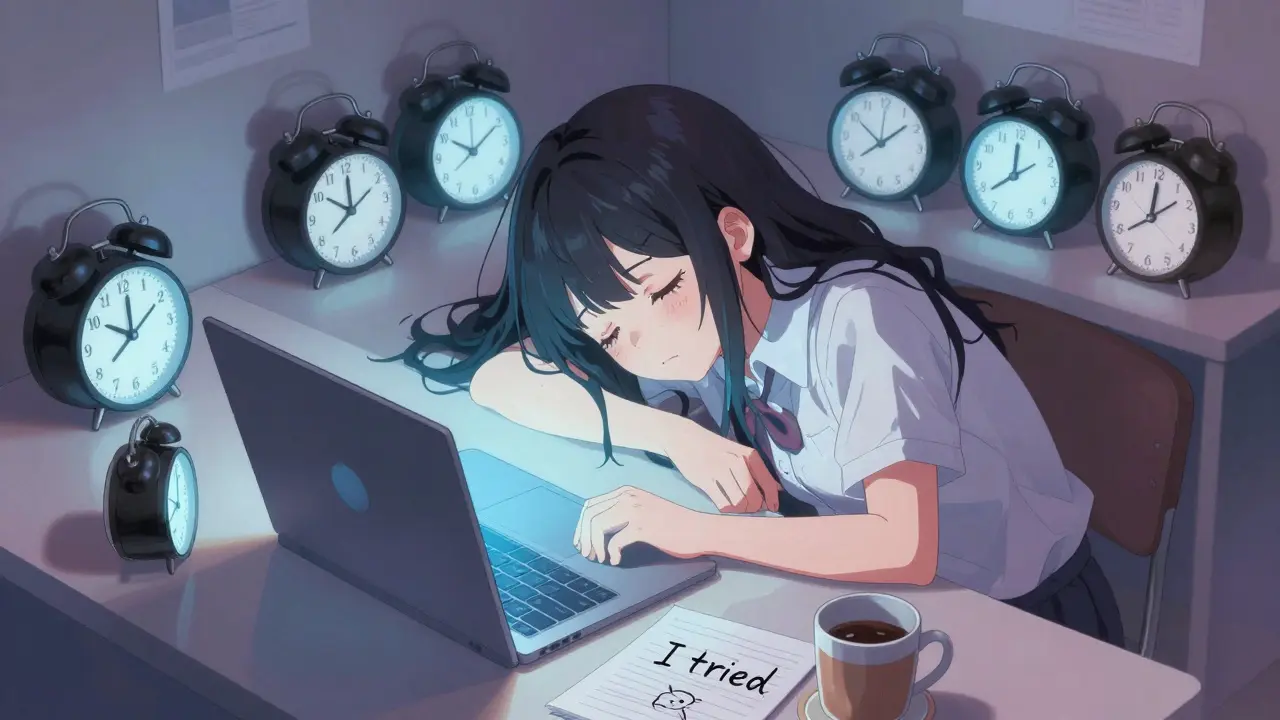
Idiopathic hypersomnia isn’t just feeling tired. It’s waking up after 11 hours of sleep and still feeling like you haven’t slept at all. It’s setting seven alarms and still missing work. It’s sitting in a meeting, nodding off, and waking up with no memory of what was said. For about 10 in every 100,000 people, this isn’t laziness or stress-it’s a real, measurable neurological condition called idiopathic hypersomnia (IH).
What Exactly Is Idiopathic Hypersomnia?
Idiopathic hypersomnia is a chronic sleep disorder where the brain struggles to maintain wakefulness, even after long, uninterrupted sleep. Unlike normal tiredness, IH doesn’t improve with more rest. People with IH often sleep 10 to 14 hours a night and still need long naps during the day-naps that don’t refresh them. The word "idiopathic" means the cause is unknown. There’s no infection, no tumor, no sleep apnea causing it. It’s a problem in how the brain regulates sleep-wake cycles.The hallmark symptom is excessive daytime sleepiness (EDS), present every day for at least three months. But IH has other unique signs. One is severe sleep inertia-the groggy, disoriented state after waking up that can last for hours. Some people describe it as "sleep drunkenness." They might sit up in bed, stare blankly, forget where they are, or even try to drive while still half-asleep. Others report automatic behaviors: typing emails without remembering typing them, walking to the fridge and not knowing why.
Brain fog is another major issue. Memory lapses, trouble focusing, slow thinking-these aren’t just "being distracted." They’re neurological. Studies show up to 66% of IH patients experience this level of cognitive impairment. One patient on Reddit wrote, "I forgot how to make coffee. I stared at the machine for 10 minutes. That’s not normal fatigue. That’s my brain shutting down."
How Is It Different From Narcolepsy?
People often confuse IH with narcolepsy because both involve extreme daytime sleepiness. But they’re not the same. Narcolepsy usually starts suddenly, often in teens or early 20s, and includes sudden muscle weakness (cataplexy) triggered by strong emotions-laughter, anger, surprise. IH patients never have cataplexy.Narcolepsy patients typically have short, refreshing naps-15 to 20 minutes. IH patients nap for an hour or more and wake up just as tired. Nighttime sleep also differs. Narcolepsy often causes fragmented sleep, while IH patients sleep deeply and long, sometimes 12 hours straight.
Diagnostic tests show clear differences. The Multiple Sleep Latency Test (MSLT), which measures how fast someone falls asleep during the day, usually shows normal results in IH. In narcolepsy, it shows very short sleep latencies and frequent REM sleep. This mismatch is why IH is so often missed. Many patients see four or more doctors before getting the right diagnosis-and it takes an average of 8 years.
Why Diagnosis Takes So Long
IH is rare, and most doctors don’t see a case in their entire career. Symptoms overlap with depression, chronic fatigue syndrome, and even burnout. Patients are often told they’re just "stressed" or "not trying hard enough."One patient shared that her psychiatrist prescribed antidepressants for five years before a sleep specialist finally ordered a polysomnogram and MSLT. By then, she’d lost two jobs and her driver’s license after a near-crash.
Diagnosis requires two key tests: an overnight sleep study (polysomnography) to rule out sleep apnea or other disorders, followed by the MSLT the next day. The International Classification of Sleep Disorders (ICSD-3) requires at least 6 hours of sleep during the overnight test and a mean sleep latency of 8 minutes or less on the MSLT. But even with these tools, diagnosis isn’t foolproof. Some IH patients have normal MSLT results, making it harder to prove.
Recent research is changing that. A 2023 study in the Journal of Clinical Sleep Medicine found a unique biomarker pattern in cerebrospinal fluid that correctly identified 89% of IH cases. This could lead to a simple spinal tap test in the future-no more long, confusing sleep studies.
What’s Going on in the Brain?
Scientists are uncovering biological reasons behind IH. One major theory points to GABA, a brain chemical that calms neural activity. In about half of IH patients, researchers found an unknown substance in their spinal fluid that makes GABA receptors overly sensitive. This is like having a brake pedal stuck to the floor-your brain can’t wake up.Another clue is low histamine levels. Histamine is the brain’s natural alarm clock. Less histamine means less wakefulness. Some patients also show problems with orexin, a neurotransmitter that keeps you alert. These findings explain why stimulants like modafinil help some people but not others.
It’s not just one broken system. IH appears to be a mix of multiple neurological glitches. That’s why treatment isn’t one-size-fits-all.
Treatment Options: What Actually Works
There’s no cure for IH, but there are ways to manage it. Treatment usually starts with medication, but it’s not as simple as popping a pill.Xywav (calcium, magnesium, potassium, and sodium oxybate) is the first and only FDA-approved drug specifically for IH. Approved in 2021, it’s taken at night in two doses. In clinical trials, it reduced daytime sleepiness by 63%. It works by stabilizing sleep architecture and reducing nighttime awakenings. But it’s expensive, requires strict dosing, and can cause nausea, dizziness, or sleepwalking.
Modafinil and armodafinil are stimulants often used off-label. About 42% of patients report improvement, but many need higher doses over time. Side effects include anxiety, headaches, and heart palpitations. One patient said, "I took 400mg a day and felt like a jittery robot. I couldn’t sleep at night, but I still fell asleep at my desk."
Pitolisant, a newer drug that boosts histamine, is approved in Europe and under review in the U.S. Early studies show a 47% response rate. It’s taken once daily and has fewer side effects than stimulants.
Not everyone responds to meds. That’s where non-drug approaches help. Cognitive Behavioral Therapy for Hypersomnia (CBT-H) teaches patients to structure their day around energy levels, manage naps effectively, and challenge thoughts like "I’m lazy" or "I should be able to push through." A 2020 study found 45% of patients improved significantly after 12 weeks of CBT-H. When combined with medication, improvement jumps to 37% more than medication alone.
Simple lifestyle changes matter too. Avoid caffeine after noon-it disrupts nighttime sleep. Stick to a strict sleep schedule, even on weekends. Exposure to bright light in the morning helps reset the body clock. Some patients use light therapy boxes for 30 minutes after waking.
Life With IH: The Hidden Costs
The real impact of IH isn’t just in sleep-it’s in life. A 2021 survey of 982 IH patients found 74% met clinical criteria for depression. The constant exhaustion, social isolation, and shame create a cycle: you feel tired, you cancel plans, you feel guilty, you feel worse.Employment suffers. 87% of patients say IH severely impacts their ability to keep a job. 62% have lost jobs because of sleepiness. One man told his employer he had "chronic fatigue." He was fired after three missed days. Later, he got diagnosed with IH. He’s now on disability.
Driving is dangerous. A 2022 survey found 78% of IH patients had at least one near-miss crash due to drowsiness. 22% had actual accidents. Many avoid driving altogether.
Even simple tasks become risky. 41% of patients reported forgetting to turn off the stove. Others walked out of the house without shoes or keys. "I’ve burned two pans, locked myself out twice, and once drove to the wrong city," one woman said. "I don’t trust myself anymore."

What’s Next? Hope on the Horizon
Research is accelerating. The NIH spent $1.2 million on hypersomnia research in 2018. By 2023, that jumped to $8.7 million-a 625% increase. Seven clinical trials are now testing new drugs for IH.One promising area is GABA-A receptor modulators. Five compounds are in Phase 2 trials, aiming to block the extra GABA activity that makes IH patients sleepy. Another targets histamine H3 receptors to boost wakefulness. Orexin replacement therapies are still in preclinical stages but could be game-changers if they work.
The International Classification of Sleep Disorders (ICSD-4) will update diagnostic criteria in late 2024, making it easier for doctors to spot IH. The Hypersomnia Foundation’s patient registry, with over 2,100 participants, is tracking long-term outcomes and treatment responses. By 2025, researchers expect to identify subtypes of IH-some driven by GABA, others by histamine-which will lead to personalized treatments.
Where to Start If You Suspect IH
If you’ve been exhausted for months, slept 10+ hours, and still feel like you’re underwater, see a sleep specialist. Don’t wait. Bring a sleep diary: record your sleep times, naps, how you feel after waking, and any accidents or memory lapses.Ask for a polysomnogram and MSLT. If your doctor says "it’s just stress," ask for a referral to a sleep center. The American Academy of Sleep Medicine has a directory of accredited centers.
Connect with others. The Hypersomnia Foundation and Reddit’s r/hypersomnia community offer support, resources, and real stories. You’re not alone. And you’re not lazy. Your brain is fighting a silent battle-and there are ways to help it win.
What You Can Do Today
- Track your sleep and symptoms for at least two weeks.
- Limit caffeine to before noon.
- Avoid naps longer than 30 minutes.
- Get bright light exposure within 30 minutes of waking.
- Write down any moments of confusion, automatic behavior, or near-misses.
- Ask your doctor about a sleep study.
Idiopathic hypersomnia doesn’t go away with willpower. But with the right diagnosis and care, life can get better. It’s not about fighting sleep. It’s about understanding it-and finally getting the help you need.
Is idiopathic hypersomnia the same as being tired all the time?
No. Everyone gets tired. IH is a neurological disorder where excessive sleepiness persists despite long, high-quality sleep. People with IH sleep 10 to 14 hours a night and still feel unrefreshed. Their sleepiness isn’t relieved by rest, unlike normal fatigue, which improves with sleep or caffeine.
Can you grow out of idiopathic hypersomnia?
For most people, IH is a lifelong condition. Symptoms may stabilize or change over time, but they rarely disappear completely. Some patients report slight improvement after age 40, but this isn’t guaranteed. Early diagnosis and management are key to maintaining quality of life.
Why don’t stimulants always work for IH?
Stimulants like modafinil target wakefulness pathways, but IH isn’t always caused by low arousal. In many cases, the brain is flooded with sleep-promoting chemicals like GABA. Stimulants can’t override that. That’s why drugs like Xywav, which target the root cause, are more effective for some patients.
Is idiopathic hypersomnia genetic?
There’s no single gene linked to IH, but some patients report family members with similar symptoms. Research suggests possible genetic predispositions affecting GABA or histamine systems, but no confirmed inheritance pattern yet. It’s likely a combination of genes and unknown environmental triggers.
Can IH be misdiagnosed as depression?
Yes, very commonly. Fatigue, low motivation, and brain fog are symptoms of both IH and depression. Many patients are prescribed antidepressants for years before a sleep specialist identifies IH. If you’ve been on antidepressants with no improvement, ask about a sleep study.
How do I find a sleep specialist who knows about IH?
Look for board-certified sleep medicine physicians affiliated with accredited sleep centers. The American Academy of Sleep Medicine website has a directory. Mention "idiopathic hypersomnia" specifically-many general neurologists aren’t familiar with it. The Hypersomnia Foundation also offers a list of specialists who treat IH regularly.
Are there any natural remedies that help with IH?
There’s no proven natural cure, but some lifestyle changes help manage symptoms: strict sleep schedules, bright light therapy in the morning, avoiding alcohol and heavy meals before bed, and short, strategic naps. Caffeine can help temporarily, but only if limited to early in the day. Supplements like vitamin B12 or iron won’t fix IH unless you have a deficiency.
Can children have idiopathic hypersomnia?
Yes. IH often begins in adolescence, though it can start in childhood. Children may appear lazy, daydreamy, or have trouble in school. They might sleep 12+ hours at night and still nap during the day. Diagnosis in kids is challenging but possible. Pediatric sleep specialists can evaluate them using the same criteria as adults.
Comments (14)
vivek kumar
January 18, 2026 AT 03:36
Idiopathic hypersomnia isn’t just fatigue-it’s a neurological hijacking. The GABA-overactivity theory makes sense. I’ve seen patients on modafinil turn into anxious robots while still nodding off at their desks. No wonder it takes 8 years to diagnose. We need better biomarkers, not just sleep studies that miss half the cases.
Riya Katyal
January 19, 2026 AT 21:51
So let me get this straight-your brain has a stuck brake pedal and we’re giving you sodium oxybate? Cool. Next they’ll prescribe a tow truck for your soul.
Henry Ip
January 21, 2026 AT 15:51
This is one of the clearest explanations of IH I’ve read. The part about automatic behaviors? That’s terrifyingly accurate. I’ve done the fridge walk too. And yes, stimulants don’t fix the root problem-just mask it. CBT-H is underrated. Structure saves lives.
kanchan tiwari
January 22, 2026 AT 03:57
THEY KNOW. THEY’VE KNOWN FOR DECADES. THE PHARMA COMPANIES ARE HIDING THE TRUTH BEHIND SLEEP STUDIES. WHY IS XYWAV SO EXPENSIVE? BECAUSE THEY WANT YOU TO SUFFER UNTIL YOU’RE TOO WEAK TO COMPLAIN. I SAW A GOVERNMENT WHISTLEBLOWER ON YOUTUBE WHO SAID GABA RECEPTORS WERE TARGETED IN THE 90S AND BURIED. THIS IS A CONTROLLED EXPERIMENT. WE’RE ALL LAB RATS.
Bobbi-Marie Nova
January 23, 2026 AT 03:17
‘I forgot how to make coffee’ - same. I once put my keys in the microwave because my brain thought it was a toaster. 😅 I’ve stopped apologizing for naps. If my brain’s on strike, I’m not gonna guilt-trip it. Also, bright light in the AM? Game changer. No cap.
Samyak Shertok
January 23, 2026 AT 12:36
So you’re telling me the brain’s GABA system is broken, but we can’t fix it? That’s not science-that’s surrender. Maybe the real issue is that we’ve been treating sleep like a switch, not a symphony. The Enlightenment didn’t fix human nature. Why do we think pills will fix neurology? We’re just shoving caffeine into a broken clock and calling it progress.
Stephen Tulloch
January 24, 2026 AT 09:58
LOL at people saying ‘it’s just stress’ 😂 I mean, yeah, maybe if you’re a 19-year-old who stayed up gaming for 72 hours. But IH? Nah. That’s a full-system crash. I’ve been on Xywav for 6 months. Still need naps. Still forget my own birthday. But at least I don’t fall asleep driving anymore. 🚗💤
evelyn wellding
January 25, 2026 AT 08:36
You’re not alone. Seriously. I used to hide my naps. Now I tell people: ‘My brain’s on a 14-hour loop.’ It’s not laziness. It’s biology. And guess what? We’re getting better treatments. Keep going. You’re doing better than you think.
Chelsea Harton
January 26, 2026 AT 09:07
ih is real. i had it. took 7 years. drs called me depressed. turned out my gaba was overactive. now i take pitolisant. still tired. but not useless.
Corey Chrisinger
January 26, 2026 AT 15:18
If the brain’s GABA system is essentially a stuck brake, then maybe wakefulness isn’t about stimulating the accelerator-it’s about releasing the brake. That’s a paradigm shift. We’ve been trying to force wakefulness instead of removing the inhibitor. Philosophically, this mirrors ancient ideas of ‘letting go’ to achieve clarity. The body knows. We just need to stop fighting it.
Travis Craw
January 27, 2026 AT 02:50
thanks for writing this. i’ve been silent for years. i thought i was just lazy. reading this made me cry. i’m going to make an appointment this week.
Kasey Summerer
January 28, 2026 AT 06:01
US has 80% of the research funding. India has 2 diagnosed cases. Why? Because we don’t have sleep labs. We have chai and ‘rest more’. My cousin slept 16 hours a day for 10 years. Family said ‘he’s just lazy’. He died in a car crash. No one tested him. This isn’t just medical-it’s cultural.
Ryan Hutchison
January 29, 2026 AT 13:43
Look, if you’re sleeping 14 hours and still tired, maybe you’re just un-American. We built this country on hustle. You think Thomas Edison napped 10 hours a day? No. He worked. Maybe you just need to get off the couch and stop blaming your brain.
Melodie Lesesne
January 29, 2026 AT 22:20
My sister was diagnosed last year. She’s 19. Started in high school. Teachers thought she was bored. Now she’s on pitolisant and uses a light box every morning. She’s back in college. It’s not perfect. But it’s progress. You’re not broken. You’re just wired differently. 💙