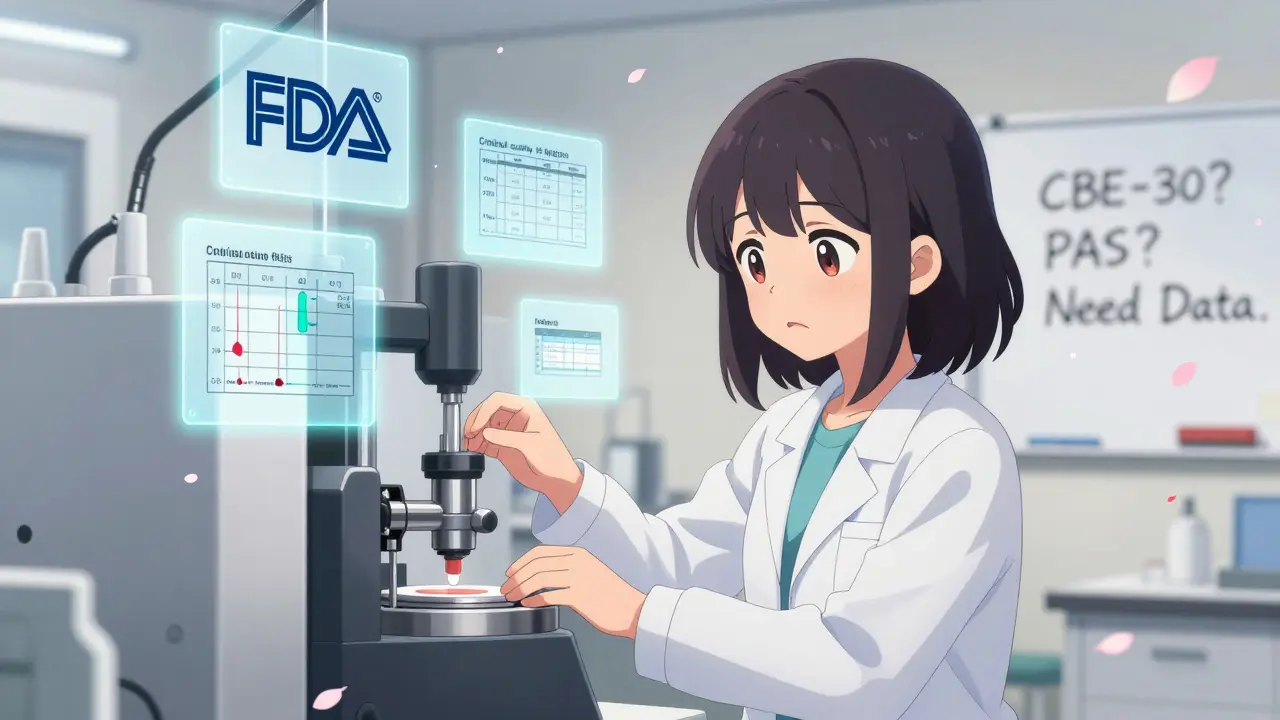
When a pharmaceutical company makes even a small change to how a drug is made-like swapping out a machine, moving a step to a different room, or using a new supplier for raw materials-it’s not just an internal decision. It’s a regulatory event. And if it’s handled wrong, it can lead to a warning letter, a product recall, or even a halt in production. The rules around these changes aren’t suggestions. They’re legally binding requirements under U.S. FDA regulations, and similar systems exist in Europe, Canada, and elsewhere. Understanding what counts as a change, how to classify it, and what you must do before implementing it can mean the difference between staying compliant and facing serious consequences.
What Counts as a Manufacturing Change?
A manufacturing change isn’t just about big equipment swaps. It includes anything that affects how the drug is made, tested, or controlled after it’s been approved. This could be:
- Replacing a tablet press with a different model
- Changing the location of a mixing step within the same facility
- Switching to a new supplier of an active ingredient
- Updating software that controls a sterilization cycle
- Modifying a testing method for purity
Even if the change seems minor, regulators assume the worst: that it could affect the drug’s safety, strength, quality, or purity. That’s why every change, no matter how small, must be evaluated. The key question isn’t whether the change feels safe-it’s whether you can prove it doesn’t impact the product’s critical quality attributes (CQAs). These are the measurable characteristics that define whether the drug works as intended, like how fast it dissolves, how pure it is, or how stable it stays over time.
The Three-Tier System: FDA’s Approach
The U.S. Food and Drug Administration (FDA) uses a three-tier system to manage changes under 21 CFR 314.70. Each tier has different rules for notification and approval.
1. Prior Approval Supplement (PAS) - Major Changes
These are changes with a high risk of affecting product quality. Examples include switching the chemical synthesis route for the active ingredient, moving production to a new facility, or changing equipment that alters critical process parameters. For these, you must get FDA approval before you start making the product with the change. Submitting a PAS means providing detailed data-process validation reports, comparative batch analysis, stability studies-and waiting for the agency to review and approve it. This can take months. Skipping this step? That’s how companies get warning letters. In 2023 alone, four warning letters were issued specifically for unapproved equipment changes.
2. Changes Being Effected in 30 Days (CBE-30) - Moderate Changes
These are changes that could affect quality but aren’t high-risk. Examples: replacing a machine with an identical one from the same manufacturer, changing the packaging material, or adjusting a process parameter within a validated range. You can implement the change after submitting a CBE-30 notice, but you must wait 30 days before distributing the product. During that time, the FDA can ask you to stop if they disagree with your classification. This is the most common gray area. Many companies spend weeks debating whether a change is CBE-30 or PAS. The FDA’s 2022 guidance clarified that "equivalent" equipment must have the same principle of operation, same critical dimensions, and same material of construction. If any of those differ, it’s likely a PAS.
3. Annual Report - Minor Changes
These are low-risk changes that don’t affect quality. Examples: changing the labeling font size, moving a non-critical step to another room in the same building, or updating internal documentation. You don’t need to notify the FDA before acting. But you must document the change and report it in your annual report, which is due within 60 days of your application anniversary date. Missing this report? That’s still a violation.
How Other Regulators Compare
The FDA isn’t alone. Other agencies have similar-but not identical-systems.
The European Medicines Agency (EMA) uses a three-type system:
- Type IA: Very minor changes (like updating a supplier name). You notify them after making the change, within 12 months.
- Type IB: Moderate changes (like changing a filter supplier). You must get approval before implementing, but the review is faster than for Type II.
- Type II: Major changes (like a new manufacturing site). Full review required before any change.
Health Canada uses Level I (prior approval), Level II (notify and wait), and Level III (annual report)-which lines up closely with the FDA’s system. The big difference? The EMA allows some Type IA changes to be implemented before notification, while the FDA doesn’t have a true "do-and-tell" option. This gives European companies a bit more flexibility for very low-risk tweaks.
The World Health Organization (WHO) requires a Comparability Protocol for changes to products under its prequalification program. That means you must submit a detailed plan ahead of time, including risk analysis and stability data, before making any change. It’s more rigid, but it’s designed for global supply chains.

Why Classification Gets Messy
Here’s the problem: real-world changes rarely fit neatly into boxes. Take a company replacing a tablet press. The old machine was from Company A. The new one is from Company B, but it’s "equivalent"-same size, same pressure settings, same materials. Sounds like CBE-30, right? Not necessarily. If the new machine has a different mixing blade design that changes how granules flow, and that affects tablet hardness (a CQA), then it’s a PAS. But how do you prove that? You need data. Three consecutive batches made with the new machine, tested side-by-side with the old ones, using validated methods. And you need to show the results are statistically equivalent.
One senior regulatory affairs specialist on Reddit said it took 37 hours of meetings just to decide if a tablet press change was CBE-30 or PAS. Why? Because the API’s particle size distribution was borderline, and the team couldn’t agree on whether the new machine altered it. That’s not rare. Companies with fewer resources often guess-and guess wrong. In 2019, the FDA issued a warning letter to Apotex for classifying a major change as moderate. The result? Delayed shipments, lost revenue, and a damaged reputation.
What You Need to Document
No matter the category, documentation is non-negotiable. The FDA expects:
- Facility diagrams showing where the change occurred
- Process validation reports for the modified step
- Comparative data from at least three batches made before and after the change
- Equipment specifications and qualification records
- Risk assessment (like FMEA-Failure Modes and Effects Analysis)
For major changes, you’ll also need stability data showing the product still meets shelf-life requirements. For biologics, the 2021 FDA guidance requires even more: bioequivalence data, immunogenicity studies, and detailed process characterization. The bar is higher for complex products.

Industry Trends and What’s Coming
The industry is moving toward smarter, data-driven change control. The ICH Q12 guideline, adopted in 2020, encourages companies to use lifecycle management tools to reduce the burden of repetitive changes. Some companies are now using real-time monitoring during production to prove that a change didn’t affect quality. For example, one company in 2023 used sensors to track temperature and pressure during lyophilization and showed the new equipment performed identically to the old one-supporting a CBE-30 instead of a PAS.
But the trend isn’t uniform. Large companies like Pfizer use internal risk-scoring tools with 15+ criteria to classify changes. Small companies? Many still rely on spreadsheets and gut feelings. According to a 2022 PDA survey, 98% of big pharma have automated change control systems. Only 63% of small and mid-sized firms do. That gap is widening.
Looking ahead, the FDA’s 2023 draft guidance on quality risk management proposes using ICH Q9 principles to make classification more flexible. If adopted, it could mean fewer PAS submissions for low-risk changes. But until then, the rules are strict. And enforcement is picking up. In Q2 2023, the FDA issued four warning letters for misclassified equipment changes. One went to Lupin Pharmaceuticals for replacing a lyophilizer without PAS approval.
What Happens If You Get It Wrong?
Non-compliance isn’t a slap on the wrist. The FDA can:
- Issue a warning letter
- Seize product
- Block imports
- Order a recall
- Refuse to approve future applications
And it’s not just the FDA. EMA and Health Canada can do the same. In 2022, 22% of all FDA warning letters were tied to manufacturing change violations. Of those, 37% involved equipment changes. That’s not a coincidence. Equipment is the most common source of misclassification.
There’s also financial risk. A single recall can cost millions. Delays in approval can cost even more in lost market time. One mid-sized generic manufacturer lost $12 million in projected revenue in 2021 because a CBE-30 submission was rejected for incomplete data. They had to halt production for 11 weeks.
How to Get It Right
Here’s what works:
- Use a risk-based approach. Don’t guess. Use FMEA or another structured method.
- Document everything. Even if you think it’s minor, write it down.
- When in doubt, consult the FDA. The 2021 biologics guidance says: "Early consultation reduces risk."
- Train your team. Regulatory affairs specialists need 18 months of focused training to classify changes correctly.
- Build cross-functional reviews. Quality, manufacturing, and validation teams must all sign off.
There’s no shortcut. But there is a path. Follow the rules. Use data. Stay transparent. And remember: regulators aren’t trying to stop innovation. They’re trying to stop harm. If your change doesn’t hurt the patient, it shouldn’t hurt your business.
What happens if I make a manufacturing change without notifying the FDA?
If you implement a change without proper notification or approval, the FDA can issue a warning letter, seize your product, order a recall, or block future applications. In 2022, 22% of all FDA warning letters were linked to unapproved manufacturing changes. Even if the change seems harmless, regulators treat it as a violation of law. The risk isn’t just financial-it’s reputational and legal.
Can I implement a change before getting approval if it’s low-risk?
In the U.S., only CBE-30 changes allow you to implement before FDA approval, but you must wait 30 days before distributing the product. You still need to submit the notice first. There is no "do-and-tell" option like in Europe’s Type IA changes. If you implement without any submission, it’s a violation-even for minor changes. Always submit, even if you believe it’s low-risk.
How do I know if a new machine is "equivalent" to the old one?
According to FDA’s 2022 guidance, "equivalent" means the new equipment must have the same principle of operation, same critical dimensions, and same material of construction. It’s not about brand or model-it’s about function. If the new machine alters how the product is mixed, dried, or compressed, even slightly, it may affect critical quality attributes. You need to test three consecutive batches and prove no difference in key metrics like dissolution, hardness, or purity. If you can’t prove equivalence, treat it as a PAS.
Do I need stability data for every change?
Not every change, but yes for any change that could affect product quality. For PAS and CBE-30 submissions, you must provide stability data showing the product still meets shelf-life specifications. For minor changes reported annually, you only need to keep internal records. But if your product is a biologic or an injectable, regulators expect stability data even for small changes. Always assume you’ll need it-better to have it and not need it than to need it and not have it.
Why do small companies struggle more with change management?
Small companies often lack dedicated regulatory teams, automated systems, and access to experienced consultants. A 2022 PDA survey found only 63% of small and mid-sized firms use formal change control systems, compared to 98% of large pharma. They may also lack the resources to run the comparative batch studies or stability tests needed to justify a change. This leads to misclassification, delays, and regulatory risk. Training, templates, and external advisory help can bridge the gap.
Comments (13)
Sarah B
February 7, 2026 AT 13:07
This whole system is a joke. FDA doesn't care about innovation they care about control. I've seen companies lose millions because some intern in Rockville decided a new tablet press was 'not equivalent'. Who the hell are they to say what 'equivalent' means? We're not building rockets here we're making pills.
Mary Carroll Allen
February 9, 2026 AT 11:43
I work in QA at a mid-sized generic and this post is 100% accurate. We had a change last year where we switched suppliers for magnesium stearate. Thought it was minor. Turned out the new batch had slightly different particle size. Caused tablet hardness to drift. Took 6 weeks to get back online. Now we test every single lot like it's the last one on earth. FDA isn't the enemy but their paperwork? It's a beast.
Patrick Jarillon
February 11, 2026 AT 00:06
You think this is bad? Wait till you hear about the 2021 incident where a company changed the color of the capsule shell from #1 to #2 because the client wanted 'a more premium look'. FDA came back with a 17-page list of required studies because they feared the dye might interact with the API. Turns out it was just a cosmetic change. They still demanded stability data. This isn't regulation it's performance art. I swear one day they'll require a notarized affidavit from the CEO saying 'I promise this pill won't turn into a dragon'.
Tola Adedipe
February 12, 2026 AT 01:10
I'm Canadian and we're not that different. We had a case last year where a small biotech changed their lyophilizer vendor. Thought they were covered under Level II. Didn't realize the new machine had a different ramp rate. Their product degraded 3% faster. Health Canada slapped them with a 90-day suspension. The lesson? Never assume equivalence. Always test. Always document. Always triple-check. It's not bureaucracy it's insurance for patients.
Heather Burrows
February 13, 2026 AT 19:08
I used to work in pharma. Now I'm just a tired mom who Googles 'why do pills look different' after my kid's prescription changed. I get that safety matters. But the whole system feels like it was designed by people who've never held a pill in their hand. Why does a change in font size on a label require documentation? Why does moving a mixer 3 feet in the same room need a 40-page report? It's not protecting health. It's protecting jobs. And it's killing innovation.
Marcus Jackson
February 14, 2026 AT 05:26
The 3-tier system makes sense if you're Pfizer. For small guys? It's a trap. We don't have 300k for stability studies. We don't have a regulatory team of 12. We do the best we can. And yeah sometimes we guess wrong. But when the FDA issues a warning letter for a CBE-30 that should've been an annual report? That's not enforcement. That's a power move. And it's crushing small players.
Lakisha Sarbah
February 15, 2026 AT 01:08
I read this whole thing. Took me 45 mins. I'm not a scientist. I'm a nurse. But I know this: when a patient gets a pill that doesn't work because a machine was swapped without testing? That's not a regulatory failure. That's a human failure. I've seen kids with asthma get the wrong dose because a change wasn't tracked. So yeah. I'll take the paperwork. I'll take the delays. Just don't let someone die because someone was too lazy to fill out a form.
Paula Sa
February 15, 2026 AT 18:15
There's a quiet truth here: the system works because people care. Not because the rules are perfect. Because someone in QA stayed late to run an extra batch. Because someone in validation double-checked the specs. Because someone in compliance said 'no' even when it was inconvenient. The FDA doesn't create this culture. We do. Every time we choose rigor over convenience. Every time we document the boring stuff. That's what keeps the lights on. Not the forms. The people.
Joey Gianvincenzi
February 16, 2026 AT 05:47
The European Type IA system is not 'flexible'. It is a regulatory loophole. It invites non-compliance. It normalizes negligence. The FDA's insistence on prior notification-even for minor changes-is not overreach. It is a moral imperative. When a change is made without oversight, it is not a technical decision. It is a breach of public trust. We do not entrust our lives to corporate discretion. We entrust them to governance. And governance requires discipline. Not convenience.
Jesse Lord
February 18, 2026 AT 03:05
I've been in this game 20 years. I've seen changes that saved lives and changes that almost killed people. The real issue isn't the rules. It's the culture. Companies treat change control like a box to check. It's not. It's a conversation. Between QA and manufacturing. Between R&D and supply chain. Between the person who runs the machine and the person who wrote the SOP. If you're not talking, you're not complying. And if you're not talking, someone might die.
Niel Amstrong Stein
February 20, 2026 AT 01:45
Just had to laugh at the part about 'equivalent' equipment. I work in a lab where we swapped a centrifuge. Same model. Same specs. But the new one had a slightly different vibration pattern. We spent 3 weeks running tests. Turns out it didn't matter. But we had the data. That's the win. Not the change. The proof. And honestly? I kinda love that. It's like being a detective for medicine 🕵️♂️💊
Amit Jain
February 21, 2026 AT 11:34
I'm from India. We make 40% of the world's generic drugs. And you know what? We don't have time for this. We change machines, suppliers, even rooms because we have to. We don't have 6 months to wait for FDA approval. We have patients waiting. So we do what we can. And yeah sometimes we get caught. But tell me this: if a drug saves a life in Uganda and the paperwork is late... is it still a violation? Or is it justice delayed?
Gouris Patnaik
February 23, 2026 AT 10:06
This entire system is a cult. The FDA is not a regulator. It's a temple. And we are all priests bowing before the altar of compliance. We run tests we don't believe in. We write reports no one reads. We fear the red stamp more than we fear disease. And for what? So a bureaucrat in Silver Spring can feel powerful? The real danger isn't the unapproved change. It's the belief that paperwork equals safety. That's the lie. And it's killing us.