Myocarditis Risk Calculator for mRNA Vaccines
Risk Calculator
How We Calculate Risk
This calculator uses data from the article and CDC monitoring systems. Your risk depends on:
- Gender: Men have 8-10x higher myocarditis risk than women
- Age: Risk drops sharply after age 30
- Vaccine: Spikevax shows slightly higher risk than Comirnaty
- Dose: Higher doses (100μg) increase risk marginally
Note: These numbers represent cases per 1 million doses. Most cases resolve completely within 30 days. The risk of myocarditis from COVID-19 infection is 15x higher than from vaccination.
When the first mRNA vaccines rolled out in late 2020, no one knew exactly what to expect. We had never used this technology on a global scale before. The science moved fast-too fast for some. But now, in early 2026, we have over five years of real-world data on millions of people. What we’ve learned isn’t just about safety-it’s about how we monitor new medicines when they’re used outside the lab.
What Happens When mRNA Enters Your Body?
mRNA therapeutics don’t change your DNA. They don’t stick around. They’re more like a temporary instruction manual. Your cells read the message, make a protein-like the spike protein in COVID vaccines-and then destroy the mRNA within hours. The whole process is over in 1 to 3 days. That’s by design. But even brief exposure can trigger reactions. The most common side effects are short-lived: sore arm, headache, fatigue, chills. These aren’t signs of illness. They’re signs your immune system is waking up. In clinical trials, 77% of people felt pain at the injection site after the first dose of Pfizer’s Comirnaty. After the second dose, nearly 70% still did. Compare that to placebo groups, where only about 10% reported similar pain. That’s a clear signal: the mRNA is doing its job. Systemic reactions like fever or muscle aches were more common with Moderna’s Spikevax, especially at the 100 μg dose. One study found 79% of people had severe fatigue or fever after the second shot. That’s high-but still temporary. Most symptoms fade within 48 hours. The body clears the mRNA and the immune response winds down. No lingering damage. No long-term changes.Myocarditis: The Rare Risk Everyone Talks About
The biggest concern since 2021 has been myocarditis-heart inflammation. It’s real, but it’s rare. In males aged 12 to 29, there are about 40 cases per million second doses of Comirnaty. That’s less than 1 in 25,000. For comparison, a COVID-19 infection itself raises the risk of myocarditis by 15 times higher than the vaccine. And here’s the critical part: 98.7% of these cases resolve completely within 30 days. Most patients recover fully with rest and anti-inflammatory meds. The risk drops sharply after age 30. It’s nearly nonexistent in women under 40. The CDC tracks this closely. Their data shows the benefit of vaccination-preventing hospitalization, long COVID, and death-far outweighs this small risk. What’s surprising is how much lower the risk is compared to other vaccine types. Adenovirus vaccines like AstraZeneca’s Vaxzevria carried a higher risk of blood clots. mRNA vaccines don’t cause those. They’re not perfect, but they’re safer in some ways than older platforms.Menstrual Changes, Swollen Lymph Nodes, and Other Anecdotes
People report odd things. Periods coming early or late. Lymph nodes under the arm swelling for weeks. These aren’t listed in the official side effect sheets-but they show up in patient forums and real-world data. A 2024 study of 6.2 million people found 3.7% of women aged 18 to 45 had temporary changes in their menstrual cycle after mRNA vaccination. Most returned to normal within two cycles. No treatment needed. No long-term impact on fertility. Lymph node swelling? That’s also common. It’s your immune system activating. One Reddit thread had over 1,200 posts from people noticing enlarged nodes after vaccination. Doctors now know to ask: “When was your last shot?” before ordering biopsies or scans. It’s a known phenomenon. Not dangerous. Just confusing if you don’t expect it. These aren’t “side effects” in the traditional sense. They’re signs your immune system is responding. The body doesn’t always signal in predictable ways.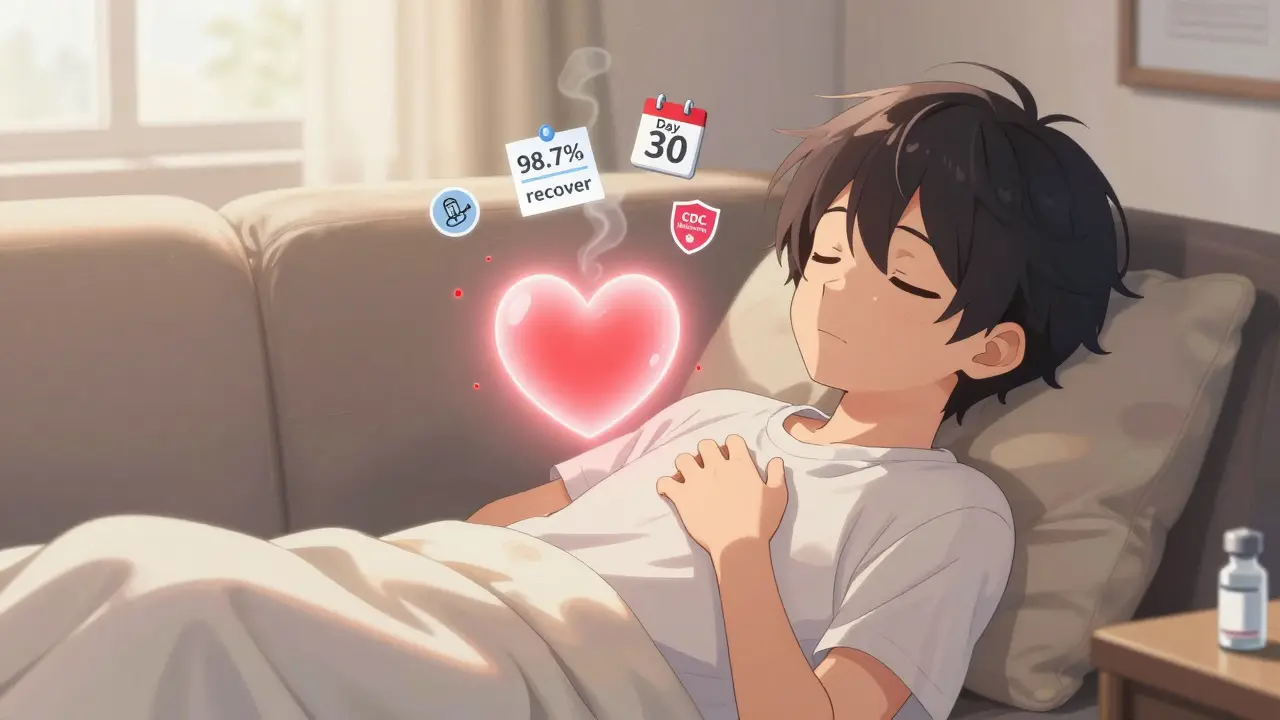
How Do We Monitor Safety After Approval?
The FDA doesn’t stop watching once a drug is approved. In fact, that’s when the real monitoring begins. The CDC’s v-safe program uses text messages and online surveys to check in with over 6 million people after vaccination. Eighty-seven percent completed at least seven days of follow-up. That’s unprecedented. You get asked: “How are you feeling?” “Any new symptoms?” “Did you go to the doctor?” Then there’s VAERS-the Vaccine Adverse Event Reporting System. Anyone can report here: patients, doctors, pharmacists. Through September 2025, over 1.2 million reports were filed for mRNA vaccines. That sounds scary-until you realize it’s 0.42% of 297 million doses given. Most reports are for minor things: headache, fever, arm pain. Only 6.2% were classified as serious. But here’s the catch: VAERS doesn’t prove causation. A person gets a headache after a shot? It gets reported. But headaches happen all the time. The system flags patterns-not individual cases. That’s why experts use tools like BCPNN (Bayesian Confidence Propagation Neural Network) to spot signals. If a rare event shows up more often than expected, they investigate. The FDA’s Sentinel Initiative scans health records from 300 million Americans. It looks for spikes in hospital visits, ER trips, or diagnoses linked to mRNA products. It found no increase in autoimmune diseases, neurological disorders, or cancer rates after vaccination.Why Diversity in Trials Still Matters
Early mRNA trials were mostly white, middle-aged, and healthy. That’s a problem. Only 9.8% of participants in pre-approval studies were Hispanic. Only 3.2% were Black. That’s not representative of the U.S. population. And it’s not good enough for global use. We now know side effects can vary by genetics, body weight, and underlying health conditions. For example, people with obesity or diabetes may respond differently to lipid nanoparticles. Older adults may have fewer systemic reactions but more fatigue. We’re still learning. Regulators now require post-approval studies to include more diverse populations. The EMA requires pregnancy registries tracking over 5,000 women exposed to mRNA vaccines. So far, no increased risk of birth defects has been found.
Comments (11)
Harry Henderson
January 27, 2026 AT 20:09
mRNA is the future and anyone who still fears it is living in 2019. We’ve got five years of data now and the only thing that’s grown is the evidence that this tech saves lives. Stop listening to TikTok doctors and start reading real studies.
suhail ahmed
January 29, 2026 AT 20:00
Man, this is the kind of science that makes me proud to be alive in this era. mRNA isn’t just a vaccine-it’s a whole new language of medicine. Imagine coding your body to fight cancer like it’s a software update. We’re not just curing diseases anymore, we’re rewriting biology. The future is here, and it’s not scary-it’s beautiful.
Anjula Jyala
January 30, 2026 AT 15:40
The data shows myocarditis risk is 40 per million in young males but the media turns it into a pandemic. Meanwhile actual COVID myocarditis is 600 per million. You want real danger look at anti-vaxxer blogs not peer reviewed journals. Also menstrual changes are not side effects they are immune modulation. Stop pathologizing normal biology.
Kirstin Santiago
January 31, 2026 AT 14:50
I’ve had both shots and honestly the worst part was the sore arm for a day. My mom got hers and she was fine. The lymph node thing freaked me out at first but my doctor said it’s totally normal. It’s wild how much we’ve learned since 2020. We’re not just guessing anymore.
Kathy McDaniel
February 1, 2026 AT 21:24
so i got my booster last month and my period was a week late but then it came and it was normal? idk if it was the shot or stress or both but like… i’m not worried anymore? everyone’s so scared of tiny things but the science says its fine??
Patrick Merrell
February 2, 2026 AT 22:48
They say 98.7% recover from myocarditis but what about the 1.3%? What if that’s your kid? You think statistics matter when you’re burying your child? This isn’t math-it’s human lives. And who authorized this experiment on the public?
Conor Flannelly
February 4, 2026 AT 08:24
There’s a deeper truth here: we’ve built a medical system that reacts faster than ever before. The old model waited decades to catch side effects. Now we catch them in real time. That’s not a flaw-it’s evolution. The fear isn’t about the science. It’s about losing control. But control was an illusion anyway. We’ve always been trusting strangers with our bodies. Now we just know more.
Conor Murphy
February 4, 2026 AT 13:04
I work in ER and I’ve seen both sides. People who got COVID and ended up on a ventilator. People who got the shot and had a sore arm for two days. The ones who are scared? They’re not evil. They’re just scared. But we owe it to them to show them the data without yelling. This isn’t a battle. It’s a conversation we’re finally learning how to have.
Desaundrea Morton-Pusey
February 5, 2026 AT 05:06
Oh so now it’s ‘manageable risks’? You know what’s manageable? The billions Big Pharma made off this. You think they care about your lymph nodes? They care about quarterly earnings. This isn’t science-it’s a cash grab wrapped in a lab coat.
Murphy Game
February 5, 2026 AT 23:57
They said the same thing about thalidomide. They said the same thing about the flu shot in 2009. They said the same thing about the swine flu. Now they’re saying it about mRNA. Who’s keeping the records? Who’s watching the watchers? The system is rigged. The data is curated. The truth is buried under 1.2 million VAERS reports and a thousand corporate PR teams.
Kegan Powell
February 7, 2026 AT 17:22
Look I used to be scared too. But I read the papers. I talked to my doctor. I saw my neighbor who had COVID and lost her sense of smell for a year. And I saw my cousin who got the shot and went hiking the next day. We’re not perfect. But we’re trying. And the fact that we can track this in real time? That’s the win. We’re not flying blind anymore. We’re learning as we go. And that’s how progress happens.