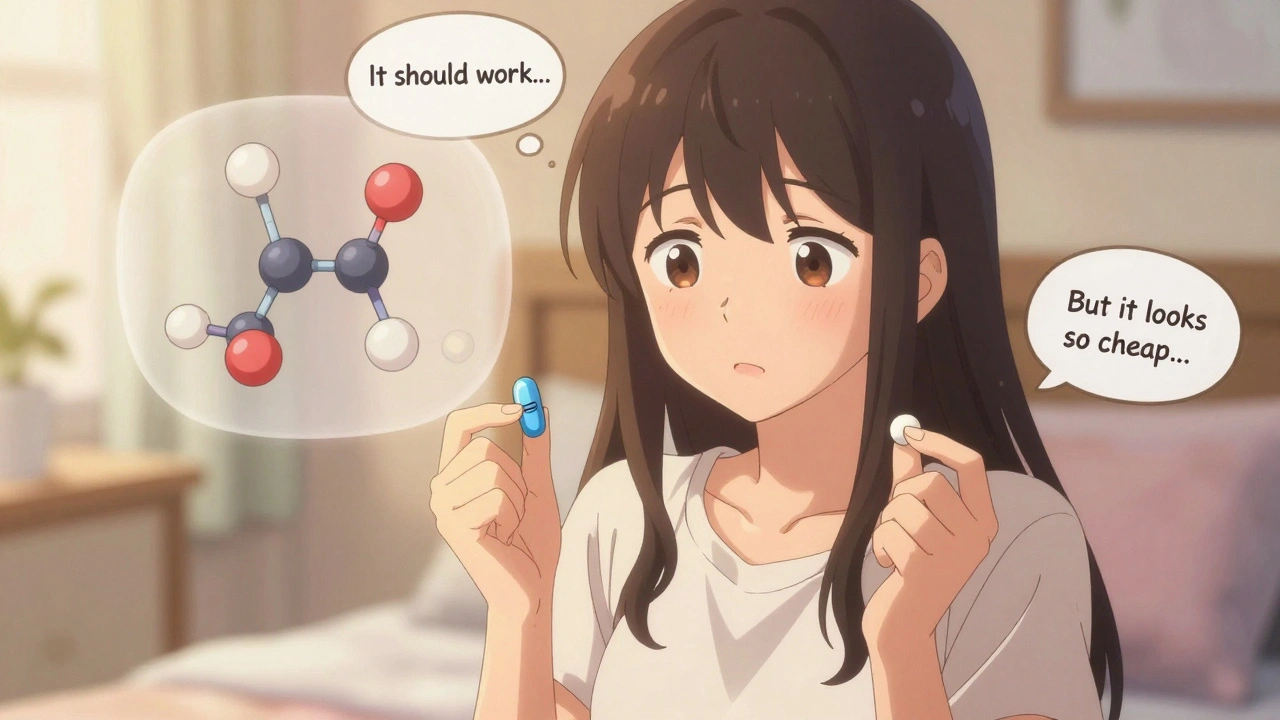
You’ve been on the same medication for years. Your doctor switches you to a generic version. You take it. A week later, you feel different. Maybe your headaches come back. Maybe your anxiety spikes. You think: generic drugs don’t work like the brand name. You’re not alone. Millions of people feel this way. But here’s the truth: the generic pill in your hand has the exact same active ingredient, at the exact same strength, as the expensive brand-name version. So why does it feel like it’s not working?
The Science Says They’re the Same
The U.S. Food and Drug Administration (FDA) doesn’t approve a generic drug unless it matches the brand-name version in every meaningful way. Same active ingredient. Same dose. Same way it’s taken - pill, liquid, injection. Same intended use. The only differences are in the inactive ingredients: the color, the shape, the filler. These don’t affect how the medicine works in your body. To get approved, generics must prove they’re bioequivalent. That means when you take it, your bloodstream absorbs the medicine at the same rate and to the same level as the brand name - within a 20% margin. That’s not a loophole. That’s science. Studies with 24 to 36 healthy volunteers show this over and over. The FDA’s standard was set in 1984 under the Hatch-Waxman Act, and it’s been proven reliable for nearly 40 years. For 90% of all prescriptions filled in the U.S., generics work just as well. Even for tricky drugs like warfarin (a blood thinner) or levothyroxine (for thyroid issues), where small changes can matter, the FDA applies extra scrutiny. And still, major medical groups like the American College of Clinical Pharmacy say there’s no meaningful difference in outcomes between brand and generic versions.So Why Do People Think They Don’t Work?
It’s not about chemistry. It’s about psychology. Think about this: you’ve been taking a blue pill with a big, familiar logo on it for years. You trust that logo. You associate it with relief. Then, you get a small, white pill with no name on it - same active ingredient, same effect - but it looks completely different. Your brain doesn’t process it as the same thing. It looks cheaper. It feels unfamiliar. And suddenly, your body starts to react - not because the drug changed, but because your expectation changed. This is called the nocebo effect. It’s the opposite of placebo. Placebo makes you feel better because you believe it will. Nocebo makes you feel worse because you believe it won’t. A 2023 study in JAMA Network Open showed patients told generics were "just as effective" had 34% better adherence. Those told they were "less effective" had 41% worse outcomes. The drug didn’t change. Their belief did. Pharmacists report patients refusing generics even after years of stable health. One pharmacist on Reddit shared a case: a woman stopped her levothyroxine after switching to generic, convinced it "didn’t work." Her blood tests showed identical hormone levels. She just didn’t feel the same - because she expected to feel different.Who Believes This - And Why?
This isn’t just random suspicion. It’s tied to deeper social and economic beliefs. In the U.S., non-Caucasian patients are significantly more likely to doubt generics. One 2015 study found 43% of non-white patients were skeptical about clinical equivalence, compared to 29% of white patients. In rural areas like Alabama’s Black Belt, people openly say generics are "for poor people," "not real medicine," or "weaker." These aren’t medical facts. They’re cultural stories - passed down, reinforced by price tags, packaging, and silent assumptions about who gets "good" medicine and who gets "cheap" medicine. Even doctors aren’t immune. Surveys show 11% of physicians believe generics are less effective, and 27% think they cause more side effects. That matters. If your doctor hesitates before prescribing a generic, you pick up on it. You start to wonder too.
The Cost of Misunderstanding
The financial impact is huge. Generics cost 80-85% less than brand-name drugs. From 2009 to 2019, they saved the U.S. healthcare system $1.7 trillion. But if people stop taking their meds because they think the generic doesn’t work, those savings vanish - and health problems grow. A 2019 study found 22% of patients who believed generics were inferior stopped taking them early. Only 8% of those with neutral views did. That’s a huge gap. People with high blood pressure, diabetes, depression - they stop treatment. Their conditions worsen. They end up in the ER. Hospital bills climb. The system pays more. Everyone loses. And it’s not just individuals. Brand-name companies spend billions every year on marketing that subtly undermines generics. Ads that say "the original," "the trusted choice," or "clinically proven for over 20 years” - all true, but designed to make you think the generic is the knockoff. They never say generics are unsafe. They don’t have to. They just make you feel like you’re settling.What Actually Works - And What Doesn’t
Simply handing someone a generic pill with a note saying "it’s the same" doesn’t work. People don’t trust paperwork. They trust people. The most effective way to change minds? Direct, clear conversation from a trusted provider. A 2022 meta-analysis found that showing patients the exact same active ingredient on both the brand and generic labels improved acceptance by 87%. Showing FDA documentation helped 76%. Talking about the nocebo effect - "sometimes, when you expect a medicine to feel different, your body reacts even if the drug hasn’t changed" - helped 68%. The FDA’s "It’s the Same Medicine" campaign reached 27 million people since 2019. But only 19% remembered it. Why? Because it was too dry. Too official. Too far removed from real lives. What works better? A nurse saying, "This is the exact same medicine your doctor prescribed, just without the fancy packaging. I’ve had patients switch for years - their numbers stay stable. You’re not losing anything. You’re saving money, and keeping your health the same."
What You Can Do
If you’ve been told to switch to a generic:- Ask your pharmacist: "What’s the active ingredient? Is it the same as my old pill?" They’ll show you the label. It’s the same.
- Check your bloodwork. If you’re on thyroid, blood pressure, or seizure meds, ask for a follow-up test. Numbers don’t lie.
- Don’t assume a change in how you feel is the drug’s fault. Stress, sleep, diet, even the season can shift how you feel. Give it two weeks.
- If you still feel off, talk to your doctor - but don’t assume the generic is broken. Ask: "Could this be my mind reacting to the change?"
The Bigger Picture
Generics aren’t a compromise. They’re a victory. They make life-saving medicine affordable for millions. They keep people out of hospitals. They let families pay rent instead of co-pays. But science alone won’t fix this. You can’t out-data a deep-seated belief. Real change comes from trust. From clear, human conversations. From providers who don’t just prescribe - they explain. The pill in your hand is not weaker. It’s not fake. It’s not charity. It’s medicine - the same medicine, at a fraction of the cost. The only thing different is what you believe.Frequently Asked Questions
Are generic drugs really the same as brand-name drugs?
Yes. By law, generic drugs must contain the exact same active ingredient, strength, dosage form, and route of administration as the brand-name version. The U.S. FDA requires them to prove they work the same way in your body - within a scientifically accepted range. The only differences are in color, shape, or inactive fillers - none of which affect how the medicine works.
Why do I feel different after switching to a generic?
It’s likely not the drug. The change in how you feel often comes from the nocebo effect - your brain expecting something to be different because the pill looks unfamiliar or cheaper. Stress, sleep, diet, or even seasonal changes can also affect how you feel. Give it a couple of weeks. If symptoms persist, talk to your doctor - but don’t assume the generic is the problem. Your bloodwork will tell you the truth.
Are generics made in worse facilities?
No. All generic drug manufacturers - whether in the U.S., India, or elsewhere - must meet the same FDA standards for safety and quality. All facilities are inspected under the same Current Good Manufacturing Practices (cGMP). While some foreign plants have had more inspection notes, that doesn’t mean their final products are unsafe. The FDA tests finished products from all sources, and there’s no evidence that generics from approved facilities are less effective.
Can generics cause more side effects?
Not because they’re generics. Side effects come from the active ingredient - and that’s identical. If you notice new side effects after switching, it could be due to changes in inactive ingredients (like dyes or fillers), which are rare but possible. If this happens, talk to your doctor. But don’t assume it’s because it’s a generic. Most people report no difference at all.
Why do some doctors hesitate to prescribe generics?
Some doctors have outdated beliefs or have heard isolated patient stories. Others are influenced by marketing from brand-name companies. But studies show that when doctors explain the equivalence clearly - showing the same active ingredient - patients are far more likely to accept generics. Many medical associations now require training on this topic to reduce bias.
Comments (9)
Lisa Stringfellow
December 11, 2025 AT 00:51
So let me get this straight - you’re telling me my body’s just being dramatic because the pill looks different? That’s rich. I’ve been on generics for years and I swear they don’t work the same. My anxiety spikes, my sleep’s trash, and my doctor just shrugs like it’s all in my head. Maybe it is - but my body doesn’t care about FDA reports. It just knows something’s off.
And don’t give me that ‘it’s the same active ingredient’ nonsense. If it was truly identical, why does the brand-name version make me feel like a human again and the generic make me feel like a zombie on a Tuesday? You can’t just wave a scientific study and expect me to ignore how I actually feel.
I’m not paranoid. I’m just tired of being told my experience doesn’t count because it doesn’t fit your narrative.
Aman deep
December 12, 2025 AT 03:33
hey lisa… i feel you. i come from india where generics are everywhere - and honestly? sometimes they do feel different. not because they’re bad, but because the fillers? they’re wild. one batch makes me drowsy, next batch gives me heartburn. it’s not placebo - it’s the little things. the dye, the coating, the binders - they ain’t regulated like the active stuff.
but here’s the thing - your body remembers the brand. the shape, the taste, the ritual of taking it. that’s part of the healing. so if switching feels like losing a friend? that’s real too. maybe we need generics that mimic the brand’s look and feel… not just the chemistry.
ps: sorry for typos - typing on my phone with one thumb while my kid screams for snacks 😅
Sylvia Frenzel
December 13, 2025 AT 17:57
Let me be clear: this whole generic debate is a government-funded scam to push down healthcare costs at the expense of patient outcomes. The FDA is not some infallible oracle - they’re a bureaucratic machine under pressure from Big Pharma to approve anything that looks close enough. And now they’re gaslighting millions of Americans into thinking their suffering is imaginary.
Why do you think every country outside the U.S. has higher generic approval standards? Because they know this isn’t science - it’s economics disguised as medicine. You think your bloodwork is ‘the truth’? Maybe. But your symptoms are the truth too. And no spreadsheet will ever replace a person’s lived experience.
Rebecca Dong
December 14, 2025 AT 02:48
Okay but what if the generics are secretly being manufactured in a basement in China with contaminated fillers? I mean, the FDA doesn’t even inspect every single plant - they just take the manufacturer’s word for it. And don’t get me started on the fact that the same company that makes the brand-name drug also makes the generic version - they just slap a different label on it.
And why do you think the packaging is so different? To make you feel like you’re getting second-rate medicine. It’s psychological warfare. They want you to doubt yourself. They want you to think you’re crazy for noticing a difference.
Also - I saw a TikTok where a guy switched to generic Adderall and ended up in the ER. The comments were full of people saying ‘it’s all in your head’ - but what if it’s not? What if they’re poisoning us and calling it ‘bioequivalent’?
Sarah Clifford
December 16, 2025 AT 02:07
bruh i switched to generic omeprazole and my heartburn came back like a horror movie. i thought it was stress. then i switched back to the brand and boom - peace. no magic. just the pill. same active ingredient? sure. but my stomach didn’t get the memo.
also the generic looked like a baby’s teething ring. i didn’t trust it. period.
stop telling people they’re imagining things. it’s not all in your head - sometimes it’s just in the coating.
Regan Mears
December 17, 2025 AT 14:47
There’s a lot of truth here - and a lot of emotion. The science is solid: generics are bioequivalent. But science doesn’t live in a vacuum. People aren’t test tubes. Their expectations, their past experiences, their cultural context - all of it matters.
I’ve been a pharmacist for 18 years. I’ve seen patients cry because they felt like the generic was ‘cheating’ them. I’ve seen people stop meds because they believed they were inferior - and then end up in the hospital. That’s not just bad health - that’s a failure of communication.
So yes, the pill is the same. But the meaning behind it? That’s different. And if we want people to take their meds, we have to meet them where they are - not where the data says they should be.
Ben Greening
December 17, 2025 AT 23:13
Interesting post. The nocebo effect is well-documented in clinical literature, and the data on bioequivalence is robust. That said, variability in inactive ingredients can occasionally lead to differences in absorption kinetics, particularly with narrow therapeutic index drugs. While the FDA’s 80–125% range is statistically valid, individual pharmacokinetic profiles vary. A small subset of patients may genuinely experience suboptimal outcomes - not due to belief, but due to metabolic differences.
It’s not an either/or situation. Science and subjectivity can coexist.
Nikki Smellie
December 18, 2025 AT 02:14
Did you know that the FDA’s bioequivalence standard was written by lobbyists from Pfizer in 1984? And that the same companies that make brand-name drugs also own the generic factories? 🤔
And what about the 2018 outbreak of contaminated valsartan? All generic. All FDA-approved. But the FDA didn’t recall them until 14 months later - after 200 people had heart attacks.
And now you want me to believe that my body’s ‘just reacting to the packaging’? I’ve seen the documents. The fillers in generics are often industrial-grade. The same ones used in paint and glue. And you think that’s safe? 😳
They’re not just selling pills. They’re selling trust. And we’re being lied to.
PS: I’ve been researching this for 7 years. I’m not paranoid. I’m informed.
Stephanie Maillet
December 18, 2025 AT 06:38
There’s a deeper layer here - one that the post almost touches on but doesn’t fully explore: the erosion of trust in institutions. When people are told, over and over, that their pain is ‘all in their head,’ they don’t just stop believing the drug - they stop believing the system.
Generics aren’t the problem. The problem is the way we’ve turned medicine into a transaction - where cost efficiency overrides human experience. We treat patients like data points, not people.
Maybe the real solution isn’t more FDA pamphlets. Maybe it’s rebuilding the relationship between caregiver and patient - where a nurse sits down, holds your hand, and says, ‘I see you. I believe you. Let’s figure this out together.’
Science gives us the ‘what.’ But only compassion gives us the ‘why.’