When you pick up a generic prescription at the pharmacy, you might think the price is simple: cheaper than the brand, right? But behind that low copay is a tangled web of federal laws, state regulations, and corporate contracts that determine exactly how much the pharmacy gets paid-and whether they can even afford to fill your prescription. In the U.S., generic drugs make up 90% of all prescriptions but only 23% of total drug spending. That’s the promise: more pills, less cost. But the system that’s supposed to deliver on that promise is full of hidden costs, legal loopholes, and financial pressures that hit pharmacies-and patients-hard.
How Generic Drugs Got Their Reimbursement Rules
The foundation of today’s generic drug system wasn’t built by pharmacists or insurers. It was written into law in 1984 with the Hatch-Waxman Act. This law created a fast-track approval path for generic drugs called the ANDA (Abbreviated New Drug Application). It let companies copy brand-name drugs without repeating expensive clinical trials, as long as they proved bioequivalence. In return, it gave brand-name makers extended patent protection to balance the scales. The goal? Lower prices through competition. And it worked. Today, over 84% of Medicare Part D prescriptions are for generics. But here’s the catch: the law didn’t fix how pharmacies get paid. That was left to insurers, pharmacy benefit managers (PBMs), and state Medicaid programs. And that’s where things got messy.Two Ways Pharmacies Get Paid for Generics
There are two main reimbursement models for generic drugs: Average Wholesale Price (AWP) and Maximum Allowable Cost (MAC). AWP used to be the standard-it’s a list price set by manufacturers, often inflated, and pharmacies got paid a percentage off that number. But AWP doesn’t reflect what pharmacies actually pay. So states and Medicare shifted to MAC. MAC programs set a fixed payment cap for each generic drug based on what pharmacies actually pay to buy it. If the pharmacy buys a pill for $0.30, and the MAC is $0.35, they get $0.35. If they bought it for $0.40? They eat the $0.05 loss. It sounds fair, but MAC lists are updated infrequently. A drug might drop in price overnight, but the MAC stays the same for weeks. Pharmacies get stuck paying more than they’re reimbursed. And then there’s the brand-to-generic switch. If a doctor writes a brand-name prescription but the pharmacy dispenses the generic (which is legal under substitution laws), the pharmacy still gets paid the MAC rate for the generic-even if the patient’s insurance would’ve covered the brand at a higher rate. That means pharmacies lose money on the difference. Some states require pharmacists to substitute unless the doctor says "do not substitute." Others leave it up to the pharmacist. The rules vary by state, and the financial impact doesn’t.Who Controls the Money: PBMs and Their Hidden Fees
Behind every prescription claim is a pharmacy benefit manager (PBM). CVS Caremark, Express Scripts, and OptumRX control over 80% of U.S. prescription claims. PBMs don’t just process claims-they negotiate rebates with drugmakers, set formularies, and decide which drugs get covered and at what cost. Their revenue comes from three places: rebates from manufacturers, spread pricing, and fees from insurers. Spread pricing is the most controversial. It’s the difference between what the insurer pays the PBM and what the PBM pays the pharmacy. For example: the insurer pays the PBM $10 for a generic. The PBM pays the pharmacy $6. The $4 difference? That’s the PBM’s profit. And it’s not disclosed to the pharmacy or the patient. In 2023, the average reimbursement margin for independent pharmacies on generic drugs was just 1.4%. In 2018, it was 3.2%. That’s not just a drop-it’s a squeeze. Many small pharmacies are losing money on every generic they fill. They’re forced to make up the difference by selling more over-the-counter products or cutting staff hours.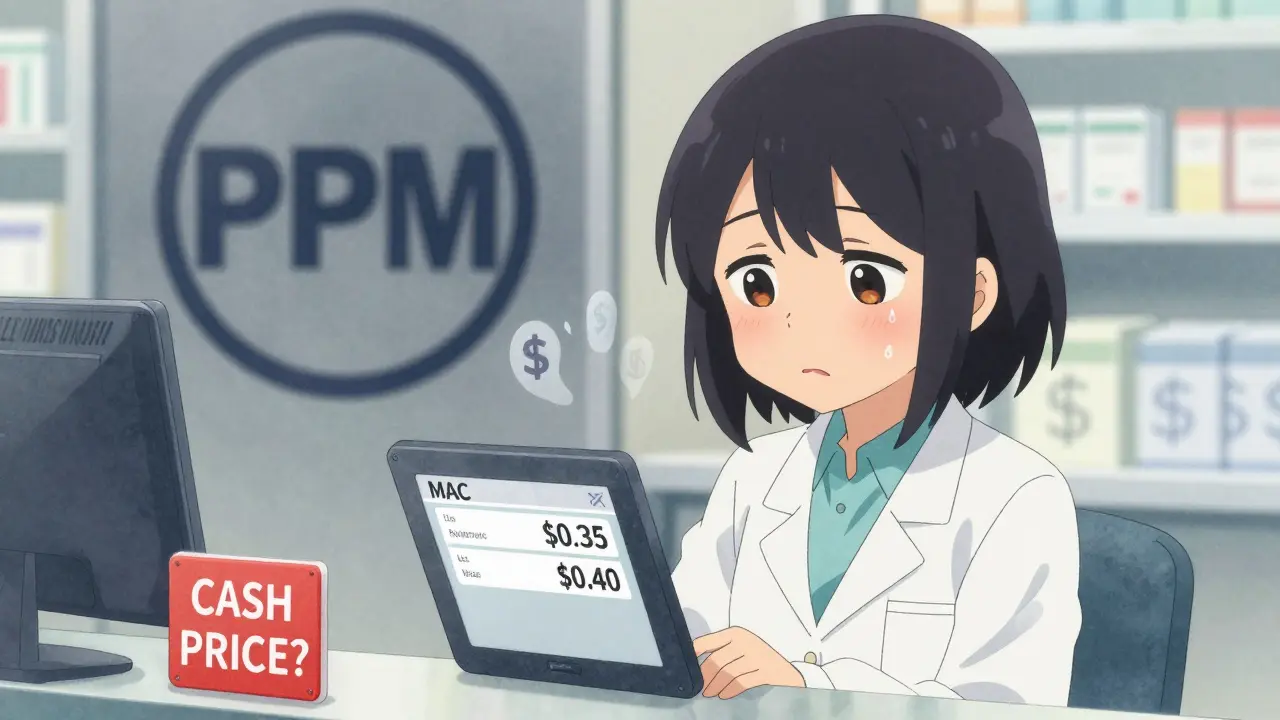
State Laws Trying to Fix the System
Forty-four states have passed laws to regulate PBMs and protect pharmacies. Some require PBMs to pay pharmacies at least the actual acquisition cost of the drug. Others ban gag clauses-those were the rules that prevented pharmacists from telling patients, “This drug is cheaper if you pay cash.” Before 2018, pharmacists couldn’t say a word. Now, in most states, they can. But enforcement is weak. Many patients still don’t know they could save $10 or $20 by paying out of pocket. States also use Preferred Drug Lists (PDLs) to steer Medicaid patients toward cheaper generics. If a drug isn’t on the list, the pharmacy might get paid less-or not at all. Prior authorization is another hurdle. In 2022, 28% of Medicare Part D plans required prior authorization for at least one generic drug. That means the pharmacist has to call the doctor, wait for approval, and hope the patient doesn’t walk away frustrated.The Medicare $2 Drug List: A New Experiment
In 2025, the Centers for Medicare & Medicaid Services (CMS) is testing a bold new model: the Medicare $2 Drug List. It’s simple: for about 100 to 150 low-cost, high-use generic drugs, Medicare Part D plans will cap the patient copay at $2. No deductible. No tiering. Just $2. The drugs on the list aren’t chosen randomly. They’re selected based on clinical guidelines, how often they’re prescribed to Medicare patients, and whether multiple manufacturers make them (to avoid supply issues). Think metformin, lisinopril, atorvastatin-drugs millions of seniors take daily. This isn’t charity. It’s economics. By making generics predictable and affordable, CMS hopes to improve adherence. Patients who skip pills because they can’t afford them end up in the ER. That costs far more than $2. Early data from grocery chains like Kroger and Walmart-where generics have been $4 or less for years-show higher refill rates and better health outcomes. If it works, this model could expand. And it might finally align reimbursement with real-world cost.
What’s Next for Generic Reimbursement?
The Inflation Reduction Act of 2022 capped insulin at $35 a month and will cap total out-of-pocket drug costs for Medicare beneficiaries at $2,000 in 2025. That’s huge. But it doesn’t fix the underlying reimbursement structure. PBMs still control pricing. MAC lists still lag behind market prices. Independent pharmacies still operate on razor-thin margins. And authorized generics-where brand-name companies release their own generic version to block competitors-are still used to delay real competition. The next big shift might be value-based payment. Instead of paying per pill, insurers could pay based on health outcomes. But that’s years away. In the meantime, pharmacies are stuck between laws that demand generic substitution and reimbursement models that don’t pay enough to make it sustainable.What This Means for Patients
You might think lower drug prices mean you’re saving money. But if your pharmacy can’t afford to fill your prescription, you’re not getting it at all. Or worse-you’re paying more than you should because the system hides the real cost. Always ask your pharmacist: “Can I pay cash instead?” Even if you have insurance, the cash price might be lower than your copay. That’s legal now. And if your copay for a generic is over $10, ask why. Is it on the Medicare $2 list? Is it being held up by prior authorization? Is your PBM making a profit off your prescription? Generic drugs are one of the most effective tools we have to control healthcare costs. But if the system that pays for them doesn’t work, the promise of affordable medicine stays unfulfilled.Why do pharmacies sometimes lose money on generic drugs?
Pharmacies lose money on generics when the reimbursement rate-set by PBMs or Medicaid-is lower than what they paid to buy the drug. This often happens under Maximum Allowable Cost (MAC) programs, where the payment cap doesn’t reflect current market prices. If a pharmacy buys a generic for $0.40 but is only reimbursed $0.35, they absorb the $0.05 loss. Spread pricing by PBMs also reduces what pharmacies receive, squeezing margins even further.
What is the difference between AWP and MAC reimbursement?
Average Wholesale Price (AWP) is a list price set by drug manufacturers, often inflated, and pharmacies were historically paid a percentage off it. Maximum Allowable Cost (MAC) is a fixed payment cap based on the actual cost pharmacies pay to buy generic drugs. MAC is more accurate and cost-effective, but it’s updated less frequently, leaving pharmacies vulnerable to price spikes. MAC is now the standard for Medicare Part D and Medicaid, while AWP is largely outdated.
Can pharmacists tell me if a drug is cheaper without insurance?
Yes. Since 2018, federal law banned "gag clauses" that prevented pharmacists from informing patients about lower cash prices. Pharmacists can now legally tell you if paying out of pocket would cost less than your insurance copay. Always ask-it could save you $5 to $20 per prescription.
How do state substitution laws affect generic payments?
State substitution laws require or allow pharmacists to swap a brand-name drug for a generic unless the doctor says "do not substitute." While this lowers costs for insurers, it can hurt pharmacies financially. If the insurer reimburses based on the brand’s higher price but the pharmacy dispenses the cheaper generic, they’re still paid the lower generic rate. This creates a reimbursement gap that pharmacies absorb.
What is the Medicare $2 Drug List and how does it work?
The Medicare $2 Drug List is a voluntary CMS model launched in 2025 that caps patient copays at $2 for about 100 to 150 widely used, low-cost generic drugs. Drugs are selected based on clinical importance, frequency of use among Medicare beneficiaries, and availability from multiple manufacturers. Part D plans that join the model must offer this flat rate regardless of the patient’s deductible or tier. Early results from retail pharmacies show improved adherence and lower overall costs.
Why are generic drug margins shrinking?
Generic drug margins have dropped from 3.2% in 2018 to just 1.4% in 2023 due to intense price competition, delayed MAC updates, PBM spread pricing, and pressure from large retailers offering ultra-low cash prices. Independent pharmacies, which lack buying power and rebate deals, are hit hardest. Many now rely on volume and non-prescription sales to survive.
Comments (13)
Gerald Tardif
December 27, 2025 AT 07:09
It’s wild how a system meant to save money ends up starving the people who actually hand you the pills. I’ve seen local pharmacies cut hours, fire staff, even shut down-all because they’re getting paid less to fill a $0.12 pill than they pay for the bottle.
And yet, no one talks about it. We just assume generics are cheap. But someone’s paying the price. And it’s not the big PBMs.
Nicola George
December 27, 2025 AT 13:24
So let me get this straight-you’re telling me pharmacists can’t even tell you if paying cash is cheaper… until 2018? And now we act like that’s progress?
lol. The system is designed to keep you confused. They want you to think insurance = savings. Nah. It’s just a tax on ignorance.
Elizabeth Ganak
December 29, 2025 AT 02:35
i just asked my pharmacist last week if i could pay cash for my metformin and she said $4. my copay was $12. she smiled and said ‘welcome to america’
we’re all just trying to survive this mess.
dean du plessis
December 29, 2025 AT 17:31
the $2 list sounds like a good start but i wonder how long it’ll last once the drugmakers figure out how to game it. they always do.
maybe we need to just nationalize drug pricing. not joking.
Raushan Richardson
December 29, 2025 AT 22:54
my grandma takes 8 generics. she’s on the $2 list for 5 of them. she cries every time she gets her prescription because she’s so relieved. but the pharmacy she goes to? They’re about to close. It’s heartbreaking.
we need to fix this before more small pharmacies disappear. they’re not just businesses-they’re community lifelines.
Anna Weitz
December 30, 2025 AT 00:39
the real problem isn’t MAC or AWP or even PBMs
it’s that we let corporations write healthcare laws
the Hatch Waxman Act was never about patients
it was about letting pharma lock in profits under the guise of competition
we’re all just collateral damage in a game they designed to never lose
Alex Lopez
December 30, 2025 AT 23:35
Let me be perfectly clear: the notion that generic drug reimbursement is a ‘market-driven’ system is a fantasy constructed by lobbyists and reinforced by regulatory capture. The Average Wholesale Price was never a price-it was a fiction. The Maximum Allowable Cost is a bureaucratic farce when updated quarterly while market prices shift daily. PBMs are not intermediaries-they are rent-seekers. And the $2 Drug List? A Band-Aid on a hemorrhage. Until we abolish spread pricing entirely, mandate real-time MAC updates, and force transparency in rebate structures, we are merely rearranging deck chairs on the Titanic. The pharmacy is not failing. The system is.
Kylie Robson
January 1, 2026 AT 08:13
you’re all missing the structural arbitrage
MAC is a cost-based reimbursement model but PBMs aggregate data across millions of claims and use proprietary algorithms to set ceilings below the true acquisition cost
they leverage economies of scale and volume-based rebate capture to extract surplus value
the 1.4% margin isn’t a coincidence-it’s a feature
in economic terms, this is a classic case of monopsony power in a vertically integrated supply chain
and no, the $2 list doesn’t fix the incentive misalignment
it just shifts the burden to the payer without altering the underlying rent extraction mechanism
Elizabeth Alvarez
January 2, 2026 AT 14:38
Have you ever wondered why the same generic drug costs $0.05 in India but $0.40 here?
It’s not because of manufacturing. It’s because the FDA and PBMs are in cahoots with Big Pharma to keep prices high.
They don’t want you to know that the same pill, made in the same factory, is sold for pennies overseas.
And the $2 list? That’s just a trap. Once you get used to paying $2, they’ll raise it to $3. Then $5. Then they’ll say ‘it’s inflation.’
They’re controlling the narrative. They’re controlling the supply. They’re controlling your life.
Ask yourself-why do only 100 drugs qualify for $2? Why not 1,000?
Because if they made them all cheap, the whole house of cards would collapse.
They need you to think you’re getting a deal. But you’re just being slowly bled dry.
Miriam Piro
January 3, 2026 AT 21:30
the $2 list is a distraction
they’re giving you one hand while they take the other
you think you’re winning because your metformin is $2
but your insurance premium just went up $50 a month
and your pharmacy is closing
and your neighbor can’t afford her blood pressure med because the MAC hasn’t been updated since 2021
they’re not fixing the system
they’re just making you feel better about it
and don’t even get me started on the fact that the same companies that run PBMs also own pharmacies
they’re playing 4D chess and we’re pawns in a game we didn’t even know we were in 😔
Monika Naumann
January 5, 2026 AT 13:10
It is an outrage that American pharmaceutical policy allows such exploitation of the public. In my country, medicine is a human right, not a commodity. The fact that pharmacies are forced to operate at a loss while corporate executives profit from patient suffering is a moral failure of the highest order. The U.S. healthcare system is not broken-it was designed this way. To serve shareholders, not citizens. Shame on you all for accepting this.
Jane Lucas
January 6, 2026 AT 03:37
just asked my pharmacist if i could pay cash for my lisinopril
she said $3
my copay was $14
i paid cash
she said ‘you’re smart’
i said ‘no i’m just tired of being played’
she nodded and gave me a lollipop
we’re all just trying to get by
dean du plessis
January 6, 2026 AT 20:42
that lollipop story got me
small acts of kindness in a broken system
keep asking the questions
and keep paying cash
it’s the only power we’ve got left