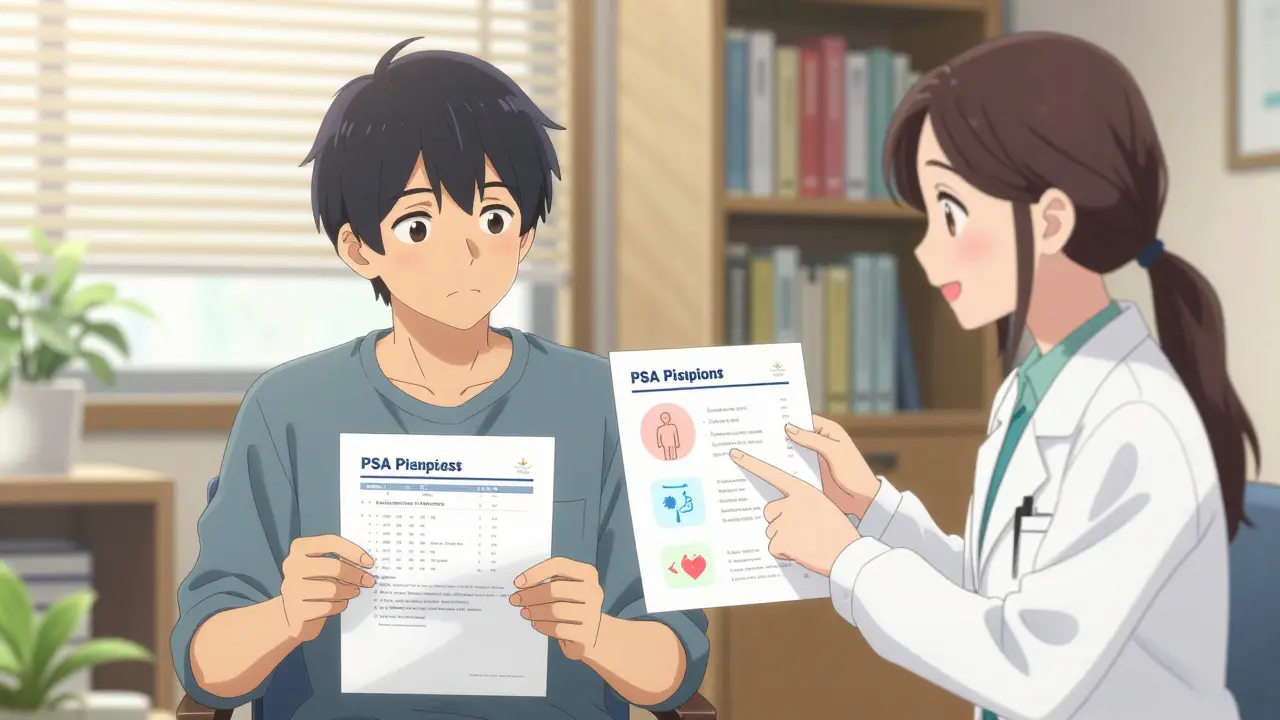
PSA Screening Isn’t Simple - Here’s Why
You get your annual checkup. Your doctor says, "You should get a PSA test." You nod, not really knowing what it means. You’ve heard it’s for prostate cancer. Maybe you’ve heard it’s controversial. But you don’t know why. And that’s the problem.
The PSA test measures a protein in your blood called prostate-specific antigen. It sounds straightforward. But here’s the truth: PSA screening doesn’t tell you if you have cancer - it tells you something might be off. And that’s where things get messy.
For every 1,000 men aged 55 to 69 who get screened every year for a decade, about 1 to 2 prostate cancer deaths might be prevented. Sounds good, right? But here’s what else happens: 100 to 120 men will get false positives, leading to unnecessary biopsies. About 80 to 100 men will be diagnosed with a cancer that would never have harmed them. They’ll get surgery or radiation. And many will end up with side effects they didn’t sign up for - urinary incontinence, erectile dysfunction, anxiety that lasts for years.
Why Do Experts Disagree So Much?
The science is split. The European study found PSA screening cuts prostate cancer deaths by about 21%. The U.S. study? No real benefit. Both were huge - over half a million men followed for more than 10 years. So why the difference? One reason: screening practices varied. In Europe, men were screened more consistently. In the U.S., many in the control group ended up getting tested anyway.
In 2012, the U.S. Preventive Services Task Force (USPSTF) said: don’t screen. Too many harms, not enough benefit. That sent shockwaves through clinics. Screening rates dropped. But then, something unexpected happened. Between 2004 and 2013, metastatic prostate cancer - the kind that’s already spread - jumped by 37%. That’s the kind of cancer that’s hard to treat and often deadly.
By 2018, the USPSTF changed its mind. Now they say: men 55 to 69 should talk to their doctor before deciding. Not because screening is clearly good. But because it might help some - and hurting others is avoidable if you know the risks.
What’s Really Going Wrong With PSA?
The PSA test is like a smoke alarm. It goes off when there’s smoke - but smoke doesn’t always mean fire. About 75% of men with a PSA between 4.0 and 10.0 ng/mL don’t have cancer. Their levels rise because of something harmless: an enlarged prostate (which affects 90% of men by 85), an infection, even biking hard the day before.
And here’s the flip side: 15% of men with aggressive prostate cancer have PSA levels under 4.0. That means the test misses some of the worst cases. It’s not reliable on its own. That’s why doctors now look at other things: how fast PSA changes over time (velocity), how big the prostate is (density), and age-adjusted ranges. A 4.5 ng/mL PSA might be normal for a 65-year-old but worrying for a 50-year-old.
Still, even with these tweaks, PSA isn’t precise enough to make life-or-death decisions alone. That’s why newer tools are emerging. The 4Kscore test looks at four different proteins in your blood and gives a clearer picture of your risk for aggressive cancer. Multiparametric MRI can scan the prostate without a needle. Genomic tests like Oncotype DX can tell you if a diagnosed tumor is likely to grow slowly or aggressively.
But here’s the catch: these tests cost hundreds or even thousands of dollars. PSA? Around $20 to $50. It’s cheap. It’s everywhere. And because of that, it’s still the starting point for most men.
Shared Decision-Making: It’s Not Just a Phrase
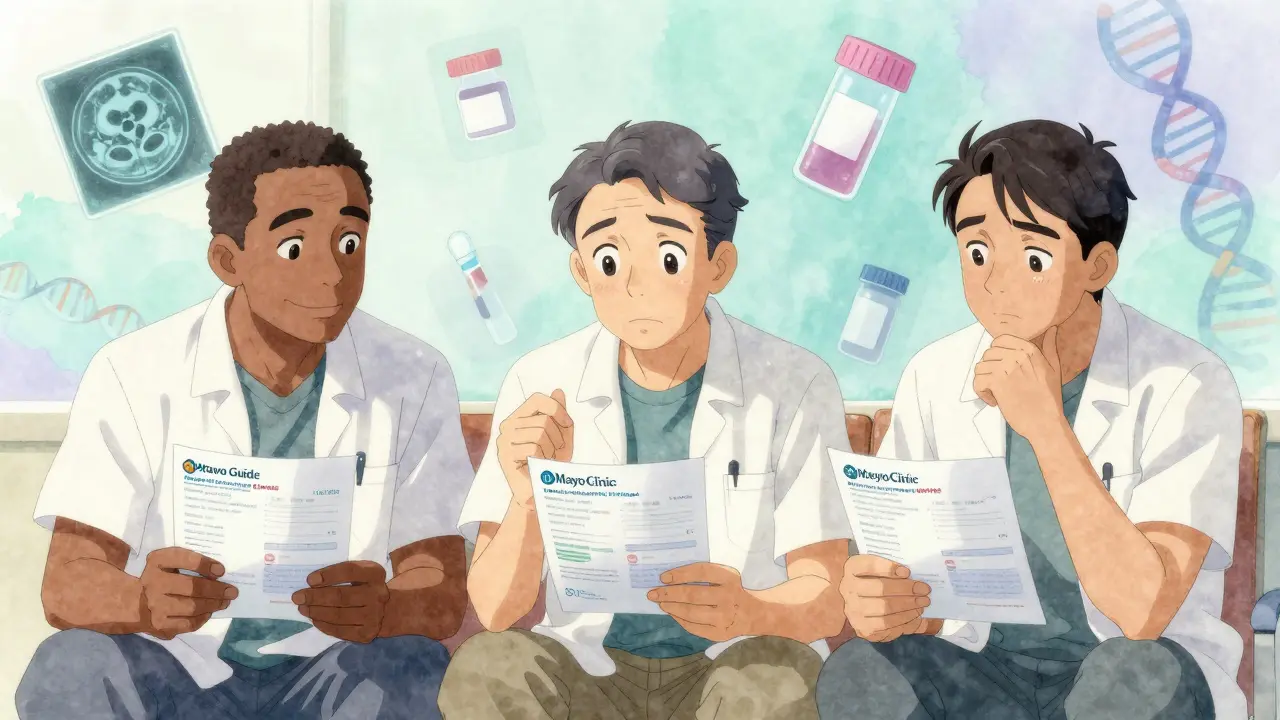
"Shared decision-making" sounds like medical jargon. But it’s really just this: you and your doctor sit down, and you both talk - really talk - about what you want, what you fear, and what the numbers mean.
It’s not about the doctor telling you what to do. It’s not about you just saying "yes" because you trust them. It’s about understanding that if you get screened:
- You might avoid a deadly cancer - but the odds are low.
- You might avoid a cancer that would’ve never hurt you - but you won’t know until after treatment.
- You might end up with side effects that change your life.
Studies show that when men use decision aids - like visual charts showing that 1 in 1,000 screened men avoids death from prostate cancer, but 240 get unnecessary biopsies - they feel less confused and more confident in their choice. One study found decision aids reduced decisional conflict by 35%.
But here’s the problem: most doctors don’t have time. A 2022 study found primary care physicians spend an average of 3.7 minutes discussing PSA screening. The recommended time? 15 to 20 minutes.
Only 38% of U.S. clinics have formal shared decision-making protocols. That means most men are making this decision with incomplete information - if they get any at all.
Who’s Being Left Behind?
Prostate cancer doesn’t affect all men the same. African American men are 70% more likely to get it and more than twice as likely to die from it. Yet they’re 23% less likely to have a real conversation about screening with their doctor.
Why? Systemic gaps. Time constraints. Bias. Language barriers. Lack of culturally tailored materials. These aren’t small issues - they’re life-or-death.
And it’s not just race. Men with family history, genetic mutations like BRCA, or a history of other cancers have higher risk. But unless their doctor asks, they won’t know. Screening isn’t one-size-fits-all. That’s why experts now say: start with a baseline PSA at age 45, especially if you’re Black or have a family history. That one number can tell you whether you need frequent checks or can wait.

What Should You Do?
If you’re 55 to 69, and you’re healthy, here’s what you should do: ask for a 15-minute appointment. Not to get a PSA test. To talk about whether you should get one.
Bring these questions:
- What’s my risk for prostate cancer based on my age, race, and family history?
- If my PSA is high, what happens next? Will I get a biopsy? What are the risks of that?
- If I’m diagnosed, what are my options besides surgery or radiation? Is active surveillance possible?
- What are the chances I’ll end up with incontinence or erectile dysfunction?
- Are there other tests - like 4Kscore or MRI - that could give me better info before we do anything invasive?
If you’re under 55, and you’re Black or have a close relative who had prostate cancer before 65, talk to your doctor about getting a baseline PSA. That’s the smartest move you can make.
If you’re over 70? Most experts say skip routine screening. The harms outweigh the benefits. Unless you’re in great health and have a life expectancy of 15+ years, it’s unlikely to help you - and very likely to hurt you.
The Future Isn’t Just PSA
PSA isn’t going away tomorrow. But it’s changing. The FDA approved IsoPSA in 2021 - a new version of the test that’s 92% accurate at spotting aggressive cancer, compared to 25% for the old one. AI tools are being trained to predict prostate cancer risk just from routine blood work. The National Cancer Institute is running a big study called P4, testing whether a single PSA test at age 45 can guide screening for life.
Within five years, screening might look nothing like it does now. Instead of a single number, you’ll get a risk score - combining genetics, PSA trends, family history, and AI predictions. That’s the future.
But until then? Shared decision-making is your best tool. It’s not perfect. It’s not easy. But it’s the only way to avoid being caught in the middle of a test that saves some lives - and ruins others.
What If I Don’t Want to Decide?
You don’t have to make this call alone. Many clinics now offer decision aids - printable guides, videos, or online tools that walk you through the pros and cons. The Ottawa Personal Decision Guide is free and used in over 50 countries. The Mayo Clinic has one too. Ask your doctor for one. If they don’t have one, search for it yourself. You deserve to know what you’re signing up for.
And if your doctor pushes you to get tested without talking through the risks? Find another one. You’re not being difficult. You’re being smart.
Comments (12)
Tim Bartik
December 16, 2025 AT 17:01
PSA? More like PSA-ly useless. I got mine done last year, turned out my prostate was just mad because I rode my bike too hard. Now I got a biopsy, a $3k bill, and my wife won’t let me touch the remote. Thanks, medicine. 🤡
Daniel Thompson
December 17, 2025 AT 17:36
The statistical implications of overdiagnosis in prostate cancer screening are profoundly complex. While the European Randomized Study of Screening for Prostate Cancer demonstrated a 21% reduction in mortality, the PLCO trial in the United States revealed significant contamination bias, rendering direct comparison problematic. The ethical imperative for informed consent cannot be overstated.
Alexis Wright
December 19, 2025 AT 02:11
Let’s be real - this whole PSA debacle is Big Pharma’s masterpiece. They don’t care if you’re impotent or incontinent, as long as you keep coming back for more scans, more biopsies, more $$$ treatments. The 2012 USPSTF recommendation was a victory for common sense. Then the urologists screamed, the lobbyists showed up, and now we’re back to ‘maybe, maybe not.’ Meanwhile, the real killer? Silence. Men die because they’re too proud to talk to their doctors. And now they’re being told to ‘talk more’? Yeah right. The system’s rigged.
Natalie Koeber
December 20, 2025 AT 21:41
I heard the CDC is secretly using PSA data to track which men are ‘high risk’ for government surveillance. They’re building a database with all the numbers - then they’ll flag you for ‘preventative detention’ if your PSA’s over 4.0. I’m not joking. My cousin’s neighbor’s cousin works at a lab and says they’re already tagging men with ‘abnormal trends.’ They’re calling it Project Prostate Watch. 😳
Wade Mercer
December 21, 2025 AT 02:17
Men who skip the PSA are just gambling with their lives. I lost my dad to metastatic prostate cancer at 62. He never got tested because he ‘didn’t want to stress.’ Now he’s six feet under and I’m stuck cleaning up his mess. If you’re not willing to get screened, at least have the decency to not pretend you’re being ‘empowered.’ You’re just scared.
Dwayne hiers
December 21, 2025 AT 23:10
The current clinical paradigm around PSA screening is fundamentally flawed due to its lack of specificity and sensitivity. While total PSA remains a useful initial biomarker, its predictive value is significantly enhanced by integrating PSA velocity, free-to-total PSA ratio, and prostate health index (PHI). Emerging modalities such as 4Kscore and mpMRI have demonstrated superior negative predictive values, reducing unnecessary biopsies by up to 40%. Shared decision-making must be operationalized through structured decision aids and standardized clinical pathways.
Jonny Moran
December 23, 2025 AT 00:56
Man, I’m a Black guy in my 50s, and I didn’t even know I should’ve gotten a baseline PSA at 45. My doc never mentioned it. I just thought, ‘I’m healthy, I’m fine.’ Turns out I had a 7.2 PSA - turned out to be aggressive cancer. Got treated early. Still got side effects, but I’m alive. If you’re Black or have family history? Don’t wait. Ask. Even if your doctor doesn’t bring it up. You’re your own best advocate.
Sarthak Jain
December 23, 2025 AT 10:24
I’m from India, and here PSA is super common - like getting a blood test for flu. But no one talks about side effects. My uncle got screened, had biopsy, got incontinence. Now he wears diapers. We didn’t know it could happen. This article? Eye opener. Maybe we need more awareness here too. Thanks for sharing. 🙏
Sinéad Griffin
December 24, 2025 AT 17:35
I’m a nurse. I’ve seen this play out 100 times. Men come in, get the PSA, panic, get biopsied, get diagnosed with something that’s basically a slow-moving snail… then spend the next 5 years being terrified of their own bodies. Meanwhile, their wives are the ones holding it all together. PSA isn’t the enemy. The system is. 🤦♀️
jeremy carroll
December 26, 2025 AT 14:05
I’m 58, healthy, no family history. I got my PSA done last year - 5.1. My doc said ‘let’s watch it.’ I didn’t freak out. I didn’t rush into anything. We’re doing a repeat in 6 months. Honestly? That’s all I needed. Just a calm conversation. No pressure. No fear-mongering. Just facts. This article? Spot on. 😊
Edward Stevens
December 26, 2025 AT 17:57
Ah yes, the sacred ritual of the PSA test. The one where you pay $50 to find out you might have cancer, then pay $15,000 to find out you don’t. Classic American healthcare. I’m just waiting for the next ad: ‘PSA: Because nothing says love like a needle in your prostate.’
Daniel Wevik
December 28, 2025 AT 12:42
This is exactly why we need better tools - and better systems. The 4Kscore and IsoPSA aren’t magic, but they’re steps forward. We need to stop treating PSA like a binary yes/no and start treating it as part of a dynamic risk profile. And yes, shared decision-making isn’t just a buzzword - it’s the bare minimum. If your doctor can’t spend 15 minutes explaining risks and benefits, they’re not doing their job. Period.