When your doctor says you can switch from your brand-name pill to a generic version, it’s natural to wonder: Will it work the same? Will I feel different? Is this just a cheaper version, or is it truly equivalent? The answer isn’t complicated, but it’s not always simple either. Most of the time, generics work exactly like the brand-name drug you’ve been taking. But there are exceptions. And knowing what to expect can save you money, stress, and even prevent dangerous mistakes.
Generics Are Not ‘Copycats’ - They’re Required to Be the Same
The FDA doesn’t allow just any company to slap a new label on a pill and call it a generic. Every generic drug must contain the same active ingredient, in the same strength, and delivered the same way - whether it’s a pill you swallow, an injection, or a cream you rub on. The FDA requires manufacturers to prove their version behaves identically in the body. That means the drug must be absorbed at the same rate and to the same extent as the brand-name version. The standard? The generic’s absorption must fall within 80% to 125% of the brand’s levels. That’s not a wide margin - it’s tight enough to ensure clinical results are the same.
Think of it like this: if your brand-name blood pressure pill lowers your systolic pressure by 12 points, the generic must do the same - not 8, not 15. A 2019 study in JAMA Internal Medicine looked at over 2,000 clinical trials and found that generics performed identically to brand-name drugs in 88% of cases. That’s not luck. That’s regulation.
Cost Difference? It’s Huge
The biggest reason to switch? Price. Brand-name drugs can cost hundreds of dollars a month. Generics? Often under $20. According to GoodRx data from 2023, generics cost 80% to 85% less than their brand-name equivalents. On average, patients save $378 per prescription annually. For people on Medicare Part D, switching to generics saves about $1,268 a year. That’s not pocket change - it’s life-changing for those choosing between medication and groceries.
Take Maria Rodriguez from Phoenix. She was skipping doses of her brand-name cholesterol medicine because it cost $350 a month. After switching to the generic - priced at $15 - she started taking it every day. She didn’t feel different. Her cholesterol levels dropped. Her doctor didn’t notice a thing. But her bank account did.
What Will Look Different? (And Why)
Here’s where confusion starts. Your new generic pill might be a different color, shape, or size. It might have a different logo or imprint. That’s not a mistake - it’s the law.
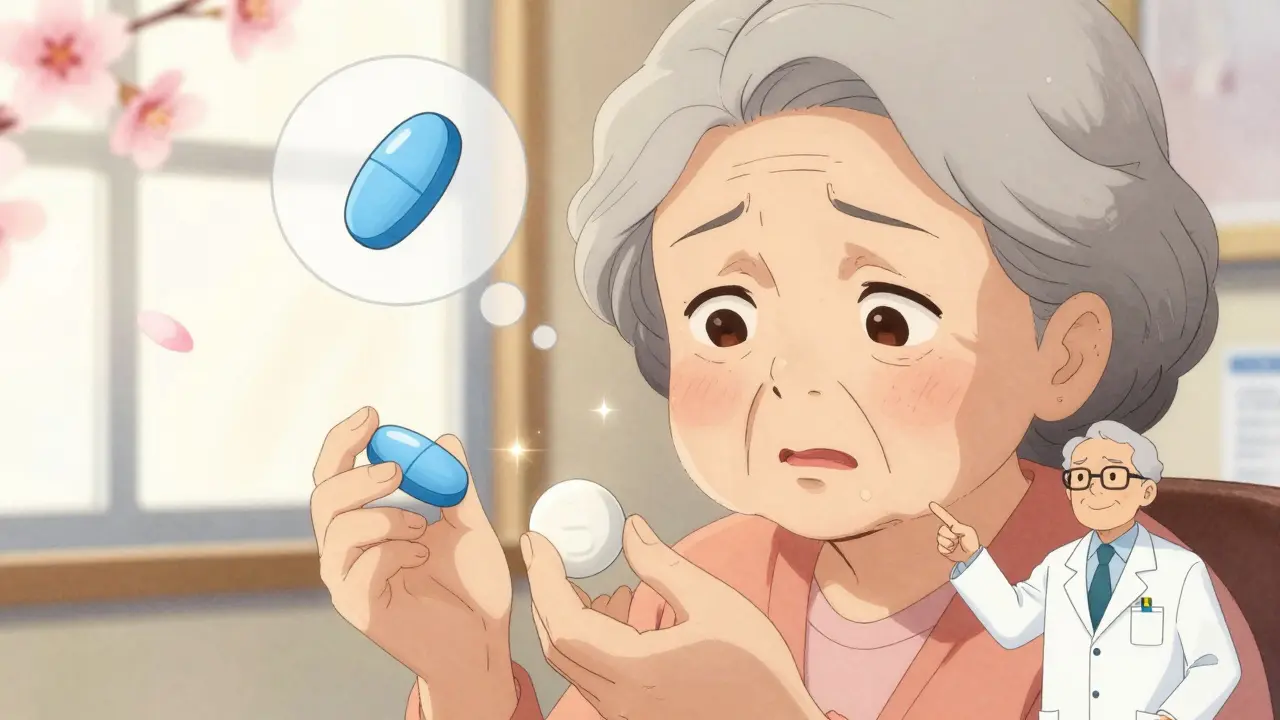
Trademark rules require generics to look different from the brand-name version. You can’t copy the exact appearance. So if your brand-name pill is a small blue oval, your generic might be a large white round tablet. It’s the same medicine, just dressed differently. This causes problems. A 2022 case in the Patient Safety Reporting System involved an 82-year-old woman who doubled her dose because she didn’t recognize the new pill. She thought the old one was gone. She didn’t realize it was just a different version.
That’s why pharmacists are required to explain the change. In 42 states, they must spend 5 to 7 minutes talking to you when switching. They’ll show you the new pill, explain it’s the same drug, and tell you what to watch for.
When Generics Might Not Be the Best Choice
Most drugs? Safe to switch. But not all. Some medications have what’s called a narrow therapeutic index - meaning even tiny changes in blood levels can cause big problems. These include:
- Levothyroxine (for thyroid)
- Warfarin (blood thinner)
- Phenytoin and carbamazepine (anti-seizure drugs)
For these, small differences in absorption can mean the difference between control and crisis. A 2021 study by the American Epilepsy Society found that 12.7% of patients switching between generic versions of anti-seizure drugs had breakthrough seizures. Only 4.3% did when they stayed on the same formulation.
That’s why neurologists like Dr. Robert Graham at Cedars-Sinai say: if you’re stable on one version - brand or generic - stick with it. If you switch, don’t jump between different generic manufacturers. Some patients respond better to one company’s version than another, even if both are FDA-approved.
What About Side Effects? New Ones After Switching?
Yes, it happens. Not often - but it happens. In a Reddit thread with over 300 responses, 16.7% of people reported new or worse side effects after switching. Some felt more drowsy. Others had stomach upset. A few said the drug just didn’t seem to work as well.
Why? It’s usually not the active ingredient. It’s the inactive ingredients. These are the fillers, dyes, binders, and preservatives that hold the pill together. Brand-name companies use specific ones. Generic manufacturers use different ones - cheaper, more common ones. For most people, it doesn’t matter. But if you’re allergic to red dye #40, or lactose intolerant, or sensitive to certain preservatives, you might react.
The FDA admits this. In its 2023 guidance, it says: “Small differences in inactive ingredients may rarely cause adverse reactions in sensitive patients.” That’s why your generic prescription should come with a Patient Package Insert (PPI). It lists all inactive ingredients. Read it. If you see something you’re allergic to - call your pharmacist. Don’t wait.
How to Monitor Your Switch
You don’t have to guess whether the generic is working. Track it.
- For diabetes meds (like metformin): Check your fasting blood sugar daily for two weeks. If it jumps more than 20 mg/dL from your usual range, call your doctor.
- For blood thinners (like warfarin): Get your INR checked within 5-7 days of switching. A change of more than 0.5 units needs attention.
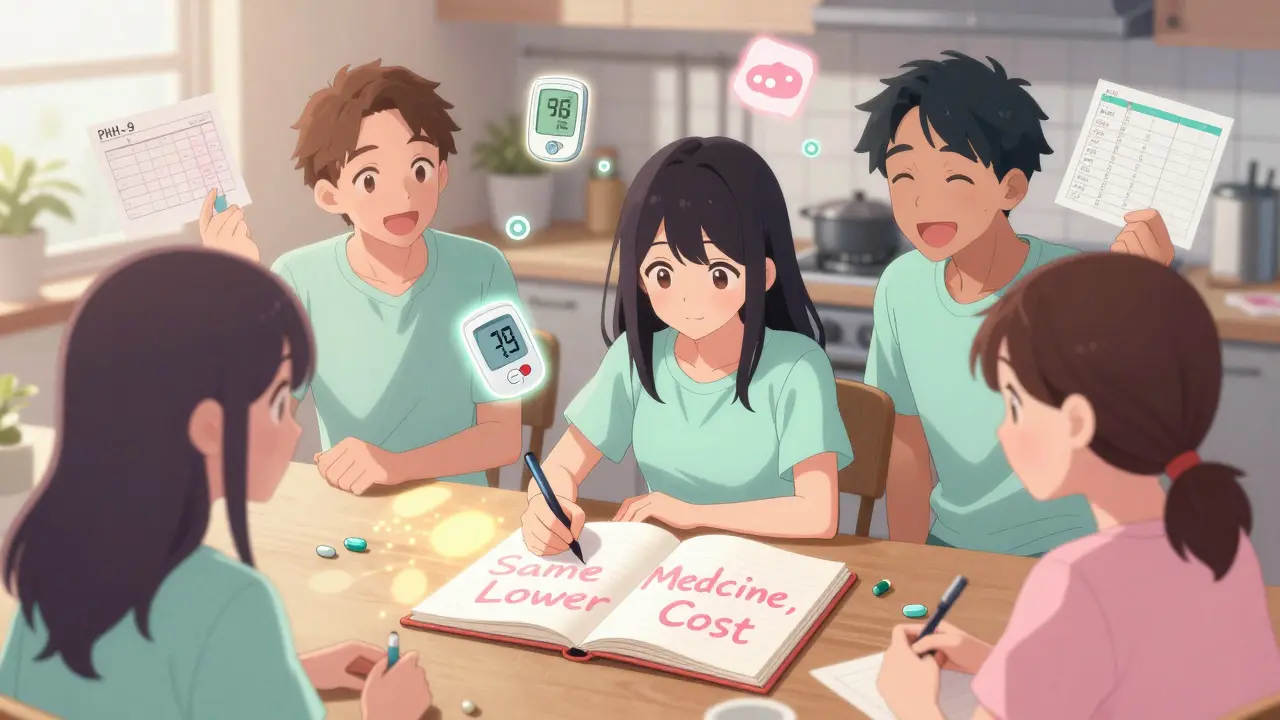
- For antidepressants or anxiety meds: Use a simple tool like the PHQ-9 or GAD-7. Fill it out before and after the switch. If your score drops by 3+ points, something’s off.
Keep a small notebook. Write down the date you switched, the name of the new pill, and how you feel each day. Bring it to your next appointment. It helps your doctor see patterns.
What’s Changing in the Future?
The FDA is pushing for better labeling. By 2025, all generic drug labels must clearly list potential allergens in plain language. Right now, only 37% of labels do this well, according to a 2022 University of Michigan study.
More complex generics are coming too - like patches, inhalers, and dissolvable tablets. The first biosimilars (generic versions of biologic drugs like Humira) hit the U.S. market in January 2024. They’re not exact copies - they’re highly similar - and they cost 15% to 30% less. They’re not for every condition, but they’re a big step forward.
By 2030, the Congressional Budget Office predicts 95% of all prescriptions will be generics. That’s not because doctors are pushing them - it’s because patients need them. And the system is catching up.
Bottom Line: Switch, But Stay Alert
For most people, switching to a generic is a smart, safe move. You get the same medicine at a fraction of the cost. You’re not sacrificing quality. You’re saving money without losing effectiveness.
But don’t assume it’s always seamless. Watch for changes. Know what’s in the pill. Keep track of how you feel. If something feels off - even if it’s small - speak up. Your pharmacist is your ally. Your doctor is your partner. And you? You’re the most important person in the room.
Generics aren’t a compromise. They’re the standard. And for most of us, they’re the best option we’ve ever had.
Comments (13)
Rajni Jain
December 25, 2025 AT 23:05
so i switched my thyroid med to generic last year and honestly? no difference. my doctor was like 'you're fine' but i was paranoid so i tracked my energy levels and sleep for 3 weeks. same as before. also saved me like $300 a year. yessss.
roger dalomba
December 26, 2025 AT 23:26
Wow. A whole essay on how generics are fine. Groundbreaking. Next you’ll tell me water is wet.
Sophia Daniels
December 28, 2025 AT 17:13
Oh sweet mercy. I switched to generic sertraline and suddenly i was crying in the cereal aisle because my brain felt like it was wrapped in wet socks. Turned out the filler had lactose. I’m dairy intolerant. No one told me. The pharmacist just handed me the pill like it was a lollipop. #genericfail
Peter sullen
December 29, 2025 AT 19:54
According to the FDA’s Bioequivalence Guidelines (21 CFR §320.1), the 80%-125% confidence interval for AUC and Cmax is statistically validated for therapeutic equivalence. Moreover, the 2019 JAMA meta-analysis demonstrates non-inferiority with a p-value <0.001 across 2,147 trials. Therefore, the assertion that generics are 'equivalent' is not merely anecdotal-it is pharmacokinetically substantiated.
Amy Lesleighter (Wales)
December 30, 2025 AT 15:05
my grandma took generic blood pressure pills for 10 years. never had a problem. she said the color changed every year but the pill didn’t care. neither did her arteries.
Fabio Raphael
December 31, 2025 AT 15:29
I’ve been on warfarin for 8 years. I switched generics twice and my INR spiked both times. Now I stick with the brand. I know it’s expensive, but I’d rather pay $400 than end up in the ER again. Has anyone else had this happen?
Steven Destiny
December 31, 2025 AT 21:48
Stop acting like generics are some kind of scam. If you’re too lazy to track your meds, that’s on you. I’ve saved over $5,000 in 3 years switching everything to generic-heart meds, antidepressants, even my insulin. You want to whine? Go cry to your insurance company. The system works if you don’t act like a baby.
Erwin Asilom
January 2, 2026 AT 04:37
While the FDA’s bioequivalence standards are robust, individual variability in absorption kinetics cannot be universally discounted. In patients with gastrointestinal disorders or those taking polypharmacy regimens, even minor differences in excipients may alter pharmacokinetic profiles. Therefore, while population-level data supports equivalence, personalized monitoring remains prudent.
Sumler Luu
January 3, 2026 AT 14:01
I switched my levothyroxine and felt fine-until I started getting heart palpitations. I didn’t think it was the pill until my doctor checked my TSH. It had jumped. I went back to the brand. No more issues. Just because it’s 'FDA-approved' doesn’t mean it’s right for you. Listen to your body.
sakshi nagpal
January 4, 2026 AT 01:27
As someone from India where generics are the norm, I can say this: in the U.S., we treat medicine like a luxury. Here, people panic over pill color. In my village, people take whatever the pharmacy gives them and pray. We need more empathy, not more fear.
Brittany Fuhs
January 5, 2026 AT 13:56
Generics? Yeah, I tried them. Then I realized the manufacturer was based in a country where they use rat fur as filler. I’m not taking my heart medication from a factory that doesn’t even have running water. America deserves better. Buy American. Or die.
Nikki Brown
January 6, 2026 AT 11:09
You people are so naive. You think generics are safe? That’s what they want you to think. Big Pharma and the FDA are in bed together. They’re pushing generics so you’ll stop asking questions. Wake up. Your medication is a tool of control. 🤕🩺
Sandeep Jain
January 6, 2026 AT 17:56
my aunt took generic seizure med and had a seizure in church. they said it was 'just stress'. she’s fine now but she’s scared to switch again. why does it have to be so hard just to stay alive?