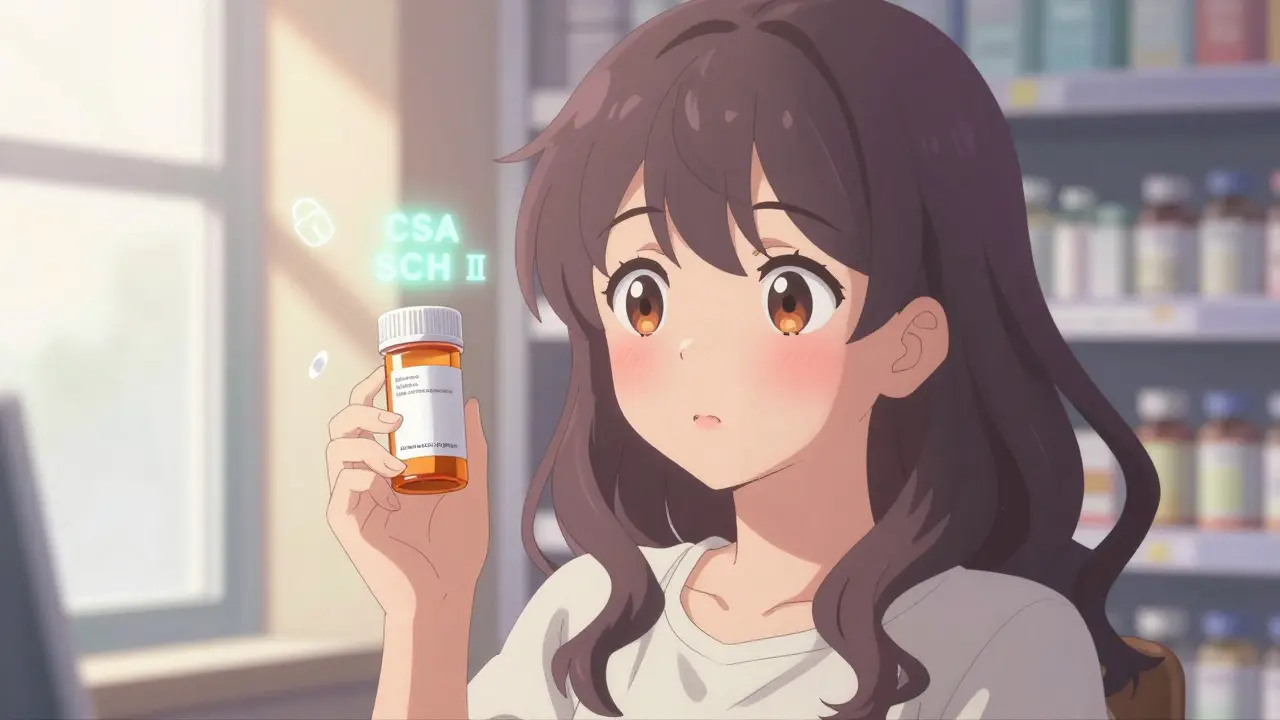
When you pick up a prescription at the pharmacy, you might not notice the small print on the label that says CSA SCH II or NARC. But those codes matter-more than you think. They tell the pharmacist, the doctor, and even law enforcement how dangerous the drug is, how strictly it’s controlled, and whether you can refill it. This isn’t just bureaucracy. It’s a system designed to keep people safe, prevent addiction, and stop drugs from falling into the wrong hands. Yet most patients have no idea what these labels mean. And that’s a problem.
What Are Controlled Substances?
Not all prescription drugs are treated the same. The U.S. government classifies certain medications as controlled substances because they carry a risk of abuse, dependence, or addiction. These include opioids like oxycodone, sedatives like Xanax, stimulants like Adderall, and even some cough syrups with codeine. The legal framework behind this is the Controlled Substances Act (CSA), passed in 1970. It’s the reason why you can’t just walk into a pharmacy and buy a bottle of hydrocodone like you would ibuprofen.
The CSA created five categories, called schedules, to group these drugs based on three things: how likely they are to be abused, whether they have accepted medical uses, and how dangerous they are if misused. Each schedule comes with its own rules for prescribing, dispensing, and recordkeeping. The DEA, or Drug Enforcement Administration, manages this system and assigns each drug a unique code number-like a fingerprint-for tracking.
The Five Schedules Explained
Here’s how the schedules actually work in real life-not just textbook definitions.
- Schedule I: These drugs have no accepted medical use in the U.S. and a high potential for abuse. Examples include heroin, LSD, and-still, as of 2026-marijuana under federal law. You can’t get a prescription for these. They’re illegal everywhere, even if your state allows medical cannabis.
- Schedule II: High abuse potential, but they’re used medically. Think fentanyl, morphine, oxycodone (OxyContin), Adderall, and methadone. These are the most tightly controlled prescriptions. No refills allowed. Each prescription must be written on special tamper-resistant paper in most states. Pharmacies must store them in locked cabinets. A single Schedule II prescription can take a pharmacist 15 extra minutes to process because of the paperwork.
- Schedule III: Moderate to low abuse potential. These include hydrocodone combined with acetaminophen (Vicodin), ketamine, and some anabolic steroids. You can refill these up to five times in six months. Electronic prescriptions are allowed. This is actually the most commonly dispensed controlled substance category in U.S. pharmacies-over 40% of all controlled prescriptions fall here.
- Schedule IV: Low abuse potential. Drugs like Xanax, Valium, Ambien, and tramadol. Refills are allowed (up to five in six months), and most are prescribed electronically. These are often the drugs people get misused for sleep or anxiety, but the risk of physical dependence is lower than with Schedule II.
- Schedule V: Lowest risk. These are mostly cough syrups with tiny amounts of codeine (less than 200 mg per 100 ml), or antidiarrheals with diphenoxylate. In some states, you can buy these without a prescription-but only if the pharmacist approves it. They’re available behind the counter, not on open shelves.
One thing to remember: the same drug can be in different schedules depending on how it’s made. Pure codeine? Schedule II. Codeine with acetaminophen in a 15 mg tablet? Schedule III. Codeine in a cough syrup with 1.5 mg per 5 ml? Schedule V. That’s why the label on your bottle isn’t just a name-it’s a code that tells the whole story.
What You’ll See on the Label
When you get your prescription back from the pharmacy, look closely. You might see one of these on the label:
- CSA SCH II - Controlled Substances Act, Schedule II
- CSA SCH III - Schedule III
- NARC - Narcotic (usually means Schedule II or III opioid)
- DEA # - The prescriber’s DEA registration number (starts with A, B, F, or M, followed by 7 digits)
These aren’t decorative. They’re legal requirements. If a pharmacy dispenses a Schedule II drug without the proper label, they can be fined or lose their license. If a doctor writes a Schedule II prescription without a DEA number, it’s invalid. Even the ink on the prescription paper matters-many states require tamper-resistant paper for Schedule II drugs to prevent forgery.
And here’s something most people don’t realize: the label also tells you if the drug is a precursor-a chemical used to make illegal drugs. That’s why some cold medicines with pseudoephedrine are kept behind the counter, even though they’re not scheduled. The DEA tracks those too.
Why the System Is Controversial
The scheduling system sounds logical, but it’s full of contradictions.
Take cannabis. It’s still a Schedule I drug federally-same category as heroin-even though 38 states allow medical use, and 24 allow recreational. Millions of patients use it for chronic pain, epilepsy, and chemotherapy side effects. But because of its federal status, doctors can’t prescribe it. Pharmacies can’t stock it. Research is nearly impossible. That’s not science-it’s politics.
Then there’s fentanyl. It’s Schedule II, but it’s killing more people than any other drug in America. Meanwhile, benzodiazepines like Xanax (Schedule IV) are widely prescribed, yet their overdose risk increases dramatically when mixed with alcohol or opioids. Why is one considered more dangerous than the other? The answer isn’t clear.
Experts agree the system is outdated. A 2022 Rand Corporation survey found 82% of addiction specialists believe the U.S. needs more than five schedules-maybe six or seven-to better reflect real-world risks. Some argue that Schedule II should be split: one for high-risk opioids, another for stimulants. Others say Schedule V should be eliminated entirely since many of those drugs are already sold over the counter in other countries.
The DEA is aware. In 2023, the Department of Health and Human Services recommended moving cannabis to Schedule III. If that happens, it will be the biggest change to the system in over 50 years. And it’s not just cannabis. The DEA added 17 new synthetic drugs to Schedule I between 2022 and 2023-fast-tracked because they were flooding the streets. The agency now aims to cut the average scheduling review time from two years to one by 2025.
What This Means for You as a Patient
If you’re taking a controlled substance, here’s what you need to do:
- Know your schedule. Ask your pharmacist: “What schedule is this?” Don’t assume it’s just another pill.
- Never share your meds. Giving away a Schedule II drug is a federal crime-even if you think you’re helping a friend.
- Don’t refill early. Pharmacies track refills electronically. Trying to get a refill before the date is flagged as suspicious.
- Keep your prescriptions secure. Schedule II prescriptions are often targeted by thieves. Store them in a locked box, not your purse or medicine cabinet.
- Ask about alternatives. If you’re on a Schedule II opioid for chronic pain, ask if a Schedule III or IV option might work. You might get the same relief with less risk.
And if you’re worried about addiction? Talk to your doctor. The scheduling system isn’t perfect, but it’s designed to help you-not trap you. The fact that your prescription has a DEA code means someone is watching out for you.
How Providers Are Adapting
Doctors and pharmacists aren’t just following rules-they’re changing how they work because of them.
Physicians now spend an average of 12.5 hours during residency learning how to write controlled substance prescriptions correctly. One mistake-like forgetting the DEA number or writing a refill on a Schedule II script-can lead to an audit, fines, or even loss of license.
Pharmacies use automated systems to track every controlled substance from the moment it arrives until it’s picked up. They log the patient’s ID, the prescriber’s DEA number, the quantity, and the date. If a patient tries to fill the same Schedule II prescription at two different pharmacies in one week? The system flags it. That’s not surveillance-it’s protection.
And the technology is improving. Since 2021, the DEA’s online ordering system (CSOS) lets pharmacies and distributors order Schedule II drugs in under 24 hours instead of waiting days. That means fewer delays for patients who need pain relief after surgery or cancer treatment.
What’s Next?
The future of controlled substance labeling is changing fast.
By 2028, experts predict at least two Schedule I drugs-likely cannabis and MDMA-will be moved to lower schedules. That will change how they’re labeled, prescribed, and sold. Some states are already experimenting with digital prescription tracking systems that link directly to state databases. Others are pushing for real-time alerts when someone tries to get multiple opioids from different doctors.
Meanwhile, the pharmaceutical industry spends over $2 billion a year just to comply with these rules. That cost gets passed on to patients. But it’s not just about money-it’s about safety. Every label, every code, every signature on a prescription is part of a system trying to balance access with protection.
So the next time you get a prescription, take a second to read the fine print. That little CSA SCH III isn’t just jargon. It’s a warning, a rule, and a lifeline-all in three words.
What does CSA SCH II mean on a prescription label?
CSA SCH II stands for Controlled Substances Act, Schedule II. It means the drug has a high potential for abuse and dependence but is approved for medical use. Examples include oxycodone, fentanyl, and Adderall. These prescriptions cannot be refilled, must be written on special paper in most states, and require strict recordkeeping by pharmacies.
Can you refill a Schedule II prescription?
No. Schedule II prescriptions cannot be refilled under federal law. Each dose requires a new, original prescription from your doctor. Some states allow electronic prescriptions, but even then, no refills are permitted. If you run out, you must see your doctor again.
Why is marijuana still Schedule I if it’s legal in my state?
Marijuana remains Schedule I under federal law because the DEA hasn’t changed its classification, even though 38 states allow medical use and 24 allow recreational use. This creates a legal conflict. Federally, it’s considered to have no medical value and high abuse potential. However, in August 2023, the Department of Health and Human Services recommended moving it to Schedule III. A final decision is pending as of early 2026.
Are all opioids Schedule II?
No. Pure opioids like morphine and oxycodone are Schedule II. But when combined with other drugs-like hydrocodone with acetaminophen (Vicodin)-they become Schedule III. Codeine in low doses (under 200 mg per 100 ml) in cough syrup is Schedule V. The schedule depends on the formulation, not just the active ingredient.
Can I get Schedule V drugs without a prescription?
In some states, yes. Schedule V medications-like certain cough syrups with small amounts of codeine or antidiarrheals with diphenoxylate-can be sold behind the pharmacy counter without a prescription. But you must ask the pharmacist, show ID, and the amount you can buy is limited. They’re not on open shelves.
How do I know if my doctor is authorized to prescribe controlled substances?
Your doctor must have a DEA registration number, which appears on your prescription label. It starts with a letter (A, B, F, or M) followed by seven digits. You can ask your pharmacist to verify it. All licensed prescribers who handle controlled substances must register with the DEA, and the process takes 4-6 weeks. If your prescription doesn’t have this number, it’s invalid.
What to Do If You’re Confused
If you’re unsure about your medication’s schedule, don’t guess. Ask your pharmacist. They’re trained to explain these labels. If you’re worried about dependence, talk to your doctor. There are alternatives. If you’re concerned about a loved one’s use of a controlled substance, reach out to a local addiction support group. The system isn’t perfect, but it’s meant to protect you. Understanding it is the first step to using it safely.
Comments (14)
Bobby Collins
January 1, 2026 AT 17:46
CSA SCH II? More like CSA SCH LIE. They say it's for safety but they're just controlling the population. You think they care if you get pain relief? Nah. They just want you dependent on their system. I saw a guy get arrested for sharing his Adderall with his buddy who had finals. Meanwhile, Big Pharma makes billions off the same drugs. Wake up.
Kristen Russell
January 3, 2026 AT 07:25
This is actually really helpful. I never knew what those codes meant and now I feel more in control of my own care. Knowledge is power, and this is the kind of info that saves lives.
Bryan Anderson
January 4, 2026 AT 23:00
Thank you for this clear, well-researched breakdown. As a healthcare provider, I appreciate the emphasis on patient education. The scheduling system is flawed, yes-but understanding it empowers patients to ask better questions and advocate for themselves. This is the kind of content we need more of.
Matthew Hekmatniaz
January 6, 2026 AT 20:15
Coming from India, where even tramadol is sold over the counter without a script, this system feels almost alien. But I see the logic-especially with opioids. Maybe the real issue isn't the schedules, but how unevenly they're enforced across cultures. We need global standards, not just American bureaucracy.
Liam George
January 7, 2026 AT 19:52
The CSA is a performative artifact of the War on Drugs, a carceral architecture disguised as public health. The scheduling algorithm is not evidence-based-it’s political theater encoded into pharmacopeia. Schedule I isn't about risk-it's about stigma. Cannabis and MDMA are neuropharmacologically less dangerous than alcohol or tobacco, yet they're locked in purgatory while fentanyl, a synthetic chimera of capitalist profit, remains Schedule II. The DEA isn't regulating substances-it's regulating dissent.
sharad vyas
January 9, 2026 AT 08:59
Very interesting. In my country, we don’t have these codes. But I think the idea behind them is good. People need to know what they are taking. Simple things matter.
Dusty Weeks
January 10, 2026 AT 11:21
so like… if i give my cousin my xanax for his anxiety… that’s a FEDERAL CRIME??? 😳 i just wanted to help… #yolo #dontbeafraid
Sally Denham-Vaughan
January 11, 2026 AT 15:49
My grandma got her Vicodin labeled NARC and she cried because she thought it meant she was a junkie. Nobody told her it’s just a code. We need better patient education-like, real plain language pamphlets. Not this legal jargon nonsense.
Bill Medley
January 13, 2026 AT 02:50
The Controlled Substances Act remains the cornerstone of pharmaceutical regulation in the United States. Its classification framework, while imperfect, provides necessary structure to mitigate misuse. The procedural rigor surrounding Schedule II prescriptions is not excessive-it is proportionate to the risk.
Richard Thomas
January 13, 2026 AT 03:48
It’s fascinating how the scheduling system reflects not just pharmacology but cultural attitudes toward pain, addiction, and authority. Schedule II drugs are treated like weapons because we fear dependency-yet we normalize alcohol, which kills more people annually than all illicit drugs combined. The real inconsistency isn’t in the schedules-it’s in our collective denial. We punish the person taking oxycodone for chronic pain but celebrate the person drinking whiskey after work. The label says CSA SCH II-but the real message is: ‘You’re not allowed to feel better unless you’re sober.’
Paul Ong
January 14, 2026 AT 17:32
Pharmacies should be able to refill Schedule II if the doctor says so. Why make people suffer because of paperwork? I know someone who missed work because they couldn't get a new script on a weekend. This system is broken. It's not helping it's hurting
Andy Heinlein
January 14, 2026 AT 22:28
OMG I had no idea codeine in cough syrup was schedule V 😱 I thought it was just like Robitussin. I'm gonna check my old bottles now. Also-can we just make marijuana schedule III already? My aunt uses it for MS and she's got to drive 2 hours to get it. This is wild.
Ann Romine
January 15, 2026 AT 14:37
Interesting how the label changes based on formulation. I never realized that hydrocodone with acetaminophen is Schedule III but pure hydrocodone is Schedule II. That’s actually a smart way to regulate-targeting dosage and combination, not just the molecule. Maybe we need more of that nuance across the board.
Todd Nickel
January 16, 2026 AT 19:00
One thing missing from this analysis is the economic incentive structure. The pharmaceutical industry spends billions lobbying to keep drugs in certain schedules because it affects patent protections, insurance reimbursement, and market exclusivity. Schedule III drugs are more profitable for manufacturers because they allow refills and electronic prescribing-leading to higher volume sales. Schedule II drugs, while more tightly controlled, carry higher margins per unit and are often prescribed for acute conditions with higher patient turnover. The system isn't designed for safety-it's designed for profit, and the scheduling codes are just the visible surface of a much deeper financial architecture. The DEA doesn't set schedules based on clinical data alone-they’re influenced by corporate submissions, FDA advisory panels with industry ties, and congressional pressure. Until we acknowledge that, we’re just rearranging deck chairs on the Titanic.