
When you’re a veteran relying on VA healthcare, your prescription costs shouldn’t feel like a surprise bill. The VA formulary is designed to make sure you get the medications you need at the lowest possible cost - and it does this by putting generics first. If there’s a generic version of your drug, the VA will cover that instead of the brand name. It’s not just a policy - it’s the rule. And it saves veterans millions every year.
How the VA Formulary Works
The VA National Formulary is the official list of all medications available to veterans through VA pharmacies. It’s not optional. Every VA clinic, hospital, and mail-order pharmacy must stock these drugs. The system was officially set up in 1998, but it’s been updated every single month since then. The latest version, as of October 2025, includes over 1,200 medications across all major health categories - from blood pressure pills to antidepressants.
Here’s the key: if a generic version exists, the VA covers the generic. Always. That’s not a suggestion. It’s the default. Brand-name drugs are only approved if there’s a documented medical reason - like an allergic reaction to the generic, or if the generic simply doesn’t work for you. Even then, you need prior authorization.
This isn’t about cutting corners. It’s about matching effectiveness with affordability. Studies show that 92% of all prescriptions filled through the VA are generics - higher than any other major U.S. payer, including Medicare Part D and private insurance. And the results? Veterans pay less, outcomes stay the same.
Tiered Copay System: What You Actually Pay
The VA doesn’t use the confusing five-tier systems you see with commercial insurers. It uses three. And it’s simple:
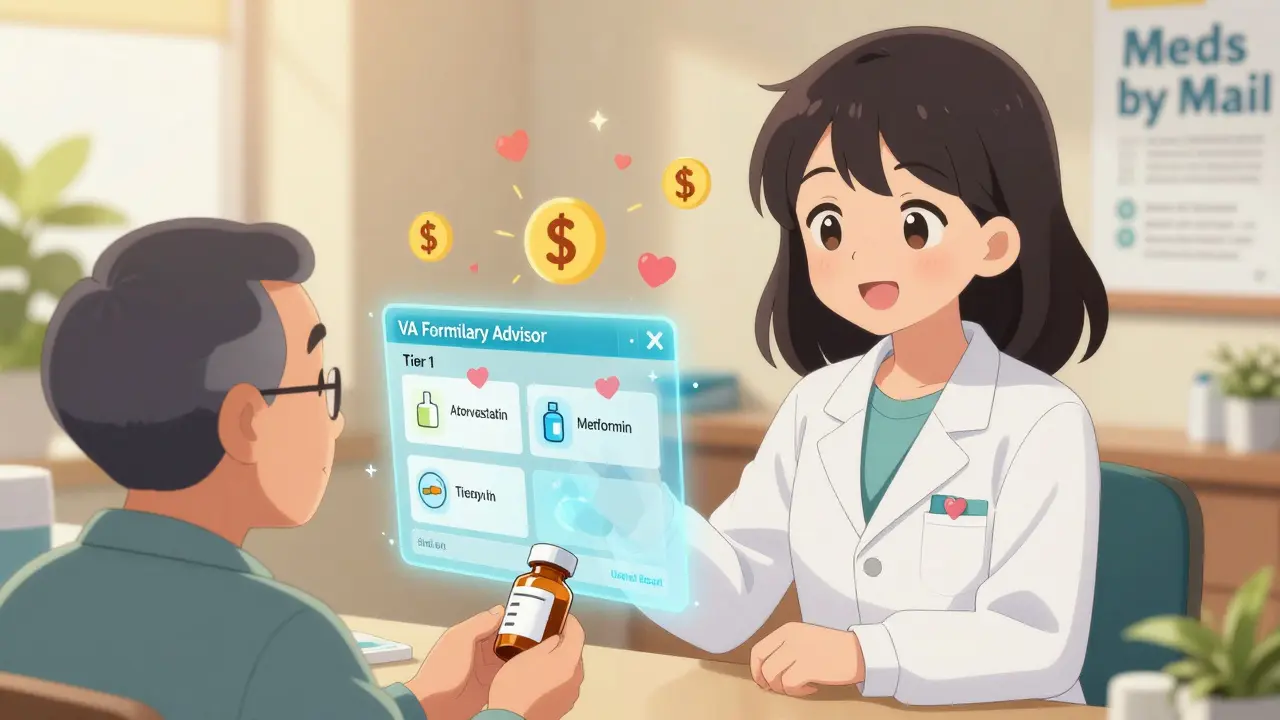
- Tier 1: Preferred generics. These are the most cost-effective drugs. Copay: $0-$9 for a 30-day supply. Most common medications fall here.
- Tier 2: Non-preferred generics or some brand-name drugs without a generic alternative. Copay: $10-$17.
- Tier 3: Specialty drugs, high-cost brand names, or medications requiring prior authorization. Copay: $20-$30.
For example, alendronate (for osteoporosis), atorvastatin (for cholesterol), and sertraline (for depression) are all Tier 1 drugs as of January 2025. That means you pay $5 or less - sometimes nothing at all - for a full month’s supply.
Compare that to commercial pharmacies. The same sertraline might cost $15-$50 out-of-pocket without insurance. With VA coverage, you’re getting the same pill - same active ingredient, same FDA approval - for a fraction of the price.
What’s Covered: Real Examples from the 2025 Formulary
Let’s look at actual medications covered under Tier 1 in 2025:
- Arthritis and pain: Aspirin buffered tablet, ibuprofen, allopurinol
- Heart and blood pressure: Furosemide, hydrochlorothiazide, lisinopril
- Cholesterol: Atorvastatin, pravastatin, ezetimibe
- Mental health: Fluoxetine, sertraline HCl, trazodone
- Diabetes: Metformin, glimepiride, insulin glargine
These aren’t obscure drugs. These are the ones millions of Americans take every day. The VA ensures they’re available - and affordable.
Some newer medications, like GLP-1 receptor agonists (Wegovy, Ozempic), are covered - but only for FDA-approved uses. That means Wegovy is covered for type 2 diabetes and cardiovascular risk reduction, but not for weight loss alone. If your doctor wants to prescribe it off-label, you’ll need to go through prior authorization. And even then, approval isn’t guaranteed.
Meds by Mail: The Secret Weapon
If you’re on long-term medications, you’re probably already using Meds by Mail. It’s the VA’s mail-order pharmacy program, and it’s one of the best benefits you might not know about.
Here’s why it’s so valuable:
- No copay for Tier 1 drugs
- No annual deductible
- 90-day supplies delivered to your door
- Free shipping
Over 87% of veterans who use Meds by Mail say they’re satisfied with the service. One veteran on Reddit wrote: “Switched to generic sertraline through VA Mail Order last month - same effectiveness as Zoloft but costs me $0 copay versus $15 at my local pharmacy.”
The only catch? Some medications can’t be mailed. Refrigerated biologics, like certain injectables for rheumatoid arthritis or multiple sclerosis, require in-person pickup at a VA clinic. But for 90% of maintenance meds - blood pressure pills, thyroid meds, antidepressants - Meds by Mail is the easiest, cheapest option.
How to Check If Your Drug Is Covered
Don’t guess. Don’t assume. Always check the VA Formulary Advisor tool on VA.gov. It’s free, updated monthly, and searchable by drug name, generic name, or condition.
You can also download the full VA Product Name List as an Excel file. It’s updated every November. Or use the National Drug File Extract - a CSV file with NDC codes, brand names, and generic equivalents - for tech-savvy users.
If your drug isn’t on the list, you have two options:
- Ask your VA provider for an alternative that is covered.
- Request prior authorization. Your provider fills out a form explaining why the non-formulary drug is medically necessary. Approval can take 3-7 days.
Don’t wait until your prescription runs out. Start the process early. Many veterans report delays when they try to switch drugs last minute.
What Veterans Say - And What They Wish Was Different
Most veterans appreciate the low cost and consistency. But there are frustrations.
One common complaint: access to newer specialty drugs. A veteran on the Veterans Benefits Network wrote: “My doctor wanted me on Wegovy for weight loss, but VA only covers it for diabetes. I had to fight for months just to get a denial letter.”
Another issue: confusion over tiers. About 35% of new enrollees mix up Tier 1 and Tier 2 copays. That’s why the VA now offers video tutorials on their pharmacy portal and a 24/7 call center (1-800-877-8339) that handles over 18,000 calls a day.
Still, the VA’s generic-first approach works. A 2024 OIG report found that 94% of veterans who had concerns about generic effectiveness continued their meds after talking to their provider. The drugs work. The system works. It’s just not always easy to navigate.
How VA Compares to Medicare and Private Insurance
Here’s the reality: VA coverage is cheaper and simpler than most.
Medicare Part D has five tiers. A drug like ALUNBRIG (for lung cancer) might be in Tier 5 - meaning you pay $500+ per month. The VA would cover a generic alternative or require prior authorization - but never let you pay that much.
Cost per veteran: $1,850/year. Cost per Medicare Part D beneficiary: $2,300. Cost per commercially insured patient: $2,700. That’s not a coincidence. It’s because the VA refuses to pay premium prices for brand-name drugs when generics exist.
Even industry analysts at Avalere Health say the VA’s model is being watched by private insurers. The VA’s 92% generic use rate is a benchmark. Its monthly updates, clinical reviews, and cost controls are becoming a template.
What’s Coming Next
The VA isn’t standing still. By late 2026, the system will start using AI to suggest generic alternatives directly in the provider’s electronic health record. That means your doctor might get a pop-up: “This brand-name drug has a generic equivalent. Would you like to switch?”
They’re also expanding coverage for rare disease treatments and oncology drugs - but with strict cost controls. The goal isn’t to cover everything. It’s to cover what works, at the best price.
Future plans include pharmacogenomic testing - checking your genes to predict which drugs you’ll respond to. That could cut down on trial-and-error prescribing and reduce waste. It’s the next step in smart, personalized care.
What You Need to Do Now
If you’re a veteran on VA benefits:
- Log into VA.gov and use the Formulary Advisor to check your current meds.
- Sign up for Meds by Mail if you’re on maintenance drugs. It’s free and saves time.
- If your drug isn’t covered, ask your VA provider for a generic alternative before requesting prior authorization.
- Call 1-800-877-8339 if you’re confused. Pharmacy staff are trained to help you navigate this.
- Don’t assume your drug will stay covered. The formulary changes monthly. Check it every six months.
The VA formulary isn’t perfect. But it’s one of the most efficient, transparent, and veteran-friendly prescription systems in the country. You’re not just getting medication. You’re getting value. And that’s worth understanding.
Are all VA prescriptions generic?
No, but the VA covers generics first whenever they exist. Brand-name drugs are only approved if there’s a documented medical reason - like an allergy or proven ineffectiveness of the generic. Even then, you need prior authorization.
How do I know if my medication is on the VA formulary?
Use the VA Formulary Advisor tool on VA.gov. You can search by brand name, generic name, or condition. The tool is updated monthly and shows you the tier, copay, and any restrictions. You can also download the full list as an Excel file from the VA Pharmacy Benefits site.
Why is my drug not covered by VA even though it’s covered by Medicare?
The VA has stricter cost controls. Medicare Part D covers more brand-name and specialty drugs, but with much higher out-of-pocket costs. The VA only covers drugs that meet clinical effectiveness and cost-saving standards. If a drug is expensive and has a generic alternative, the VA will likely exclude the brand-name version unless medically necessary.
Can I get brand-name drugs through the VA if I prefer them?
Only with prior authorization and a valid medical reason. The VA does not approve brand-name drugs just because you prefer them. You’ll need your provider to document why the generic doesn’t work for you - and even then, approval isn’t guaranteed.
Does the VA cover weight loss drugs like Wegovy or Ozempic?
Yes - but only for FDA-approved uses: type 2 diabetes, cardiovascular risk reduction, and obstructive sleep apnea. Weight loss alone is not an approved indication under current VA policy (as of January 2025). Off-label use requires prior authorization and is rarely approved.
How often does the VA update its formulary?
Monthly. The VA National Formulary is updated every month with new additions, removals, or tier changes. Changes are published in the Monthly Decision Newsletter on VA.gov. Annual tier changes are rare - most adjustments happen monthly based on cost, availability, or new clinical evidence.
What’s the difference between VA pharmacy and Meds by Mail?
VA pharmacies are physical locations where you pick up prescriptions in person. Meds by Mail is a mail-order service that delivers 90-day supplies to your home. Both use the same formulary, but Meds by Mail has no copay for Tier 1 drugs and no deductible. It’s ideal for maintenance medications and saves time.
Can I use my VA coverage at a civilian pharmacy?
Only under specific conditions: if you’re enrolled in Community Care and the VA has authorized it, or if you’re in an emergency. For routine prescriptions, you must use VA pharmacies or Meds by Mail to get the lowest cost. Otherwise, you’ll pay full price and won’t be reimbursed.
Comments (14)
Dana Termini
January 6, 2026 AT 08:53
The VA formulary is one of the few things in American healthcare that actually works. No surprise bills, no tiered nonsense, just generics that do the job. I’ve been on sertraline through Meds by Mail for three years now. Zero copay. Same as Zoloft. Why would anyone complain?
Susan Arlene
January 7, 2026 AT 19:12
so like... if my doc wants me on some fancy new drug but its not on the list i just gotta suck it up? kinda wild that they dont just let us pick. but hey at least i pay $5 for my blood pressure pills lol
Leonard Shit
January 9, 2026 AT 04:44
they say 'generics are just as good' but i had one that made me dizzy. turned out it was the filler, not the active ingredient. took 6 months and 3 prior auths to get back on the brand. VA system is efficient until it's not.
Wesley Pereira
January 11, 2026 AT 02:43
the real win is the 90-day mail order. no more running out on a friday. no more $40 copays at CVS. i get my meds delivered like pizza. and no, i don't need to be home. they just leave it at the door. genius.
Jeane Hendrix
January 12, 2026 AT 13:03
is there any data on how many veterans get denied prior auth for brand-name drugs? i’ve heard stories of people with autoimmune conditions being stuck on generics that cause flares. is the cost savings worth the risk? i’m not anti-generic, but i’m pro-outcome.
Rachel Wermager
January 13, 2026 AT 18:16
the VA formulary follows the FDA’s therapeutic equivalence ratings and applies a cost-effectiveness threshold modeled after ICER methodology. Any drug with a generic equivalent below the $1.20/day threshold is automatically placed in Tier 1 unless pharmacokinetic variability exceeds CV >15%. That’s why you see so many high-coverage generics.
Ashley S
January 14, 2026 AT 02:57
of course they cover Wegovy for diabetes but not weight loss. because why would you want to be healthy? just let us get fat and then bill us for the complications. typical VA logic.
Kelly Beck
January 15, 2026 AT 11:07
Y’ALL. I switched to VA Meds by Mail last year and I’m crying happy tears. My anxiety meds went from $48 to $0. I didn’t know this was even an option. If you’re on long-term meds, DO THIS. It’s like free money. Seriously. Go to VA.gov right now. I’ll wait. 🙏❤️
Pavan Vora
January 16, 2026 AT 10:43
in India, we have no such system... government hospitals give generics too, but no tracking, no mail order, no clarity. VA system is actually... organized. impressive. even if i’m not a vet, i admire this.
Isaac Jules
January 18, 2026 AT 01:24
92% generic use? that’s not efficiency, that’s coercion. they don’t care if you’re depressed or in pain-they care about the budget line. if your brain doesn’t respond to the generic, tough luck. you’re just a number in their spreadsheet.
Joann Absi
January 19, 2026 AT 10:27
they call it 'cost control' but it's just American greed wrapped in a flag. if you're rich you get the brand, if you're a vet you get the cheap version. same pill, different price tag. that's not healthcare, that's class warfare.
Brian Anaz
January 20, 2026 AT 22:21
the VA doesn’t cover brand names? then why does my cousin get his insulin brand-name through VA? oh right-because he’s got a letter from his endo. so it’s not a blanket ban. it’s just a bureaucratic obstacle course. still better than Medicare.
Lily Lilyy
January 22, 2026 AT 21:23
Thank you for sharing this important information. The VA formulary is a gift to our veterans. Many of us do not realize how fortunate we are to have access to affordable, high-quality medications. Please take a moment to thank your VA pharmacist-they work hard every day to keep you safe and healthy. You deserve this care.
Mukesh Pareek
January 23, 2026 AT 09:19
the ICER-based formulary design is textbook value-based pharmacoeconomics. the VA’s monthly updates align with NICE’s dynamic formulary model, but with stricter budget constraints. what’s missing is real-time pharmacogenomic integration-which is why the 2026 AI rollout is critical. we’re still in phase 1 of precision medicine.