When you have a severe reaction to a medication, it’s natural to want to avoid anything similar. But not all reactions mean you need to avoid the whole drug family. Some people are told they’re allergic to penicillin because they got a rash as a kid-only to find out decades later they never had a true allergy. Others are told to avoid every sulfa drug after a serious skin reaction, even if they need antibiotics for a life-threatening infection. The truth? Severe drug reaction doesn’t always mean lifelong avoidance of an entire class of drugs. Knowing when to avoid a medication family-and when you don’t-can save you from unnecessary treatment delays, risky alternatives, or even death.
What Counts as a Severe Drug Reaction?
A severe drug reaction isn’t just a stomachache or a mild rash. The FDA defines it as a reaction that is life-threatening, requires hospitalization, causes lasting disability, or leads to birth defects. In real terms, this means symptoms like:
- Sudden swelling of the throat or tongue (angioedema)
- Difficulty breathing or wheezing
- Low blood pressure, dizziness, or passing out (anaphylaxis)
- Blistering skin, peeling skin, or widespread rash (Stevens-Johnson syndrome or TEN)
- Fever, swollen lymph nodes, and organ damage (DRESS syndrome)
These reactions usually happen within hours or days after taking the drug. If you’ve had any of these, you need to take action. But here’s the catch: not every bad reaction is an allergy. About 80-90% of reported drug reactions aren’t immune-driven at all. They’re side effects-predictable, dose-related, and often not dangerous if you switch to a different drug in the same class.
True Allergies vs. Non-Allergic Reactions
A true drug allergy means your immune system reacted. It’s like your body mistook the drug for a virus and launched a full attack. These reactions are rare but dangerous. They’re often linked to IgE antibodies, which cause symptoms like hives, swelling, and anaphylaxis. Penicillin is the classic example. But here’s what most people don’t know: only about 10% of people labeled as penicillin-allergic actually have a true IgE-mediated allergy. Most were misdiagnosed after a rash that had nothing to do with immunity.
Non-allergic reactions, on the other hand, come from how the drug works in your body. For example, NSAIDs like ibuprofen can irritate your stomach lining. That’s not an allergy-it’s a side effect. Or take statins: some people get muscle pain. That doesn’t mean you can’t take any statin. In fact, switching from one statin to another often solves the problem. Cross-reactivity here is low-around 10-15%.
Drug Families That Demand Caution
Some drug families have high rates of cross-reactivity. Avoiding the whole group is often necessary. Here are the big ones:
- Beta-lactam antibiotics (penicillins, cephalosporins, carbapenems): Cross-reactivity between penicillin and cephalosporins is only 0.5-6.5%, depending on the specific drug. But if you had anaphylaxis to penicillin, avoid all beta-lactams until tested. If you only had a mild rash, you might be fine with a different one.
- Sulfa antibiotics (Bactrim, Septra): True sulfa allergy affects about 3% of people. But here’s the twist: sulfa antibiotics are chemically different from sulfa-containing drugs like diabetes pills or diuretics. If you reacted to Bactrim, you likely don’t need to avoid furosemide or sulfasalazine. But if you had Stevens-Johnson syndrome, avoid all sulfonamide antibiotics.
- NSAIDs: If you have aspirin-exacerbated respiratory disease (AERD), you’ll likely react to most NSAIDs. About 70% of these patients react to multiple drugs in this class. But if you just got a stomach ache from ibuprofen, naproxen might be fine.
- Anticonvulsants (carbamazepine, phenytoin, lamotrigine): These are linked to SCARs like DRESS and TEN. If you had a severe skin reaction to one, avoid the whole class. The risk of recurrence is over 80%.
- Allopurinol: This gout drug causes about 17% of all TEN cases. If you had a severe reaction, never take it again.
When You Can Still Use Other Drugs in the Class
Not every bad reaction means you’re locked out forever. Consider these scenarios:
- You got a mild rash on amoxicillin during a childhood illness. You’re now 35 and need antibiotics for a sinus infection. You don’t need to avoid all penicillins. A simple skin test or oral challenge under supervision can confirm you’re safe.
- You had nausea and vomiting after taking naproxen. You still need pain relief. Try celecoxib-a COX-2 inhibitor. It’s in the same class but works differently. No cross-reactivity expected.
- You were told you’re allergic to all cephalosporins after a reaction to cephalexin. But you need a different antibiotic for a bone infection. A newer cephalosporin like ceftriaxone has a much lower chance of reacting. A doctor can test this safely.
Doctors often over-avoid because they fear liability. But guidelines from the American College of Allergy, Asthma, and Immunology (2021) say: “Do not assume cross-reactivity without evidence.” If your reaction wasn’t life-threatening, and wasn’t immune-mediated, you may not need to avoid the whole family.
The Danger of Over-Avoidance
Too often, avoiding a whole drug class leads to worse outcomes. A 2022 survey by the Asthma and Allergy Foundation of America found that 42% of patients with drug allergy labels faced treatment delays-on average, 3.2 days longer than needed. That delay can mean:
- More hospital stays
- More expensive antibiotics
- More side effects from alternatives
- Higher risk of antibiotic resistance
One patient on a patient forum described being denied antibiotics for a UTI after a past sulfa reaction-even though she needed them urgently. She ended up with a kidney infection. Another man avoided all beta-lactams for 20 years after a childhood rash. He finally got tested, and it turned out he could safely take penicillin. He’s been healthy since.
Over-avoidance isn’t just inconvenient-it’s dangerous. Using a less effective or more toxic drug because you’re avoiding a whole class increases your risk of complications.
What You Should Do After a Severe Reaction
If you’ve had a severe reaction, here’s what to do next:
- Document everything. Write down the drug name, dose, timing, symptoms, and how you were treated. Did you need epinephrine? Were you hospitalized? This matters.
- Ask for a referral. See an allergist or immunologist. They can do skin tests, blood tests, or even an oral challenge under supervision. The success rate for safely re-challenging penicillin-allergic patients is 70-85%.
- Get a medical alert. If you truly have a life-threatening allergy, wear a bracelet or carry a card. It could save your life in an emergency.
- Update your records. Make sure your doctor, pharmacy, and hospital know exactly what happened. Vague notes like “penicillin allergy” without details cause errors.
- Ask about alternatives. Don’t assume you have no options. Sometimes, a different drug in the same class works. Sometimes, a drug from a different class is just as effective.
What’s Changing in Drug Safety
There’s a major shift happening. Hospitals are finally realizing that blanket avoidance causes more harm than good. In 2023, 87% of academic medical centers in the U.S. started formal penicillin allergy de-labeling programs. These programs use simple skin tests and oral challenges to remove false labels. The result? Fewer patients get stuck with broad-spectrum antibiotics that cost more and cause more side effects.
Genetic testing is also changing the game. The HLA-B*57:01 gene test can tell you with 99% accuracy if you’re at risk for a reaction to abacavir (an HIV drug). If you don’t have the gene, you can take it safely. This is now standard care.
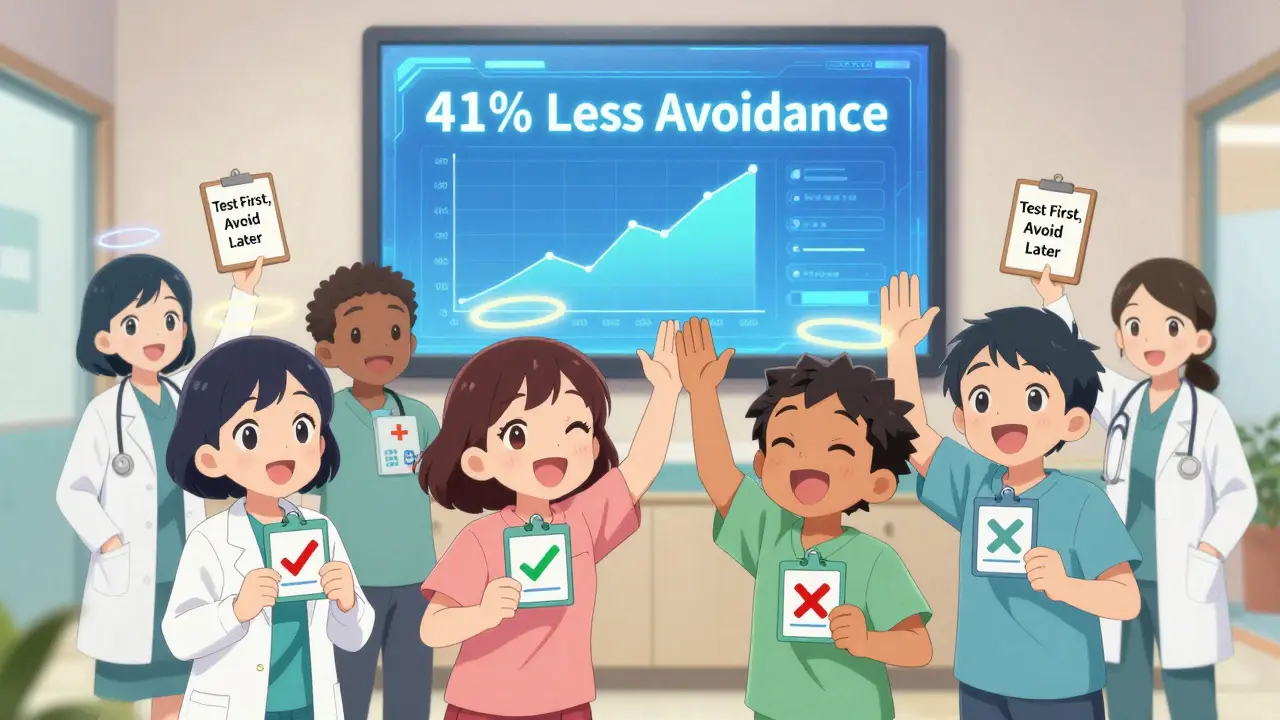
And AI tools are helping. A 2022 Mayo Clinic trial used an AI system to review allergy histories. It reduced inappropriate avoidance by 41%. That means fewer patients are being denied safe, effective drugs.
Bottom Line
Severe drug reactions are scary. But not every reaction means you need to avoid the whole drug family. The key is knowing the difference between:
- A true immune reaction (anaphylaxis, SJS, TEN) → Avoid the whole class.
- A non-allergic side effect (nausea, rash, muscle pain) → Try another drug in the class.
Don’t let a past label dictate your future care. If you’ve had a severe reaction, get evaluated. Ask for testing. Push for clarity. Your health depends on it.
If I had a rash from penicillin as a child, do I need to avoid all penicillin forever?
Not necessarily. Only about 10% of people labeled as penicillin-allergic have a true IgE-mediated allergy. Most rashes from childhood are non-allergic and don’t predict future reactions. A simple skin test or oral challenge under medical supervision can confirm whether you’re truly allergic. Many people who were told they’re allergic for decades find out they can safely take penicillin.
Can I take a cephalosporin if I’m allergic to penicillin?
It depends. The cross-reactivity between penicillin and cephalosporins is low-only 0.5% to 6.5%, depending on the specific drugs. If your reaction to penicillin was mild (like a rash), you’re likely safe. If you had anaphylaxis, avoid all beta-lactams until tested. Newer cephalosporins like ceftriaxone have even lower cross-reactivity. Always check with an allergist before taking one.
I had Stevens-Johnson syndrome from Bactrim. Do I need to avoid all sulfa drugs?
Yes. If you had Stevens-Johnson syndrome (SJS) or toxic epidermal necrolysis (TEN) from a sulfa antibiotic like Bactrim, you must permanently avoid all sulfonamide antibiotics. These reactions are immune-mediated and have a very high risk of recurrence. However, sulfa-containing drugs like diuretics (furosemide) or diabetes pills (glyburide) are chemically different and usually safe. Always confirm with your doctor.
Can I take NSAIDs again after a stomach bleed from ibuprofen?
You may be able to. A stomach bleed from ibuprofen is usually a side effect of how NSAIDs affect the stomach lining-not an allergy. Switching to a COX-2 inhibitor like celecoxib can reduce this risk significantly. Always take it with a stomach-protecting drug like omeprazole, and avoid long-term use. Never take another non-selective NSAID without consulting your doctor.
Why do doctors keep telling me to avoid entire drug classes if I only had one bad reaction?
Many doctors avoid risk by default. If they’re unsure whether a reaction was allergic or not, they err on the side of caution. But this often leads to over-avoidance. The latest guidelines say: don’t assume cross-reactivity without evidence. If your reaction wasn’t life-threatening or immune-driven, ask for testing. You might be able to safely use other drugs in the class.
Comments (9)
Gabrielle Conroy
February 24, 2026 AT 15:12
OMG YES THIS IS SO IMPORTANT!!! 🙌 I was told I'm allergic to penicillin because of a rash at age 6, and for 25 years I avoided it-until I got a life-threatening UTI and my doctor insisted on testing me. Turns out? I'm fine. They did a skin test and an oral challenge-no reaction. I took amoxicillin like a champ and didn't even get a tummy ache. Why do doctors just label you and move on?? We need more de-labeling programs!!
Nandini Wagh
February 25, 2026 AT 20:54
Of course doctors over-avoid. They'd rather you die of a kidney infection than get sued for one rash. 😒 I had a mild rash on sulfa at 19-now I'm 38 and need an antibiotic for pneumonia. They gave me vancomycin. $5000 dose. I asked if I could try a non-sulfa alternative. 'Nope.' So I paid out of pocket for a test. Turns out I'm fine. But now I'm on a blacklist. Thanks, healthcare system.
Ashley Johnson
February 27, 2026 AT 02:49
Wait. So you're saying the FDA and doctors are just wrong? That this is all a big pharmaceutical scam? I read somewhere that drug companies pay allergists to keep people afraid of penicillin so they can sell expensive alternatives. And what about the HLA-B*57:01 test? Isn't that just another way to sell genetic tests? I'm not saying I'm against testing-but we're being manipulated. I don't trust any of this.
Maranda Najar
February 28, 2026 AT 09:07
My heart is breaking. 😭 I had Stevens-Johnson syndrome from Bactrim when I was 22. I spent 87 days in the ICU. My skin peeled off in sheets. I lost my eyelashes. My nails fell out. I thought I’d never walk again. And now? I’m being told I might be able to take furosemide? That’s not just a drug-that’s a death sentence waiting to happen. You don’t understand trauma. You don’t understand the nightmares. Don’t tell me to ‘just get tested.’ I’ve lived this. I’m not your experiment.
Christopher Brown
February 28, 2026 AT 18:18
America’s healthcare is a joke. We let people avoid drugs because of a childhood rash? In my country, we test, we move on. No drama. No fear. Just science. You want to live? Stop being soft.
Sanjaykumar Rabari
March 1, 2026 AT 03:49
They are lying. All of this. The tests, the AI, the HLA stuff. It's all controlled by big pharma. They want you to think you're safe so they can sell you new drugs. I know people who got sick after 'safe' re-challenges. The system is rigged. Don't trust doctors. Don't trust tests. Just avoid everything. Forever.
Kenzie Goode
March 1, 2026 AT 11:02
I just want to say thank you for writing this. I’ve been terrified to take any antibiotics since my dad died from a reaction we didn’t understand. Reading this made me feel less alone. I’m going to ask my doctor about an allergist referral. Maybe I can finally stop living in fear. Thank you for the clarity.
Dominic Punch
March 2, 2026 AT 16:30
One of the most important posts I’ve read all year. Seriously. I work in a rural clinic and see this every day. A patient comes in with a UTI, labeled 'penicillin allergic'-so we give them cipro. They get diarrhea, then C. diff, then end up hospitalized. Meanwhile, the real solution? A 10-minute skin test. I’ve done 37 de-labeling referrals this year. 35 of them were safe. We need to change the culture. Not just the guidelines. The fear has to go.
Khaya Street
March 3, 2026 AT 08:35
Interesting. But why do we even have drug classes if we’re going to pick and choose? If you can take one cephalosporin after a penicillin reaction, why not just make them all the same? The whole classification system is outdated. Maybe we should stop grouping drugs and just test each one individually. Less confusion. Less fear. More science.