Warfarin Dosing Calculator
Personalized Warfarin Dosing Tool
Warfarin is a common blood thinner where dosing is critical. Your genetics, age, weight and target INR can significantly impact safety and effectiveness.
Ever taken a pill that worked perfectly for your friend but made you feel sick? You’re not alone. The same medication can save one person’s life and hospitalize another - not because of mistakes, but because of biology. Your genes, your age, what you eat, even the other drugs you take - all of it shapes how your body reacts to medicine. This isn’t random. It’s science. And it’s changing how doctors prescribe drugs.
Why Two People, One Pill, Totally Different Results
Think of your body like a factory. Drugs are like machines sent in to fix a broken part. But every factory is built differently. Some have faster assembly lines. Others have weaker tools. Some have extra safety checks. Your body’s factory is shaped by your genes. That’s why two people taking the same dose of warfarin - a blood thinner - can have wildly different outcomes. One stays stable. The other bleeds internally. This isn’t rare. About 1 in 10 people who go to the hospital get hurt by their own medication. In the U.S., adverse drug reactions are the fourth leading cause of death. In Europe, 3.6% of hospital admissions are due to side effects. And it’s not just old people. Young, healthy adults get hit too - often because their bodies process drugs in ways doctors don’t expect.Your Genes Are the Main Player
The biggest reason drugs affect people differently? Your DNA. Specifically, variations in genes that control how your body breaks down drugs. The most important players are enzymes called cytochrome P450 - CYP2D6, CYP2C9, and CYP2C19. These enzymes act like scissors, cutting drugs into pieces your body can get rid of. Some people have slow scissors. These are called poor metabolizers. About 5 to 10% of white Europeans have this with CYP2D6. They can’t break down drugs like codeine or antidepressants fast enough. So the drug builds up. Side effects? Nausea, dizziness, even breathing trouble. Others have super-fast scissors - ultra-rapid metabolizers. Up to 29% of people in Ethiopia have this version of CYP2D6. They turn codeine into morphine too quickly. A normal dose can overdose them. That’s why some people get no pain relief from codeine - their body turns it into something too strong too fast. It’s not just metabolism. Some genes change how drugs bind to their targets. For example, people with a certain variant in the VKORC1 gene need much lower doses of warfarin. Without testing, they’re at high risk of dangerous bleeding. In fact, CYP2C9 and VKORC1 variants together explain 30 to 50% of why warfarin doses vary so much between people. That’s why doctors who test for these genes reduce major bleeding by 31%.Age, Body Type, and Other Hidden Factors
Genes aren’t the whole story. Your body changes as you get older. Older adults have more body fat and less muscle. Fat-soluble drugs - like some antidepressants or sedatives - get stored in fat. That means they stick around longer. A dose that’s fine for a 30-year-old can build up in a 70-year-old and cause confusion or falls. Your liver and kidneys also slow down with age. These organs clear drugs from your blood. If they’re not working as well, even normal doses can become toxic. That’s why older adults are 300% more likely to have a bad reaction when taking five or more drugs at once. Even what you eat or what illness you have matters. If you’re sick with the flu or have an infection, your liver enzymes can drop by 20 to 50%. That means drugs aren’t broken down as fast. A normal dose of statins or antibiotics can suddenly become dangerous. And then there’s drug interactions. Amiodarone, a heart medicine, blocks the enzyme that breaks down warfarin. That can make warfarin levels jump 100 to 300%. One patient I read about had an INR over 10 - that’s life-threatening. Turns out, she was a poor metabolizer AND on amiodarone. Two hits. That’s how accidents happen.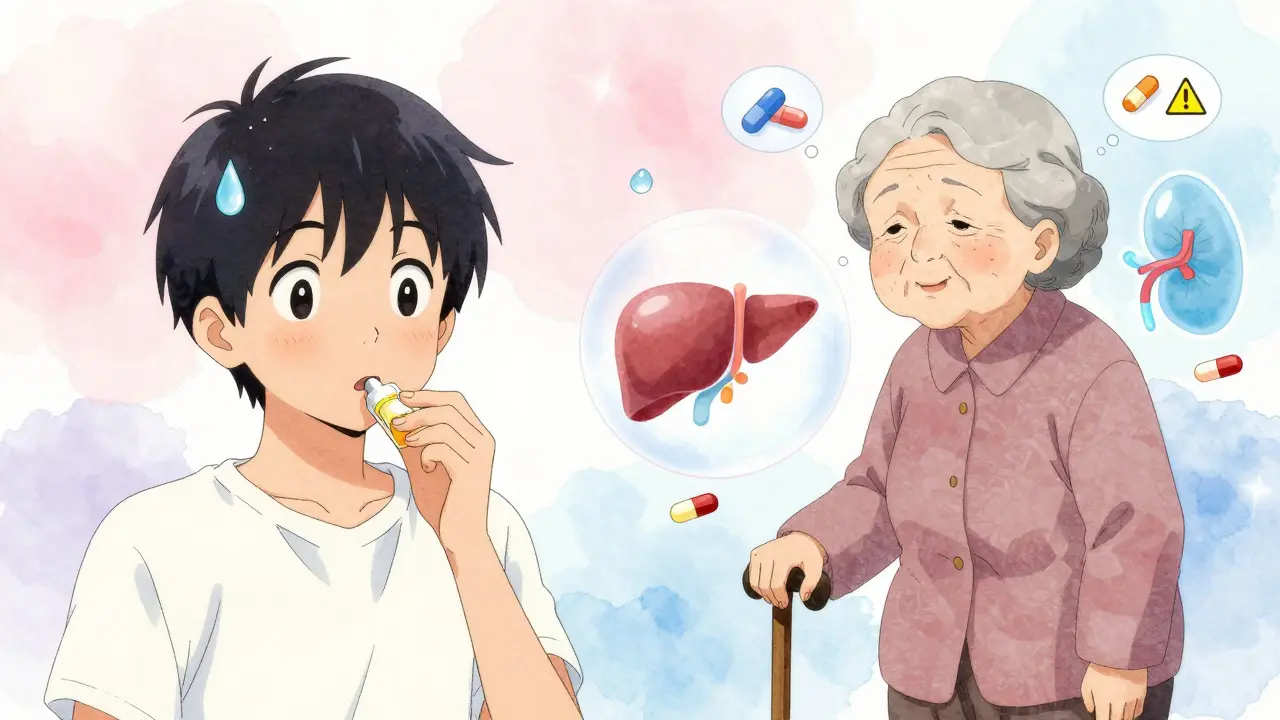
Pharmacogenomics: The Future of Prescribing
This is where pharmacogenomics comes in - using your genes to guide your treatment. The FDA now includes pharmacogenomic info on the labels of over 300 drugs. For 44 of them, they even give specific dosing advice based on genetics. Take clopidogrel, a drug used after heart attacks. About 2 to 15% of people have a CYP2C19 variant that makes the drug useless. They don’t get protection from clots. But if you test for it, doctors can switch them to a different drug. Same with antidepressants. If you’re a poor metabolizer of SSRIs, you’re more likely to get side effects and less likely to respond. Testing can save months of trial and error. In pediatric cancer, the results are stunning. At St. Jude’s, testing for TPMT gene variants before giving mercaptopurine dropped severe toxicity from 25% to just 12%. That’s a 52% reduction in life-threatening side effects. Even in asthma, genetics matter. About 15% of severe asthma patients have a variant in the LTC4 synthase gene. They respond dramatically better to leukotriene modifiers like zafirlukast - 45% better lung function. But for the other 85%? These drugs cost $250 to $300 a month and do almost nothing. Testing avoids wasting money and time.Why Isn’t Everyone Getting Tested?
If it’s so good, why aren’t we doing it all the time? First, most doctors haven’t been trained. A 2023 survey found 68% of physicians feel unprepared to use genetic test results. It takes 15 to 20 hours of training just to read the reports correctly. Second, insurance doesn’t always pay. Only 18% of U.S. insurers cover full pharmacogenomic testing. Medicare started covering 17 high-risk drugs in January 2024 - a big step - but many others still don’t. Third, the tech isn’t always ready. Only 32% of major hospitals have electronic systems that flag drug-gene conflicts when a doctor writes a prescription. So even if you’ve been tested, your doctor might never see the results. And here’s the catch: testing only looks at a few genes. CYP2D6, CYP2C9, CYP2C19 explain only 15 to 19% of all adverse reactions. There are thousands of other genes involved. A single test won’t catch everything. That’s why some experts warn against overpromising. Pharmacogenomics isn’t a magic bullet - it’s a powerful tool that’s still growing.
What’s Next? Polygenic Scores and Real-World Change
The next big leap is polygenic risk scores. Instead of looking at one or two genes, these scores combine hundreds - even thousands - of tiny genetic signals to predict how you’ll respond to a drug. Early studies show they’re 40 to 60% better at predicting outcomes than single-gene tests. The NIH’s Pharmacogenomic Resource for Clinical Care now has data from 1.2 million people. The FDA approved the first point-of-care CYP2C19 test in 2023 - results in 60 minutes. In Europe, starting in 2024, all new drug trials must include pharmacogenomic data. Costs are falling fast. In 2015, a full pharmacogenomic panel cost $2,000. Today? Around $250. That’s cheaper than a single specialist visit. And as prices drop, more clinics will start offering it - especially in oncology, psychiatry, and cardiology, where the benefits are clearest.What You Can Do Today
You don’t need a genetic test to be smarter about your meds. Start here:- Keep a full list of everything you take - including supplements and OTC drugs. Bring it to every appointment.
- Ask your doctor: "Could any of these drugs interact with my genes?" Or, "Is there a test that could help me avoid side effects?"
- If you’ve had a bad reaction to a drug before, tell your doctor. That’s valuable data.
- Don’t assume a drug that worked for someone else will work for you. Your body is unique.
Why do some people have side effects from a drug while others don’t?
It’s mostly due to genetic differences that affect how your body absorbs, breaks down, and responds to drugs. Other factors include age, liver and kidney function, other medications you’re taking, diet, and even infections. For example, some people have gene variants that make them poor metabolizers - meaning drugs build up in their system and cause side effects, while others break them down too quickly and get no benefit.
Can genetic testing prevent bad drug reactions?
Yes, in specific cases. Testing for genes like CYP2C9 and VKORC1 before starting warfarin reduces dangerous bleeding by 31%. Testing for CYP2C19 before prescribing clopidogrel prevents heart attack patients from getting a useless drug. In pediatric cancer, testing for TPMT cuts severe toxicity in half. But testing doesn’t catch every risk - it only covers a portion of known genetic factors.
Are side effects more common in older adults?
Yes. As people age, their liver and kidneys slow down, body fat increases, and muscle mass decreases. This changes how drugs are processed and stored. Older adults are also more likely to take multiple medications, which increases the risk of dangerous interactions. Studies show seniors on five or more drugs have a 300% higher chance of a bad reaction than younger adults.
What drugs are most likely to cause side effects?
The most common culprits are anticoagulants like warfarin, antiplatelets like clopidogrel, NSAIDs (like ibuprofen), diuretics, and certain antidepressants. These drugs have narrow safety margins - meaning small changes in blood levels can cause harm. Genetics, age, and other drugs all play a role in making these risks worse.
Is pharmacogenomic testing covered by insurance?
Coverage is improving but still limited. As of 2024, Medicare in the U.S. covers pharmacogenomic testing for 17 high-risk medications, including warfarin, clopidogrel, and some antidepressants. Private insurers cover it in only about 18% of cases. Costs have dropped from $2,000 in 2015 to around $250 today, making it more accessible - but you still need to ask your provider if it’s covered for your specific situation.
Comments (15)
Juan Reibelo
January 24, 2026 AT 01:42
So this is why my grandma went to the ER after taking her usual dose of blood pressure med-turns out, she’s a slow metabolizer for CYP2D6. Her doctor never tested her. We just assumed it was ‘old age.’ Turns out, it was genetics. Now she’s on a different drug, no more dizziness. Why isn’t this standard? 🤔
Himanshu Singh
January 24, 2026 AT 11:56
Man, this hits home. 😔 I took SSRIs for 8 months, felt like a zombie, then switched to another-one worked like magic. No one told me to get tested. Now I know: my CYP2C19 is a slowpoke. If we had this info upfront, I wouldn’t have wasted half a year feeling like a ghost. Pharma needs to stop treating us like lab rats.
Jamie Hooper
January 24, 2026 AT 18:31
so like… if i’m a super fast metabolizer, does that mean my coffee works faster too?? 😂 i swear i drink one cup and i’m already typing emails at 7am like a caffeinated robot. maybe my liver’s got a turbo button. also, why does everyone still take ibuprofen like it’s candy??
Husain Atther
January 26, 2026 AT 16:02
This is a profoundly important topic. The reduction in adverse drug reactions through pharmacogenomic screening is not merely a statistical improvement-it represents a paradigm shift in clinical ethics. To prescribe without considering genetic variability is, in many cases, an act of negligence masked as standard practice. The cost of testing is now lower than the cost of one hospitalization. The question is not whether we should implement this, but why we have not yet done so universally.
Izzy Hadala
January 28, 2026 AT 10:22
While the data presented is compelling, it is critical to acknowledge the limitations of current pharmacogenomic testing. The CYP450 system accounts for only a subset of metabolic pathways, and epigenetic factors, gut microbiome composition, and environmental exposures remain largely unaccounted for in clinical algorithms. The overreliance on single-gene markers may create a false sense of predictive certainty. Further research into polygenic risk scores is warranted, but clinical implementation must remain cautious and evidence-based.
Elizabeth Cannon
January 29, 2026 AT 03:22
my sister took warfarin and ended up in the hospital with a brain bleed. they never tested her genes. her doctor just said ‘oh you must’ve eaten too much spinach.’ SPINACH?? 😤 i’m so tired of doctors blaming the patient. we need mandatory genetic screening for high-risk meds. period. no more guessing games with people’s lives.
Phil Maxwell
January 30, 2026 AT 21:02
Yeah I’ve been on antidepressants for 5 years. Tried like 6 different ones. Some made me suicidal, others just made me sleepy. Finally found one that works. Never got tested. Maybe I’m just lucky. Or maybe I’m a weirdo who happens to match the right gene combo. Either way, I’m glad I didn’t give up.
Tommy Sandri
January 31, 2026 AT 04:29
In Japan, pharmacogenomic testing for clopidogrel and statins is routine in cardiology clinics. Why is the U.S. lagging? It’s not a technological gap-it’s a systemic one. Insurance incentives, physician training, and fragmented EHR systems create barriers that are political, not scientific. The science is ready. The infrastructure is not.
Josh McEvoy
February 1, 2026 AT 10:16
so i took codeine for a toothache and felt like i was floating on a cloud of pure joy. my friend took the same pill and threw up for 3 hours. i thought she was just weak. turns out i’m a super metabolizer and she’s a slowpoke. also, why is codeine even still a thing?? 🤡
Heather McCubbin
February 2, 2026 AT 01:44
Everyone thinks science is magic but nobody wants to pay for it. You want to live longer? Get tested. You want to avoid dying from your own meds? Pay $250. But nooo, let’s keep playing Russian roulette with prescriptions. It’s not the drugs that are dangerous-it’s the arrogance of doctors who think they know better than your DNA.
Karen Conlin
February 2, 2026 AT 19:38
I’m a nurse. I’ve seen this over and over. An elderly patient on 7 meds. No one checks for interactions. No one asks about genetics. They just keep adding pills. One day, they’re confused, falling, hospitalized. It’s not ‘old age.’ It’s preventable. We need to stop treating patients like one-size-fits-all widgets. We need to treat them like humans with unique biology. And yes-it’s worth the time and cost. Their lives depend on it.
asa MNG
February 3, 2026 AT 20:37
you guys are all missing the point. i took 3 different anxiety meds and each one made me feel like i was being eaten alive from the inside. finally found one that worked. turns out i’m a CYP2D6 ultra-rapid metabolizer. BUT HERE’S THE THING: my doctor didn’t even know what that meant. he just said ‘try this.’ so i googled it. i’m the one who taught him. why are we trusting people who don’t even know their own field? 🤦♂️
Chloe Hadland
February 5, 2026 AT 00:40
my mom had a bad reaction to a statin. they thought it was just ‘bad luck.’ turns out she has a variant in SLCO1B1. now she’s on a different one and feels great. i wish we’d known sooner. i’m just glad we found out before it got worse. this stuff matters. please, if you’ve ever had a weird reaction to a drug-tell your doctor. it might save someone else’s life.
Michael Camilleri
February 5, 2026 AT 20:21
People think genetics is the future but it’s just another way for Big Pharma to sell more tests. They’ll charge you $250 then upsell you their own branded meds. Meanwhile, the real problem? Overprescribing. Stop giving people so many drugs in the first place. You don’t need a gene test to know that 5 pills a day is asking for trouble.
Darren Links
February 7, 2026 AT 01:46
Why are we letting scientists play God with our bodies? Next they’ll be testing our kids’ genes before they even get a flu shot. This isn’t medicine-it’s eugenics with a lab coat. America used to value freedom. Now we’re being turned into data points for corporate pharmacology. I’d rather take my chances than let a machine decide what my body can handle.