Why does a cheap version of a popular medication take years to appear after its brand-name rival's patent expires? It’s a question that frustrates patients and healthcare providers alike. You might think that once a legal protection ends, the market floods with affordable alternatives immediately. In reality, the journey from patent expiration to actual shelf availability is a complex race involving regulatory hurdles, legal battles, and manufacturing logistics. This gap often spans several years, keeping prices high longer than expected.
Understanding this timeline helps explain why some generic drugs are scarce or expensive even when their intellectual property protections seem to have lapsed. The process isn't just about waiting for a clock to run out; it involves navigating a specific framework designed to balance innovation with competition. Let’s break down exactly what happens between the moment a patent dies and the day you can pick up a generic box at your local pharmacy.
The Legal Framework: How Generic Approval Works
To understand the delay, we first need to look at the rules of the game. In the United States, the primary vehicle for bringing a generic drug to market is the Abbreviated New Drug Application, or ANDA. Established by the Hatch-Waxman Act in 1984, this pathway allows manufacturers to prove that their version is bioequivalent to the original reference listed drug without repeating the costly and time-consuming clinical trials that took the innovator years to complete. This efficiency is crucial for making generics affordable, but it doesn't mean instant approval.
The FDA reviews these applications rigorously. According to recent data from the Federal Trade Commission, the average time required for FDA review and approval of an ANDA is approximately 25 months from the date of filing. That’s over two years just for the regulatory paperwork. But here’s the catch: FDA approval doesn’t always mean immediate market launch. If a brand-name company files a lawsuit within 45 days of receiving notice that a generic manufacturer intends to challenge their patent, a provision known as the 30-month stay kicks in. This effectively pauses the FDA’s final approval action until the court case is resolved. While this stay can be significant, research indicates that it is rarely the sole bottleneck; other factors often contribute to the total delay.
Patents vs. Exclusivity: More Than Just One Clock
A common misconception is that there is only one patent protecting a drug. In reality, pharmaceutical companies build a "thicket" of intellectual property rights. A single medication might be protected by patents on the active ingredient, the specific formulation, the manufacturing process, and even the method of use. Each of these patents has its own 20-year term starting from the filing date, not the approval date. This means that while the core compound patent might expire, a formulation patent could still be valid for another five years.
Beyond patents, there are regulatory exclusivity periods granted by the FDA that prevent generic entry regardless of patent status. For example, a New Chemical Entity (NCE) receives five years of exclusivity. Orphan drugs, which treat rare conditions, enjoy seven years of exclusive market access. Pediatric exclusivity adds six months to existing protections. These layers create a complex shield around the brand-name product. Dr. Aaron Kesselheim, a professor at Harvard Medical School, noted that the median time from patent expiration to generic entry is 21 months, but this varies wildly depending on how many layers of protection surround the specific drug. The more patents listed in the Orange Book-the FDA’s database of approved drugs and their patent information-the harder it is for generics to enter quickly.
The Litigation Race and Strategic Delays
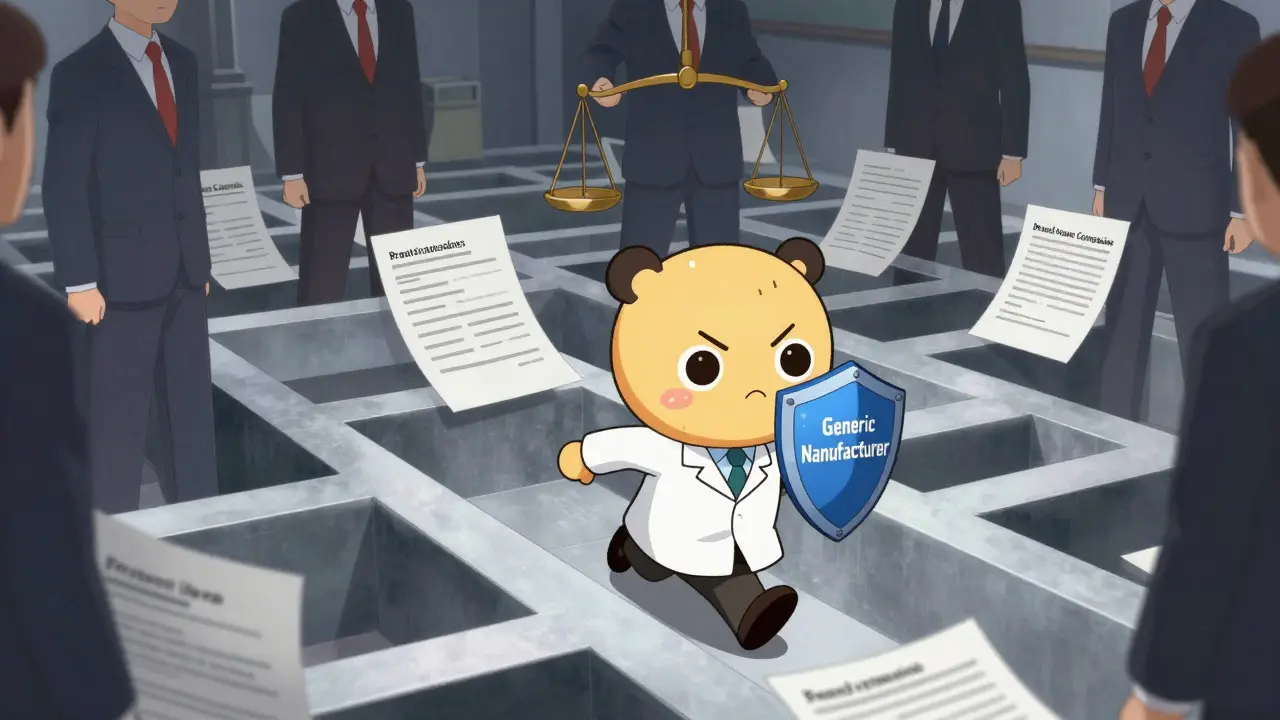
When a generic manufacturer decides to challenge a patent, they file a Paragraph IV certification. This asserts that the patent is invalid or will not be infringed. If successful, the first generic applicant earns 180 days of market exclusivity, meaning no other generic can enter during that window. This creates a strategic race. Manufacturers spend 18 to 24 months developing their product before filing, aiming to get ahead of the competition. However, if the brand-name company wins the lawsuit, or if they settle in a way that delays entry, the generic manufacturer may lose that exclusivity or face further delays.
Settlements play a massive role in this dynamic. Historically, "reverse payment" settlements, where the brand-name company pays the generic maker to wait, were a major source of delayed entry. Although the Supreme Court ruled in 2021 that such secret settlements violate antitrust laws, they still influence timing. The FTC estimated that patent litigation settlements cost consumers billions annually. On average, a drug with multiple related patents sees generic entry delayed by 28 months compared to a drug with a single patent. This "thicket effect" means that for high-revenue drugs, which often have dozens of patents, the wait can stretch to three or four years post-expiration.
Manufacturing Realities and Market Entry
Even after winning the legal battle and getting FDA approval, getting the drug onto shelves takes time. The first generic filer must launch within 75 days of approval to keep their 180-day exclusivity. This tight deadline puts immense pressure on manufacturing. If there are supply chain issues, quality control problems, or packaging delays, the exclusivity period can be forfeited. Data shows that while 68% of first generic applicants successfully launch within the window, nearly a quarter lose out due to manufacturing hiccups.
For complex generics, such as those involving difficult-to-absorb compounds or new delivery systems, the development phase alone can take up to 36 months. Companies like Sandoz have found success by developing multiple formulations simultaneously, having backup processes ready to go. This proactive approach minimizes the risk of missing the launch window. However, for smaller manufacturers, these costs and risks can be prohibitive, leading to fewer competitors entering the market and potentially higher prices for consumers during the early stages of generic availability.
Economic Impact and Future Trends
The delay between patent expiration and generic launch has profound economic consequences. Generic drugs account for 92% of prescriptions in the US but only 16% of total drug spending, saving the healthcare system hundreds of billions annually. Every year of delay keeps prices artificially high. The Congressional Budget Office estimates that a one-year delay in generic entry for a top-selling drug can cost Medicare $1.2 billion. As we move forward, regulations like the GDUFA II aim to streamline the review process for complex generics, targeting a reduction in review times from 36 months to 24. Additionally, the rise of biosimilars for biologic drugs offers a parallel path, though these face similar, if not more complex, regulatory hurdles under the BPCIA pathway. Despite ongoing improvements, the median gap remains a significant barrier to affordable medicine, highlighting the need for continued vigilance in both regulatory policy and market competition.
How long does it typically take for a generic drug to appear after patent expiration?
On average, it takes about 21 months for a generic drug to reach the market after the relevant patent expires. However, this can vary significantly; simple small molecules might appear within 1.5 years, while complex biologics or drugs with multiple patent thickets can take 3 to 5 years.
What is the difference between patent expiration and regulatory exclusivity?
Patent expiration refers to the end of the legal right to exclude others from making the invention, lasting 20 years from filing. Regulatory exclusivity is a separate protection granted by the FDA (like NCE or Orphan Drug exclusivity) that prevents generic approval for a set period (e.g., 5 or 7 years), regardless of patent status. Both must lapse for generics to enter freely.
What is the 30-month stay in generic drug approval?
The 30-month stay is a provision in the Hatch-Waxman Act that pauses the FDA's approval of a generic drug application if the brand-name manufacturer sues them for patent infringement within 45 days of a Paragraph IV certification. It gives courts time to resolve the dispute before the generic can be officially approved.
Why do some generic drugs cost more than others?
Pricing depends on the number of competitors. If only one or two generic manufacturers enter the market due to high development costs or patent barriers, they can charge higher prices. Once more competitors join, competition drives prices down. The first generic entrant also has 180 days of exclusivity, allowing them to maintain higher prices temporarily.
Can I trust generic drugs to be the same as brand-name versions?
Yes. To get FDA approval via the ANDA pathway, generic drugs must demonstrate bioequivalence to the brand-name drug. This means they deliver the same amount of the active ingredient into the bloodstream at the same rate. They may differ in inactive ingredients (color, shape, fillers) but are therapeutically equivalent.