Drug Interaction Checker
Select two or more medications to check for potential interactions. This tool demonstrates common interaction patterns discussed in the article.
How It Works
This checker analyzes:
- CYP450 Enzyme inhibition/induction
- P-glycoprotein transporter effects
- Pharmacodynamic synergies/antagonisms
- Absorption interference
Imagine taking a pill for your heart condition and another for an infection. You expect them to work together, but instead, one cancels out the other, or worse, they combine to create a toxic effect in your body. This isn't science fiction; it is a daily reality for millions of people managing multiple medications. These are drug-drug interactions, and understanding how they happen is the difference between effective treatment and a trip to the emergency room.
We often think of drugs as isolated tools that fix specific problems. In reality, our bodies are complex chemical factories where these tools constantly bump into each other. When two drugs meet inside you, they don't just sit politely in separate corners. They compete for resources, alter each other's chemistry, and sometimes amplify effects to dangerous levels. To stay safe, we need to look under the hood at the mechanisms driving these changes.
The Two Main Pathways of Interaction
To understand why interactions happen, we have to split them into two broad categories based on what actually changes in your body. The first type is pharmacokinetic interaction. This happens when one drug changes the concentration of another drug in your bloodstream. It’s about quantity: does Drug A make there too much or too little of Drug B? The second type is pharmacodynamic interaction. Here, the amount of drug in your blood stays the same, but the drugs affect the same biological target or system, changing the final effect. It’s about quality: do the effects add up, cancel out, or clash?
Think of it like traffic. A pharmacokinetic interaction is like a roadblock (Drug A) stopping cars (Drug B) from reaching their destination, causing a backup. A pharmacodynamic interaction is like two drivers trying to steer the same car in opposite directions, causing chaos regardless of how many cars are on the road.
Pharmacokinetics: The Journey Through the Body
When a drug enters your body, it goes through four main stages: absorption, distribution, metabolism, and excretion. Interactions can disrupt any of these steps.
Absorption issues often happen in the gut. Some drugs change the acidity of your stomach or slow down how fast food moves through your intestines. If your gut motility slows down, a drug might sit in your stomach longer than intended, leading to higher absorption. Conversely, some drugs bind to others in the gut, forming a lump that your body can’t absorb at all. For example, taking certain antibiotics with calcium supplements can result in neither being properly absorbed.
Distribution problems involve how drugs travel through your blood. Many drugs hitch a ride on proteins in your blood plasma to get around. If two drugs need the same protein seat, the stronger binder kicks the weaker one off. Suddenly, the displaced drug floats freely in your blood, potentially reaching toxic levels because it’s no longer buffered by the protein.
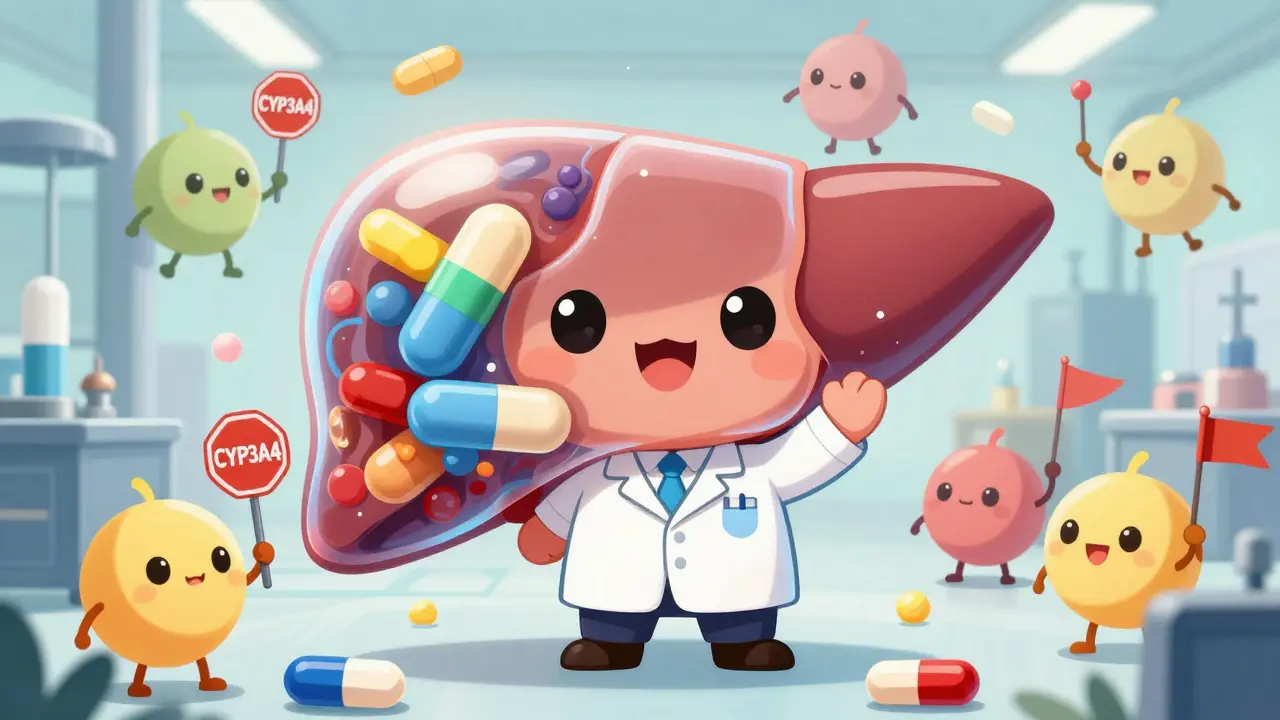
However, the biggest culprit in pharmacokinetic interactions is metabolism. Your liver acts as the body’s primary detox center, using a family of enzymes called cytochrome P450 (CYP) to break down drugs. About 70-80% of all clinically used drugs are processed by these enzymes. The most important player here is CYP3A4, which handles roughly 50% of all medications.
| Enzyme | Percentage of Drugs Metabolized | Common Examples |
|---|---|---|
| CYP3A4 | ~50% | Simvastatin, Midazolam, Calcium Channel Blockers |
| CYP2D6 | ~25% | Codeine, Metoprolol, Tamoxifen |
| CYP2C9 | ~10-15% | Warfarin, Phenytoin |
| CYP2C19 | ~10% | Clopidogrel, Omeprazole |
Here is where things get tricky. Some drugs act as inhibitors, blocking these enzymes. If you take a strong inhibitor like ketoconazole along with simvastatin (a cholesterol drug), the enzyme can’t break down the statin. Simvastatin levels can skyrocket by 10 to 20 times, drastically increasing the risk of rhabdomyolysis-a severe muscle breakdown condition. Other drugs act as inducers, speeding up enzyme production. St. John’s Wort, a popular herbal supplement, induces CYP3A4, which can reduce the effectiveness of birth control pills or immunosuppressants like cyclosporine by half.
Pharmacodynamics: Clashing Effects
Sometimes, the drugs don’t interfere with each other’s chemistry, but they do interfere with each other’s job. This is a pharmacodynamic interaction. These can be synergistic (working together to amplify an effect) or antagonistic (working against each other).
Synergistic interactions aren’t always bad. Combining acetaminophen and ibuprofen for pain relief is a common, safe example of synergy. But dangerous synergy exists too. Consider QT interval prolongation. Both fluoroquinolone antibiotics (like ciprofloxacin) and macrolide antibiotics (like erythromycin) can slightly lengthen the electrical cycle of your heart. Taken alone, this might be harmless. Taken together, the risk of a fatal arrhythmia called torsades de pointes increases by nearly six times.
Antagonistic interactions usually mean treatment failure. If you take a beta-blocker to lower your heart rate and someone accidentally gives you a stimulant like albuterol for asthma, the drugs fight each other. The beta-blocker tries to slow the heart, while the albuterol speeds it up. The result? Neither drug works effectively, and your symptoms remain uncontrolled.
Transporters: The Hidden Gatekeepers
We often focus on enzymes, but transporters play a huge role too. Proteins like P-glycoprotein (P-gp) act as pumps, moving drugs in and out of cells. P-gp pushes drugs out of the brain and back into the gut or urine. If you take verapamil, a blood pressure medication that inhibits P-gp, alongside digoxin, a heart medication, the pump stops working efficiently. Digoxin builds up in your system, increasing its concentration by 50-100%. Since digoxin has a narrow therapeutic window, this buildup can quickly lead to life-threatening heart rhythms.
Who Is Most at Risk?
Not everyone faces the same level of danger. The risk skyrockets with polypharmacy, which is simply taking five or more medications daily. This is common in elderly patients. Studies show that drug interactions account for 3-5% of hospital admissions in people over 65. The American Geriatrics Society’s Beers Criteria identifies 30 high-risk combinations for older adults, such as mixing NSAIDs (like ibuprofen) with anticoagulants (like warfarin), which triples to quintuples the risk of bleeding.
Genetics also play a surprising role. Some people are "poor metabolizers" due to genetic variations in their CYP enzymes. For instance, if you lack functional CYP2D6, you might not convert codeine into morphine, meaning it won’t relieve your pain. Others are "ultrarapid metabolizers," turning codeine into morphine so fast that they risk respiratory depression even at normal doses. This is why personalized medicine is becoming so critical.
Prevention and Management Strategies
So, how do you protect yourself? First, maintain a master list of every medication you take, including over-the-counter drugs and herbal supplements. Many people forget that St. John’s Wort or grapefruit juice interacts with prescription meds. Grapefruit juice contains furanocoumarins that permanently inhibit CYP3A4 in the gut, keeping this inhibition active for days after consumption.
Second, utilize technology wisely. Electronic health records (EHRs) now include interaction checkers. However, these systems suffer from "alert fatigue." Clinicians override up to 96% of alerts because many are low-severity or irrelevant. Newer systems are getting smarter, using context-aware algorithms to flag only the dangerous combinations. As a patient, you can ask your pharmacist to run a comprehensive review. Pharmacists are trained experts in pharmacology and can spot risks that doctors might miss during a busy appointment.
Finally, monitor closely. If you start a new medication, watch for unexpected side effects. Dizziness, unusual bruising, muscle pain, or sudden changes in mood can be signs of an interaction. Therapeutic Drug Monitoring (TDM) involves testing blood levels for drugs like warfarin (checking INR levels) or lithium to ensure they stay within the safe range.
What is the most common drug-drug interaction?
One of the most frequently reported interactions involves anticoagulants like warfarin. Warfarin interacts with hundreds of drugs, including common antibiotics and NSAIDs. Data from the FDA Adverse Event Reporting System shows warfarin is involved in nearly 29% of all reported drug interaction cases. Another very common issue is the combination of opioids and benzodiazepines, which significantly increases the risk of respiratory depression and overdose.
Can natural supplements cause drug interactions?
Yes, absolutely. Many people assume "natural" means "safe," but supplements can be potent pharmacological agents. St. John’s Wort is a powerful inducer of CYP3A4 and P-glycoprotein, reducing the effectiveness of birth control, HIV medications, and transplant drugs. Garlic and ginkgo biloba can increase bleeding risk when taken with blood thinners. Always tell your doctor about any supplements you use.
How long does it take for a drug interaction to occur?
It depends on the mechanism. Pharmacokinetic interactions involving enzyme induction (like with rifampin or carbamazepine) can take several days to weeks to reach full effect as the body produces more enzymes. Inhibition-based interactions (like with ketoconazole) can happen almost immediately upon starting the second drug. Pharmacodynamic interactions, like additive sedation from alcohol and antihistamines, occur instantly.
What should I do if I suspect a drug interaction?
Do not stop taking your prescribed medication abruptly, as this can cause withdrawal or rebound effects. Instead, contact your healthcare provider or pharmacist immediately. Describe your new symptoms and provide a list of all substances you have taken recently. They may adjust your dosage, switch to a non-interacting alternative, or order blood tests to check drug levels.
Are there apps or tools to check for drug interactions?
Yes, several reputable resources exist. The University of Liverpool’s HIV Drug Interactions Checker is a gold standard for antiretroviral therapies. For general medications, tools like Epocrates or Micromedex are used by professionals. Patients can use consumer-friendly apps provided by major pharmacies, but remember that these tools are aids, not replacements for professional medical advice. Context matters, and AI models are improving prediction accuracy, but human judgment remains essential.