
Imagine a child needing a thyroid medication. The standard pill is too big to swallow, and crushing it destroys the drug's effectiveness. A compounding pharmacy steps in, creating a tiny, flavored liquid drop specifically for that child. It sounds like a perfect solution, right? But what if the pharmacist miscalculates the strength by just a fraction? That "perfect" dose could become dangerous. This is the reality of pharmaceutical compounding, the practice of customizing medications for individual patients when commercial options fail.
Compounding saves lives and improves quality of life for millions. Yet, because these drugs are made one at a time rather than mass-produced in factories, they carry unique risks. Without strict safeguards, small mistakes can compound-literally-into serious harm. So, how do we keep this essential service safe? The answer lies in rigorous protocols, technology, and a culture of double-checking everything.
Understanding the Risk Landscape
To prevent errors, you first need to understand where they come from. Unlike FDA-approved drugs that undergo massive clinical trials with thousands of participants, compounded medications are not tested for safety or efficacy before they reach the patient. According to the U.S. Food and Drug Administration (FDA), the federal agency responsible for protecting public health through regulation of food, drugs, and medical devices, this lack of pre-market approval means the burden of safety falls entirely on the pharmacy preparing the drug.
The stakes are high. Data from the FDA shows that while compounding makes up only about 1.5% of total prescriptions, it accounts for nearly 5% of medication error reports. Why? Because human beings make mistakes. Whether it’s misreading a label, miscalculating a dilution, or using contaminated equipment, the margin for error is slim. The tragic 2012 meningitis outbreak linked to the New England Compounding Center highlighted this vulnerability starkly. Over 60 deaths resulted from contaminated steroid injections, leading to major regulatory shifts including the Drug Quality and Security Act of 2013.
This act split the industry into two categories: Section 503A pharmacies (traditional local compounds) and Section 503B outsourcing facilities. Studies show that 503B facilities have a 22% lower error rate because they follow stricter Current Good Manufacturing Practices (CGMPs). For most patients, however, care happens in 503A settings, making local protocol adherence critical.
Core Safety Protocols: The USP Standards
If there is a bible for compounding safety, it is the United States Pharmacopeia (USP) General Chapters. These aren't suggestions; they are enforceable standards that dictate how every step of the process should happen.
- USP <795> (Non-Sterile Compounding): Covers pills, creams, and liquids. It requires a dedicated clean area with ISO Class 8 air quality or better. Think of this as a controlled environment free from dust and pests.
- USP <797> (Sterile Compounding): Applies to injections and eye drops. This demands an ISO Class 5 primary engineering control, typically a laminar airflow hood or isolator. Any breach here can introduce bacteria directly into the bloodstream.
- USP <800> (Hazardous Drugs): Protects staff and patients from toxic substances like chemotherapy agents, requiring closed-system transfer devices.
Adherence to these standards reduces compounding errors by at least 60%, according to Dr. Linda Tyler, Chair of the USP Compounding Expert Committee. But following the rules isn't enough. You must also verify that your environment actually meets them. This means regular particle counting, air pressure monitoring, and surface sampling.
The Power of Dual Verification
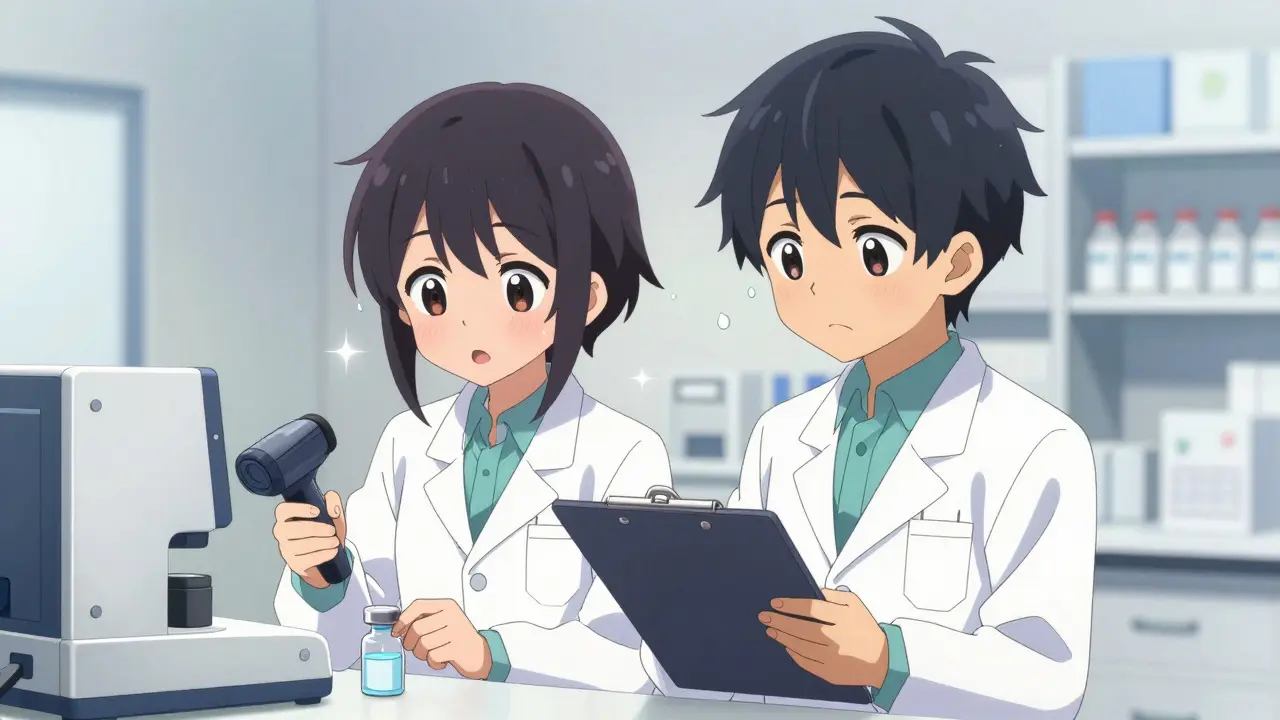
No single person should ever be the final gatekeeper for a compounded dose. The gold standard in error prevention is the dual-check system. This doesn't mean glancing over someone else's shoulder. It requires a second qualified professional to independently perform all calculations and verifications from scratch.
Here is how it works in practice:
- Independent Calculation: Pharmacist A calculates the amount of active ingredient needed. Pharmacist B takes the original prescription, ignores Pharmacist A’s work, and performs the math again.
- Ingredient Verification: Both pharmacists check the identity, purity, and potency of each component. This might involve checking lot numbers against certificates of analysis or using tools like Fourier-transform infrared spectroscopy (FTIR).
- Final Product Check: Before labeling, both professionals inspect the final mixture for clarity, color, and consistency.
This redundancy catches the types of errors that slip past even experienced eyes. For example, a decimal point placed incorrectly in a calculation can change a dose by tenfold. If both people make the same mistake, it’s rare-but if one catches the other, a crisis is averted. The American Society of Health-System Pharmacists (ASHP) strongly recommends this approach in their 2020 guidelines.
Technology as a Safety Net
Human attention fades. Technology does not. Integrating specialized software into the compounding workflow is no longer a luxury; it’s a necessity. Tools like Compounding.io, software designed to streamline and secure the pharmaceutical compounding process and PharmScript offer built-in calculation checks and automated formula verification.
A 2022 study published in the Journal of the American Pharmacists Association found that such electronic batch records reduced human error by approximately 40%. How? By forcing the user to input specific data points. If the math doesn’t balance, the system flags it immediately. Barcode scanning adds another layer. Scanning ingredients ensures you are using the correct substance and concentration, eliminating the risk of picking up a vial that looks similar but contains a different drug.
Looking ahead, AI-powered systems like CompoundingGuard AI are showing promise. In a 2022 pilot study across 15 pharmacies, this technology reduced calculation errors by 87%. While AI won’t replace pharmacists, it acts as an tireless assistant, spotting patterns and anomalies that humans might miss.
Labeling: The Last Line of Defense
You can prepare the perfect dose, but if the label is confusing, the patient might take it wrong. Labeling inconsistencies are cited by 67% of pharmacists as their top safety concern. Misinterpretation of concentration units has led to real-world tragedies, including 27 fentanyl overdose incidents reported to the FDA between 2018 and 2022.
Clear labeling means:
- Standardized Units: Always state concentration clearly (e.g., "mg/mL"). Never assume the patient knows what "grain" or "unit" means.
- Beyond-Use Dates (BUDs): Clearly mark when the medication expires. Non-sterile compounds typically last 30-180 days, while sterile ones may last only hours. Using outdated meds can lead to ineffective treatment or infection.
- Simplified Instructions: Use plain language. Instead of "take q.i.d.", write "take four times a day."
The FDA’s 2023 draft guidance mandates standardized concentration labeling to prevent these exact issues. Until then, pharmacies must go above and beyond to ensure labels are unambiguous.
| Strategy | Error Reduction Impact | Implementation Cost |
|---|---|---|
| Dual Verification | Catches ~60% of calculation errors | High (increases prep time by 25-40%) |
| Barcode Scanning | Reduces ID errors by 92% | Medium ($15k-$50k for equipment) |
| Compounding Software | Reduces overall error by ~40% | Low-Medium (subscription fees) |
| PCAB Accreditation | Lowers facility-wide error rates significantly | High ($15k-$25k initial + ongoing) |

Training and Culture
Protocols sit on paper until people bring them to life. Dr. Henry Cohen, past president of the International Academy of Compounding Pharmacists (IACP), states that rigorous staff training with quarterly competency assessments is the single most effective error prevention strategy.
What does good training look like?
- Initial Education: At least 40 hours of compounding-specific instruction covering calculations, aseptic technique, and chemical compatibility.
- Ongoing Learning: 8-12 hours of annual continuing education, especially as standards like USP <795> and <797> evolve.
- Media Fill Testing: For sterile compounding, staff must pass media fill tests twice a year to prove they can maintain sterility.
But training is more than just classes. It’s about fostering a culture where speaking up is encouraged. If a technician sees something odd-a strange smell, a cloudy solution-they should feel empowered to stop the line without fear of reprimand. The Joint Commission found that inadequate procedures were a root cause in 18% of medication error sentinel events. Often, these failures stemmed from a culture that prioritized speed over safety.
Accreditation: A Mark of Trust
For patients and prescribers, how do you know which pharmacy to trust? Look for accreditation. The Pharmacy Compounding Accreditation Board (PCAB) sets voluntary standards that exceed many state requirements. As of 2023, only 18% of compounding pharmacies hold PCAB accreditation, up from 8% in 2018.
Why does this matter? Accredited facilities demonstrate consistent quality. They undergo rigorous inspections, maintain detailed documentation, and commit to continuous improvement. While the process takes 12-18 months and costs $15,000-$25,000, it signals to the community that the pharmacy is serious about safety. In non-accredited facilities, error rates can be as high as 25%, compared to 2% in accredited ones, according to Harvard Medical School researchers.
Next Steps for Stakeholders
For Pharmacists: Audit your current processes. Are you doing dual checks? Is your software up to date? Schedule a mock inspection against USP standards. Invest in barcode scanners if you haven’t already.
For Prescribers: Know your compounding partners. Ask about their accreditation status and error reporting practices. Specify concentrations clearly in prescriptions to avoid ambiguity.
For Patients: Don’t be afraid to ask questions. Where was this made? Who checked the dose? What is the expiration date? If a medication looks or smells different than expected, call the pharmacy before taking it.
Preventing compounding errors isn’t about achieving perfection-it’s about building layers of defense so that when humans inevitably slip, the system catches them. By combining strict standards, smart technology, and a vigilant culture, we can ensure that customized medicine remains a lifeline, not a liability.
What is the biggest risk in pharmaceutical compounding?
The biggest risk is calculation or formulation errors leading to incorrect dosages. Since compounded drugs aren't clinically tested like FDA-approved medications, any mistake in mixing or measuring directly affects the patient. Contamination in sterile compounding is another major risk.
How can I tell if a compounding pharmacy is safe?
Look for PCAB (Pharmacy Compounding Accreditation Board) accreditation. Also, check if the pharmacy follows USP <795>, <797>, and <800> standards. Safe pharmacies will openly discuss their quality control measures, dual-check processes, and staff training protocols.
What is the difference between 503A and 503B pharmacies?
503A pharmacies are traditional compounding pharmacies that prepare drugs based on individual prescriptions. 503B outsourcing facilities operate on a larger scale, often producing stock supplies, and are subject to stricter FDA oversight and Current Good Manufacturing Practices (CGMPs).
Why is dual verification important in compounding?
Dual verification involves two independent professionals checking calculations and ingredients. This redundancy catches errors that a single person might miss, such as decimal point mistakes or wrong ingredient selection, significantly reducing the risk of patient harm.
How long do compounded medications last?
It depends on the type. Non-sterile compounded preparations typically have beyond-use dates (BUDs) of 30 to 180 days. Sterile preparations vary widely, from just 3 hours for some IV mixes to 45 days for others, depending on storage conditions and preparation methods.
Comments (10)
Rachel Robinson Interiors
August 15, 2026 AT 00:34
This is such a vital topic that often gets overlooked by the general public. We tend to trust that anything coming from a pharmacy is automatically safe, but as this article highlights, the compounding process introduces unique variables. The section on dual verification really resonated with me because it emphasizes human accountability over blind reliance on systems. It is encouraging to see that there are established protocols like USP standards in place to mitigate these risks. I think more patients need to be educated on asking questions about their medication sources rather than just accepting what they are given without inquiry.
The statistics regarding error rates in non-accredited facilities versus accredited ones are quite alarming and should serve as a wake-up call for anyone relying on custom medications. Thank you for sharing this comprehensive guide; it provides actionable steps for both healthcare providers and patients to ensure safety.
Michael Smith
August 15, 2026 AT 23:25
oh great another list of rules nobody follows
pharmacists are too busy counting pills to care about your fancy ai software
olatunde oluranti
August 16, 2026 AT 02:51
The FDA is just a puppet for big pharma trying to squeeze every last dollar out of sick people. They claim these errors are due to 'human mistake' but we all know it's about cutting corners to maximize profit margins. The 2012 meningitis outbreak wasn't an accident, it was negligence covered up by regulatory capture.
Why do we trust these outsourcing facilities? Because they pay off the inspectors. The whole system is rigged against the patient who just wants medicine that doesn't kill them slowly. You think PCAB accreditation means anything? It's a stamp bought with money, not quality. Wake up sheeple.
teresa baldini
August 17, 2026 AT 20:18
Indeed! And furthermore, let us not forget the sinister implications of standardized labeling! They want to control how we read, how we think, and ultimately, how we consume our so-called 'medicines.' The use of plain language is a subtle form of indoctrination, stripping away the medical terminology that once empowered the layperson to question authority.
Moreover, the push for AI-powered systems like CompoundingGuard AI is nothing short of a dystopian nightmare where algorithms dictate our health outcomes without human oversight or empathy. Who programs these AIs? Who audits them? The answer is: no one! It is a black box of corporate greed disguised as technological progress. We must resist this encroachment on our bodily autonomy!
Eunice Chen
August 18, 2026 AT 18:16
i think its scary but also good info
my mom uses compounded meds and i never thought about checking if the pharmacy was accredited
thanks for posting this
Paul Coar
August 19, 2026 AT 05:40
hey everyone just wanted to say this is super important stuff
we gotta look out for each other and make sure our meds are safe
the part about culture and speaking up was really cool
if u see something weird say something dont be shy
lets keep pushing for better safety standards everywhere
no cap this needs more attention
Jesse Barlau
August 19, 2026 AT 19:11
It is imperative to consider the broader implications of the regulatory frameworks discussed herein, particularly when one examines the historical context of pharmaceutical oversight and the subsequent evolution of compounding practices within the United States healthcare system. The distinction between Section 503A pharmacies and Section 503B outsourcing facilities is not merely a semantic difference but represents a fundamental shift in the liability structure and the expected standard of care that patients can reasonably anticipate when seeking customized therapeutic interventions.
Furthermore, the integration of technology, while promising, must be viewed through the lens of complementary support rather than replacement, as the nuanced decision-making processes inherent in clinical pharmacology require a level of contextual understanding that current artificial intelligence models have yet to fully encapsulate. Therefore, the emphasis on rigorous staff training and the cultivation of a safety-first culture remains the cornerstone of effective error prevention strategies, underscoring the necessity for continuous professional development and adherence to established best practices such as those outlined by the United States Pharmacopeia.
Usha Ranji
August 21, 2026 AT 00:46
I work in a hospital pharmacy and can confirm that the dual-check system is absolutely critical. It feels tedious sometimes when we are behind on prescriptions, but knowing that a second pair of eyes has verified the calculation gives us peace of mind. The barcode scanning implementation was a game-changer for us a few years ago; it eliminated so many near-misses with look-alike vials.
One thing I would add is that communication with prescribers is key. Often, errors start with ambiguous orders. If a doctor writes 'make up some liquid amoxicillin,' there is room for interpretation on concentration. Being specific helps the pharmacist avoid having to guess. Great article highlighting these essential points.
sonia rockett
August 22, 2026 AT 11:46
Stop making excuses for lazy pharmacists! If you cant get the dose right you shouldnt be working! This industry is full of incompetent people who hurt kids for fun basically. Get your act together or get out! Patients deserve better than half-assed efforts and vague guidelines. Demand perfection or demand nothing at all!
Daniel Cook
August 22, 2026 AT 22:02
Interesting read. The data on error reduction with software is compelling. Just observing that adoption seems slow in smaller rural pharmacies likely due to cost constraints mentioned in the table.