Imagine you are about to hand a bottle of pills to a patient. The label says "Metformin." But what if it’s the wrong strength? What if it’s the wrong manufacturer? One small mistake can lead to serious health consequences. This is why the National Drug Code (NDC) exists. It is not just a random string of numbers on a pharmacy label. It is the universal fingerprint for every drug product in the United States. Reading this code correctly is one of the most powerful ways to prevent dispensing errors and ensure patient safety.
If you have ever looked at a medication box and felt confused by those hyphenated numbers, you are not alone. The format changes, the rules seem arbitrary, and the stakes are high. In this guide, we will break down exactly how to read an NDC number, verify the correct medication, and avoid common pitfalls that even experienced professionals sometimes miss.
What Is the NDC Number?
The National Drug Code (NDC) is a unique 10-digit, 3-segment numerical identifier assigned to medication products in the United States. It was created by the Food and Drug Administration (FDA) under the Drug Listing Act of 1972. Think of it as the Social Security Number for drugs. Every prescription and over-the-counter finished drug product must have one.
Why does it matter? Because generic names can be misleading. Two different companies might make the same drug, but with different inactive ingredients or packaging sizes. The NDC tells you exactly who made it, what is in it, and how much is in the package. According to FDA data from October 2023, there are over 150,000 active listings in their directory. Without the NDC, tracking these variations would be nearly impossible.
The Anatomy of an NDC Code
To read an NDC, you need to understand its three parts. These segments are separated by hyphens. However, here is the tricky part: the length of each segment can vary. There are three standard formats:
- 4-4-2: Four digits for the labeler, four for the product, two for the package.
- 5-3-2: Five digits for the labeler, three for the product, two for the package.
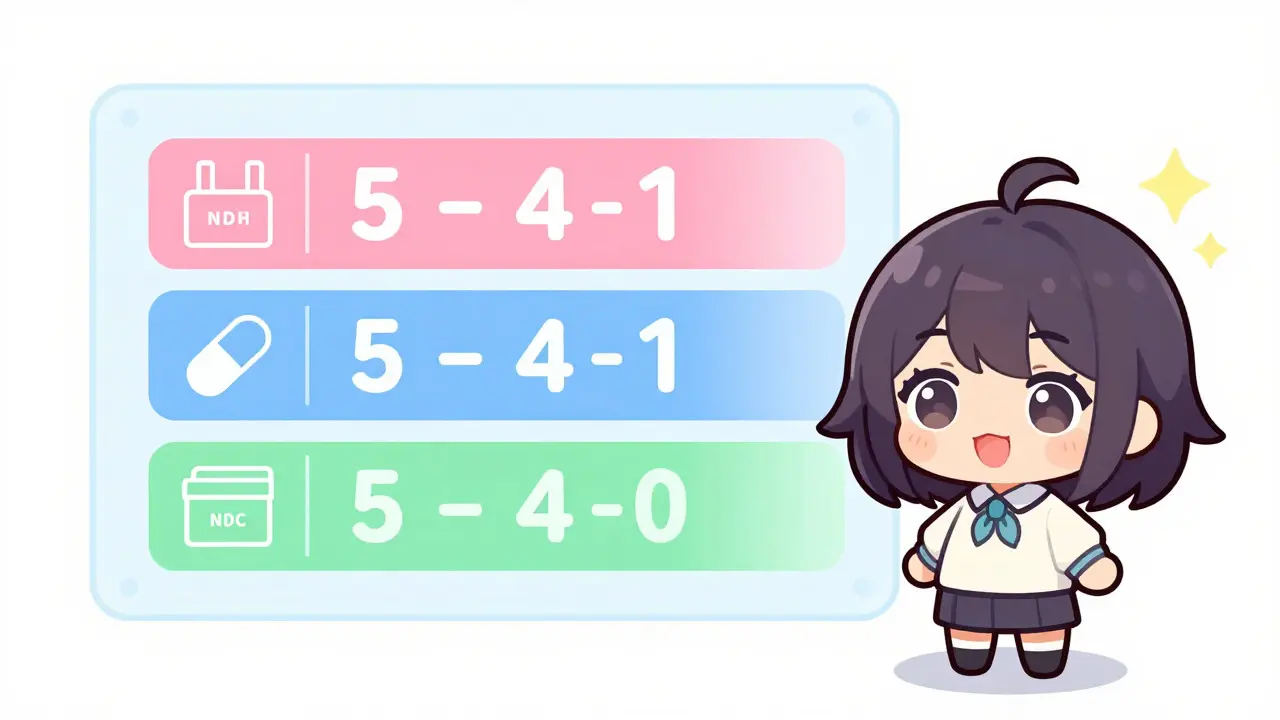
- 5-4-1: Five digits for the labeler, four for the product, one for the package.
Let’s look at an example. Consider the NDC 00002-3105-01. This follows the 5-4-1 format. Now let’s break down what each segment means.
Segment 1: The Labeler Code
The first segment identifies the company. This could be the manufacturer, repacker, or distributor. In our example, 00002 is the labeler code. The FDA assigns these codes. As of late 2023, there were approximately 3,500 active labeler codes. If you see a different labeler code for the same drug name, it likely means a different company produced it. This matters because manufacturing processes can vary slightly between companies.
Segment 2: The Product Code
This is the heart of the identification. The second segment specifies the drug’s active ingredient, strength, dosage form, and route of administration. In our example, 3105 is the product code. This specific code tells us it is Prozac (fluoxetine) in a 10mg capsule. If the code changed to 4465, it would mean the strength changed to 20mg, even though the labeler remained the same. This is where many errors happen-confusing similar-looking codes for different strengths.
Segment 3: The Package Code
The final segment tells you about the packaging. It indicates the commercial package size and type. In our example, 01 represents a specific bottle size, such as a bottle of 30 capsules. Another code, like 02, might represent a bottle of 100 capsules. For billing and inventory, knowing the exact package size is crucial. You don’t want to bill for 100 pills when the patient only received 30.
How to Verify the Correct Medication
Knowing the structure is step one. Using it to verify safety is step two. Here is a practical workflow you can use in any healthcare setting, whether you are a pharmacist, technician, or a careful patient checking your own meds.
- Locate the NDC: Find the code on the medication container. It is usually printed near the barcode. On vials, bottles, or tubes, it is often circled or highlighted. If you cannot find it, check the outer carton.
- Identify the Format: Count the digits between the hyphens. Is it 4-4-2? 5-3-2? Or 5-4-1? This determines how you parse the subsequent segments.
- Check the Labeler: Does the manufacturer match the prescription order? Sometimes prescriptions specify a brand, but the pharmacy dispenses a generic from a different supplier. Ensure this change is intentional and approved.
- Verify the Product: Cross-reference the product code with the prescribed drug name, strength, and form. For example, if the order says "Lisinopril 10mg Tablet," ensure the product code corresponds to that exact specification. Do not assume the drug name on the box is enough; the NDC confirms the specifics.
- Confirm the Package: Check the package code against the quantity dispensed. If the order is for 30 days’ supply, does the package code reflect a 30-count bottle? Mismatches here often signal inventory errors.
Dr. Michael Cohen, President of the Institute for Safe Medication Practices (ISMP), notes that incorrect NDC interpretation accounts for about 12% of reported dispensing errors. Most of these occur when people misread the product or package codes. Taking these five steps systematically can drastically reduce that risk.
The Billing Trap: 10-Digit vs. 11-Digit Formats
Here is where things get confusing. While the physical label shows a 10-digit NDC, most insurance systems and Medicare require an 11-digit format for billing. Specifically, they require the 5-4-2 configuration.
This means you often have to convert the printed NDC. How do you do it? You add zeros to the beginning of the segment that is too short until all segments meet the 5-4-2 requirement.
| Printed Format | Original NDC | Action Required | Billing Format (5-4-2) |
|---|---|---|---|
| 4-4-2 | 1234-5678-90 | Add zero to Labeler | 01234-5678-90 |
| 5-3-2 | 12345-678-90 | Add zero to Product | 12345-0678-90 |
| 5-4-1 | 12345-6789-0 | Add zero to Package | 12345-6789-00 |
For instance, if you have a 5-3-2 code like 12345-678-90, the product segment has only three digits. To make it four digits (for the 5-4-2 format), you add a zero at the start: 0678. The final billing code becomes 12345-0678-90. Failing to do this conversion correctly is a leading cause of rejected claims. Always double-check which segment needs padding.
Common Mistakes and How to Avoid Them
Even with training, errors slip through. Based on surveys from the American Pharmacists Association (APhA) and real-world reports, here are the most frequent issues:
- Misreading Strengths: Similar product codes for different strengths (e.g., 10mg vs. 20mg) are dangerous. Always verbalize the full NDC during double-checks. Say out loud, "Product code 3105, which is 10mg."
- Ignoring Repackagers: Hospitals often buy drugs in bulk and repackage them into smaller doses. These repackaged items have different NDCs than the original manufacturer’s product. If you see an unfamiliar labeler code, check if it is a known hospital repackager.
- Assuming Uniformity: Just because two boxes look identical doesn’t mean they have the same NDC. Different batch numbers or slight formulation changes can result in new codes. Never rely solely on visual inspection.
- Billing Format Confusion: Mixing up the 10-digit label format with the 11-digit billing format leads to delays. Keep a quick reference chart handy for conversions.
A survey found that 63% of pharmacists encounter at least one NDC-related confusion incident per month. The best defense is a culture of verification. Use tools like the FDA’s National Drug Code Directory mobile app for real-time checks. It takes seconds and can save lives.

Future Changes: The Move to 12 Digits
The system is evolving. The FDA announced plans to standardize all NDCs to 12 digits by 2025. This change aims to eliminate the current format variations (4-4-2, 5-3-2, 5-4-1) that cause so much confusion. The new format will expand the labeler code to six digits, providing more space for growing manufacturers and reducing ambiguity.
While this transition is supported by major industry groups, some small pharmacies worry about the cost of updating their software. Regardless, understanding the current 10-digit system remains critical right now. As the industry shifts, the core principle stays the same: precise identification prevents error. Stay updated on FDA announcements, and prepare your systems for the eventual switch to 12 digits.
Tools for Verification
You do not have to memorize every code. Several resources exist to help you:
- FDA National Drug Code Directory: A free, searchable database with over 150,000 active listings. You can search by NDC, drug name, or manufacturer.
- AAPC Codify: A paid service ($129/month) that integrates NDC verification with electronic health records, useful for larger practices.
- FDA NDC Hotline: Call 1-855-543-3784 for immediate assistance with complex queries.
Using these tools regularly builds familiarity. Over time, you will start recognizing patterns in labeler codes and product structures, making manual verification faster and more intuitive.
Where can I find the NDC number on a medication?
The NDC is typically printed on the medication container label, often near the barcode. It may also appear on the outer carton. Look for a series of numbers separated by hyphens. If it is not visible, check the prescription receipt or consult the pharmacy staff.
Why are there different NDC formats like 4-4-2 and 5-3-2?
The FDA allows flexibility in how manufacturers assign digits to the labeler, product, and package segments. This results in three valid 10-digit formats: 4-4-2, 5-3-2, and 5-4-1. The variation depends on the length of the manufacturer’s assigned labeler code and the complexity of their product line.
Do I need to convert the NDC for billing?
Yes, most insurance systems and Medicare require an 11-digit NDC in the 5-4-2 format for billing. You must add zeros to the beginning of the shortest segment(s) to achieve this configuration. Failure to convert correctly can lead to claim rejections.
Can two different medications have the same NDC?
No, each unique combination of manufacturer, drug product (strength/form), and package size has a distinct NDC. If two medications have the same NDC, they are considered the same product. However, different inactive ingredients in otherwise identical drugs may result in different NDCs if listed separately.
What happens if the NDC is missing from the label?
If the NDC is missing, the medication should not be dispensed or administered until verified. Contact the pharmacy or manufacturer to confirm the correct NDC. Dispensing without an NDC increases the risk of errors and complicates tracing in case of recalls.