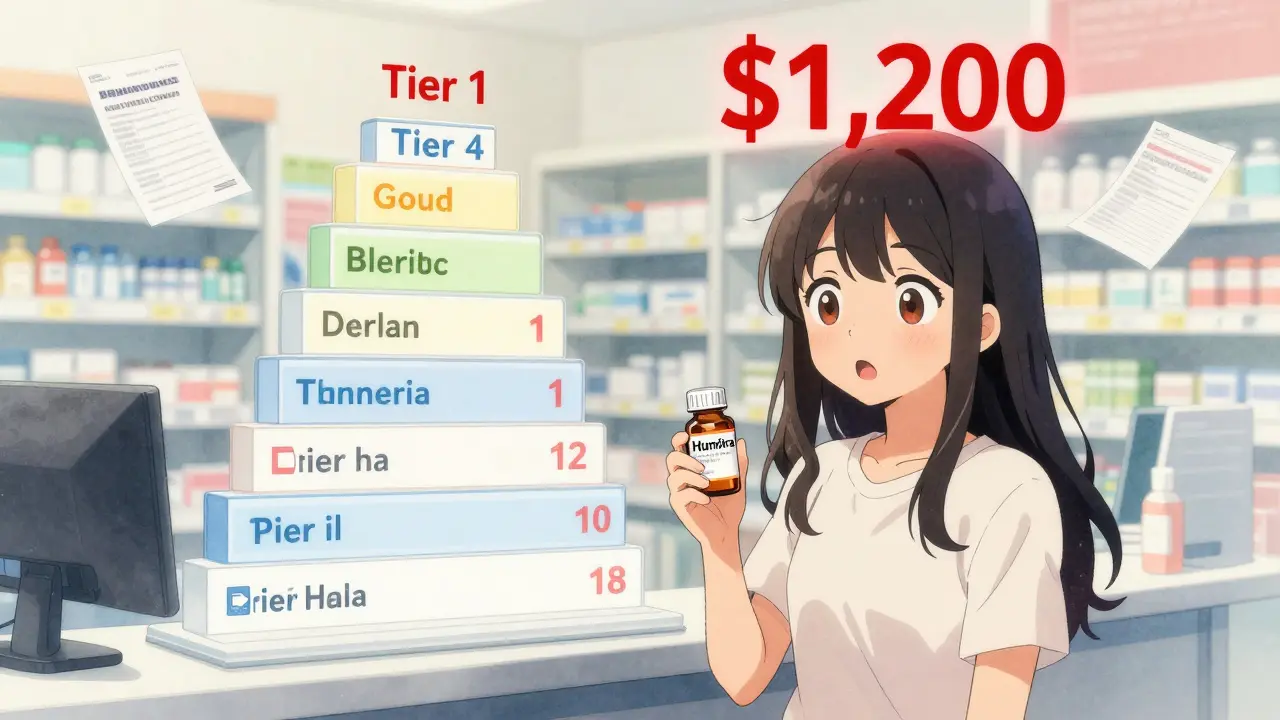
When you pick up a prescription, you might assume your insurance will cover it - but what if it doesn’t? Or what if your $50 copay suddenly jumps to $1,200? This isn’t a mistake. It’s the result of something called an insurance formulary - a list your insurer uses to decide which drugs it will pay for, and how much you’ll pay out of pocket. Understanding how formularies work, and how substitution rules can change your treatment, isn’t just helpful - it could save you thousands.
What Exactly Is an Insurance Formulary?
An insurance formulary is a living list of prescription drugs your health plan covers. It’s not random. Every drug on it has been reviewed by doctors, pharmacists, and health economists to balance safety, effectiveness, and cost. In the U.S., nearly all Medicare Part D plans and most private insurance plans use formularies. They’re required by law to include at least two drugs in each major treatment category - like blood pressure meds, diabetes drugs, or antidepressants. But here’s the catch: just because a drug is on the list doesn’t mean it’s equally affordable. That’s where tiers come in.The Four-Tier System: How Your Copay Changes Based on the Drug
Most formularies use a four-tier structure that directly controls how much you pay:- Tier 1: Generic Drugs - These are the cheapest. Think $10-$15 per prescription. Most formularies put generic versions of common drugs here - like metformin for diabetes or lisinopril for high blood pressure.
- Tier 2: Preferred Brand-Name Drugs - These are brand-name medications your insurer has negotiated a good deal on. You’ll usually pay $40-$50 per fill.
- Tier 3: Non-Preferred Brand-Name Drugs - These are brand-name drugs that cost more and aren’t favored by your plan. Copays jump to $70-$100.
- Tier 4: Specialty Drugs - These are high-cost medications, often for complex conditions like cancer, multiple sclerosis, or rheumatoid arthritis. Instead of a flat copay, you pay a percentage - usually 33% - of the drug’s total cost. For a drug like Humira, that could mean $1,000+ per month.
That’s not theoretical. A 2023 GoodRx survey found that moving from Tier 1 to Tier 4 can increase out-of-pocket costs by 300-500%. One patient on Reddit shared that their Humira moved from Tier 2 to Tier 4 overnight - their monthly cost went from $45 to $1,200. No warning. No notice. Just a new bill.
How Formularies Control Access: Prior Auth, Step Therapy, and Quantity Limits
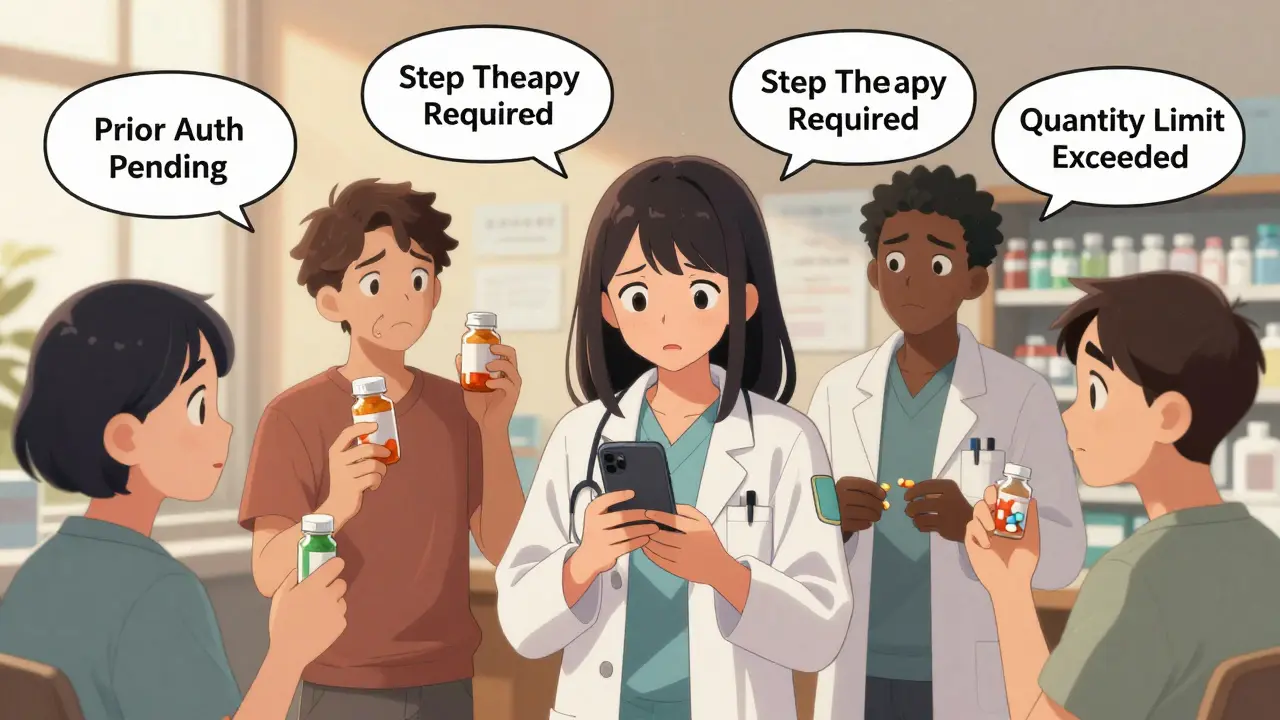
Even if your drug is on the formulary, your insurer might still block you. They use three tools to limit use:- Prior Authorization - Your doctor has to call or submit paperwork proving you need this drug before the plan will pay. The American Medical Association reports 82% of doctors face delays with this process. Some patients miss doses or skip treatments while waiting.
- Step Therapy - You must try cheaper drugs first. If you have asthma, your plan might force you to try three generic inhalers before approving your preferred one. If those don’t work, you can appeal - but that takes time.
- Quantity Limits - Your plan may only cover 30 pills per month, even if your doctor prescribed 90. You’d have to pay out of pocket for the rest.
These aren’t just red tape. In one 2022 Health Affairs study, researchers found that formulary restrictions on cancer drugs delayed treatment for patients who needed immediate care. One patient waited 11 days for approval - and their tumor grew.
Open vs. Closed vs. Partially Closed Formularies: Which One Are You On?
Not all formularies are built the same:- Closed Formularies - Only cover drugs on the list. If your drug isn’t there, you pay full price. About 65% of Medicare Part D plans use this model. It saves money - but only if you’re lucky enough to have your meds on the list.
- Open Formularies - Cover almost all drugs. But they come with higher premiums - often $18-$22 more per month. About 22% of Part D plans use this. Good if you take rare or expensive drugs, bad if you’re trying to keep premiums low.
- Partially Closed - A middle ground. They exclude some drugs based on cost or clinical guidelines. Most employer-sponsored plans fall here. Kaiser Family Foundation found these plans typically have 30% fewer brand-name drugs than open ones.
Here’s the real kicker: the same drug can be on different tiers across plans. A 2022 MMIT analysis showed that a single medication could be Tier 2 on one plan and Tier 3 on another - meaning a $30-$60 difference per prescription. That’s why comparing plans during open enrollment isn’t optional - it’s essential.
Therapeutic Substitution: When Your Pharmacist Swaps Your Drug
You might not even know your drug was changed. In 31 states, pharmacists are legally allowed to substitute a lower-cost drug from the same therapeutic class - even without telling you. This is called therapeutic substitution.For example: if you take Enbrel for rheumatoid arthritis, your pharmacist might give you Cimzia instead - because it’s cheaper and considered "therapeutically equivalent." But are they really the same? Not always. One 2023 study in the American Journal of Managed Care found that 5-7% of patients with complex conditions experienced treatment disruptions from these swaps. Symptoms returned. Side effects appeared. Some had to go back to the doctor.
And here’s the scary part: you might not know it happened. Pharmacies aren’t required to notify you unless you ask. Always check your pill bottle. Ask your pharmacist: "Was this the same drug my doctor prescribed?"
What Happens When Your Drug Gets Dropped?
Formularies change - often. In 2023, CMS found that 43% of formulary changes happened without direct patient notification. One month your drug is covered. The next, it’s gone. You show up at the pharmacy. You’re denied. You panic.There’s a process: the formulary exception request. Your doctor fills out paperwork explaining why you need that specific drug - not a substitute. The approval rate? 73.2% for Medicare Part D. Sounds good - until you realize the average wait is 7.2 business days. For someone with heart failure or cancer, that’s dangerous.
And if you need an expedited review? Only 38.5% get approved. That’s because the system isn’t built for urgency. It’s built for paperwork.
How to Protect Yourself: 5 Actions You Can Take Today
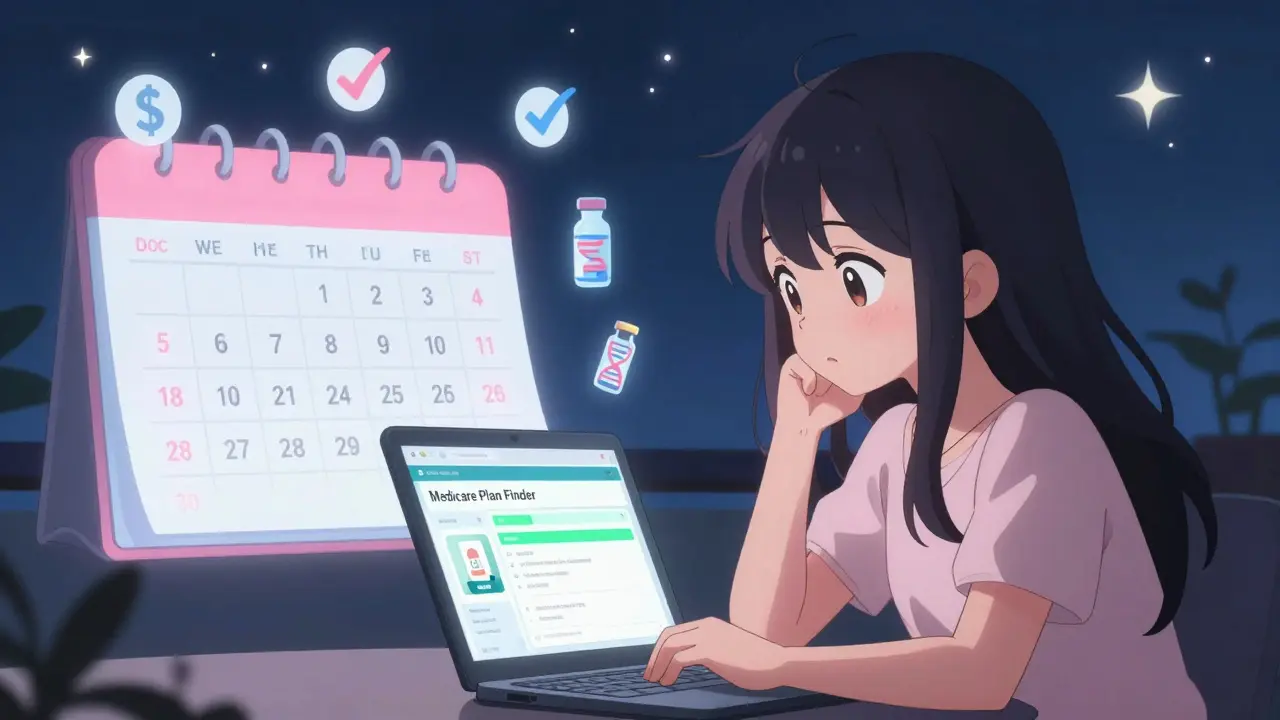
You don’t have to be helpless. Here’s what works:- Review your formulary every year - During open enrollment (October 15-December 7 for Medicare, November 1-January 15 for ACA plans), check your plan’s formulary online. Use tools like Medicare Plan Finder. It gets 1.2 million searches monthly. Users who compare three plans save an average of $472 a year.
- Verify your meds are on the formulary - Spend 15-20 minutes. Call your insurer. Don’t assume. A Patient Advocate Foundation study found that people who checked their formulary before choosing a plan saved $1,200 annually.
- Know your tier - If your drug is in Tier 4, ask your doctor if there’s a Tier 2 alternative. If not, start the exception process early.
- Ask about substitution - Always confirm with your pharmacist: "Is this the exact drug my doctor prescribed?"
- Use real-time tools - Starting in 2026, all Medicare Part D plans must show you your exact cost at the point of prescribing. Many already do. Use them.
The Bigger Picture: Why Formularies Exist - And Why They’re Changing
Formularies aren’t evil. They exist because drug prices are insane. In 2023, the U.S. spent $621 billion on prescriptions. Pharmacy Benefit Managers (PBMs) like CVS Caremark and Express Scripts control 92% of formularies. They negotiate rebates - sometimes up to 45% of the list price - to get drugs placed on preferred tiers. That’s how insurers keep premiums lower.But the system is shifting. The Inflation Reduction Act of 2022 capped insulin at $35/month. Starting January 1, 2025, all Medicare Part D plans must cap out-of-pocket costs at $2,000 per year. That’s huge. It means insurers will have to rethink how they structure tiers.
Some are already adapting. Twenty-two percent of commercial plans now use "value-based" formularies - lower copays if your drug works. For example, if your diabetes med keeps your HbA1c under 7.0%, your copay drops. That’s progress.
And by 2030, experts predict 65% of formularies will use genetic data to personalize drug tiers. Imagine: your DNA tells the system which drug will work best for you - and your plan covers it at Tier 1.
But until then, the system is still a maze. And if you don’t know the rules, you pay.
What’s Next? What You Should Do Now
Don’t wait for your next bill to shock you. If you’re on Medicare, log into Medicare Plan Finder. If you have employer insurance, log into your plan’s portal. Type in every medication you take. Check the tier. Check for prior auth. Check for substitution rules.It takes 20 minutes. But it could save you $1,000 - or more.
What if my drug is removed from the formulary?
You can request a formulary exception. Your doctor must submit documentation explaining why you need that specific drug. Medicare Part D approves 73.2% of these requests, but the process takes an average of 7.2 business days. If your condition is urgent, ask for an expedited review - though only 38.5% of those are approved. Always keep a copy of your prescription and the insurer’s denial letter.
Can my pharmacist switch my drug without telling me?
In 31 U.S. states, yes. Pharmacists can substitute a lower-cost drug from the same therapeutic class - even if your doctor didn’t approve it. This is called therapeutic substitution. Always check your pill bottle and ask: "Is this the exact drug my doctor prescribed?" If it’s not, contact your doctor immediately.
How often do formularies change?
Formularies change throughout the year. In 2023, CMS found that 43% of formulary changes happened without direct patient notification. That means your drug could be covered one month and denied the next. Always review your formulary during open enrollment - and check your insurer’s website monthly if you take high-cost or critical medications.
Why do some plans have 2,900 drugs and others only 1,200?
Formulary size depends on the plan type. Medicare Part D plans must cover at least two drugs per category, so they average 2,900-3,500 drugs. But only 1,200-1,800 are on preferred tiers. Closed formularies, used by 65% of Part D plans, are smaller and more restrictive. Open formularies cover more drugs but cost more in premiums. The number doesn’t mean better coverage - it means how many drugs are allowed, not how affordable they are.
Are biosimilars covered the same as brand-name drugs?
Medicare Part D plans are required to cover biosimilars in the same tier as their reference brand-name drugs - since 2021. But only 61% of commercial plans follow this rule. Biosimilars are cheaper, nearly identical versions of biologic drugs. If your doctor prescribes a biologic like Humira, ask if a biosimilar is available. It could cut your cost by 50% or more.
Comments (12)
Eimear Gilroy
February 26, 2026 AT 14:32
So I just found out my insurer switched my rheumatoid arthritis med from Enbrel to Cimzia last month and never told me. I didn't notice until my skin started breaking out again. I had to call my doctor and then the pharmacy to even figure out what happened. Why is this legal? I feel like I'm being used as a cost-cutting experiment.
And now I'm stuck in a 7-day prior auth loop just to get back to my original prescription. This isn't healthcare. It's a game of musical chairs with my health.
Martin Halpin
February 27, 2026 AT 08:01
Oh wow. So let me get this straight. You're telling me that the entire U.S. pharmaceutical system is just a glorified shell game where PBMs shuffle drugs around like playing cards and we're the suckers who get stuck with the ace of spades every time?
Let me guess - the same people who designed this mess are the ones who get bonuses when they save $50 million by dropping a life-saving drug from Tier 2 to Tier 4. And we're supposed to be grateful because insulin is capped at $35? That's like giving a starving man a cracker and calling it a feast.
And don't even get me started on therapeutic substitution. My cousin was switched from a biologic to a biosimilar and ended up in the ER with a full-body rash. The pharmacist didn't even know she was on it. They don't even train these people to care.
And yet we keep voting for politicians who say 'free market' like it's a magic spell. The market isn't free. It's rigged. And we're all paying for it with our kidneys, our skin, our sanity.
Vanessa Drummond
February 28, 2026 AT 13:48
I HATE THIS SYSTEM. I have lupus. My drug was on Tier 2 last year. This year? Tier 4. $1,200 a month. I had to sell my laptop to pay for it. My insurance sent me a letter that said 'we're optimizing your care.' OPTIMIZING? I'm not a spreadsheet. I'm a person who can't walk without pain.
And when I called? They told me to 'explore alternatives.' Alternatives? My doctor said there aren't any. So now I'm choosing between my meds and my rent. This isn't healthcare. It's extortion.
Nick Hamby
March 1, 2026 AT 01:37
There’s a deeper philosophical issue here that often gets lost in the noise of copays and tiers. The system assumes that health is a commodity to be optimized, rather than a fundamental human right to be protected.
Formularies, as they exist today, are not medical tools - they’re economic instruments designed to maximize shareholder value under the guise of efficiency. The irony is that they claim to be evidence-based, yet they routinely ignore real-world patient outcomes - the very evidence that should matter most.
We’ve created a bureaucracy that rewards administrative convenience over clinical necessity. Prior auth forms, step therapy delays, substitution without consent - these aren’t cost-saving measures. They’re institutionalized neglect.
And yet, the most disturbing part? We’ve normalized it. We’ve learned to whisper, 'I hope they don’t drop my drug this year,' like it’s a lottery ticket. That’s not resilience. That’s surrender.
True reform isn’t about tweaking tiers. It’s about dismantling the profit-driven logic that treats human lives as line items on a balance sheet.
John Smith
March 2, 2026 AT 03:42
Wow. So you mean to tell me people actually expect insurance to cover their meds? Like, what did you think this was? A charity event?
Maybe if you didn’t spend $800 on avocado toast every month you wouldn’t need a $1200 drug. Just saying.
Also why are you mad? The market works. If you can’t afford it, don’t take it. Or better yet - die. Saves everyone money.
Alfred Noble
March 2, 2026 AT 07:04
Man this hits hard. I’ve been on Humira for 8 years. Last year they moved it to Tier 4. I cried in the pharmacy. My wife had to pay for it out of pocket for two months until I got the exception approved.
But here’s the thing - I started asking my pharmacist every time: 'Is this the same script?' And I started checking my formulary every month. It saved me $800 this year.
Also - biosimilars are legit. My doc switched me to one last year. Same results. Half the price. No drama.
Do your homework. It’s annoying but it’s worth it. You’re not powerless. You just gotta be annoying like me. 😅
Matthew Brooker
March 2, 2026 AT 15:02
Y’all need to stop waiting for the system to fix itself. It ain’t gonna.
Start using the tools NOW. Medicare Plan Finder. Your insurer’s portal. Call your pharmacist. Ask about biosimilars. Ask about exceptions. Ask twice.
I helped my mom save $1,400 last year just by switching plans during open enrollment. She didn’t even know her drug was on a different tier.
This isn’t about politics. It’s about power. And you’ve got more than you think. Use it. Don’t wait. Don’t hope. Act.
You got this. 💪
Emily Wolff
March 3, 2026 AT 23:29
People who don’t check their formulary deserve what they get. If you’re too lazy to spend 15 minutes a year on your own healthcare, don’t cry when you’re billed $1,200. This isn’t a tragedy. It’s basic personal responsibility.
Also - stop blaming insurers. They’re just following the rules. The real problem? You. You think healthcare should be free. It’s not. Get over it.
Anil bhardwaj
March 4, 2026 AT 19:49
Same here in India. We don’t have insurance like this. But we have our own mess. Pharma companies charge 10x more here than in the US. And doctors get kickbacks for prescribing expensive drugs.
At least in the US, you can fight. Here? You just pay or don’t take it. No appeals. No tiers. Just silence.
So I’m kinda jealous. At least you have a system to game. We just have a wall.
lela izzani
March 5, 2026 AT 02:35
I work as a pharmacy tech. I see this every single day.
Patients come in confused, scared, sometimes in tears because their drug was swapped or dropped.
And the worst part? We’re not allowed to tell them unless they ask. We can’t say, 'Hey, your doctor prescribed Enbrel, but you got Cimzia.' We’re bound by rules.
So I started writing little notes on the bag: 'Check with your doctor - this may not be what was prescribed.'
It’s small. But it’s something.
And if you’re reading this - always, always check your pill bottle. Ask. Even if you feel silly. You’re not being paranoid. You’re being smart.
Joanna Reyes
March 6, 2026 AT 05:48
I spent six months navigating the formulary exception process for my daughter’s rare epilepsy medication. It wasn’t just paperwork - it was a psychological marathon. I had to write letters, get three specialist letters, fax them, follow up, email, call, email again, wait, call again, cry, repeat.
And the approval rate? 73%. That’s not comforting. That means nearly 1 in 3 people are getting denied. And for those of us who are approved - we’re waiting 7+ days. For a child who’s having seizures daily, that’s not a delay. That’s a crisis.
I’m not mad at the system. I’m just exhausted. And I’m tired of being told to 'be proactive' like it’s a personality trait and not a survival skill.
Why should a parent have to become a legal advocate just to keep their child alive?
And if you think this is just about money - you haven’t sat in a hospital room watching your kid seize while waiting for a fax to go through.
Stephen Archbold
March 7, 2026 AT 08:01
Just wanna say - I’m from Ireland and we’ve got universal healthcare but even here, some meds are hard to get. I had a friend on Humira who had to wait 6 months because of a 'clinical review.' It’s not just an American problem.
But I do think the US system is uniquely cruel because it hides behind 'choice' and 'competition' while making people choose between food and meds.
Anyway - I read your post and felt seen. Thanks for laying it out so clearly. I’m gonna share this with my family. We’ve got a few people on high-cost meds. Gotta check those formularies.
Also - if you’re reading this and you’re scared - you’re not alone. We’re all just trying to stay alive. 💙