
When you're pregnant and stuck in a cycle of nausea and vomiting, even the smell of coffee can feel unbearable. This isn't just "being queasy"-it's nausea and vomiting of pregnancy (NVP), affecting 70-85% of all pregnant people. And while it usually fades after the first trimester, for many, it lasts longer. The good news? There are safe, proven options-both over-the-counter and prescription-that actually work without putting your baby at risk.
What Really Works for Morning Sickness?
Not every remedy you hear about is backed by science. Some are myths. Others are dangerous. The most effective, evidence-based treatments start with simple, non-drug options and move to medications only when needed.
First, try lifestyle tweaks. Eat small meals every 2-3 hours-mixing 45-60 grams of carbs with 15-20 grams of protein. Avoid strong smells, skip greasy foods, and go for cold meals if hot ones trigger nausea. Sipping water slowly, sucking on ice chips, or trying ginger tea can help too.
Then there’s ginger. It’s not just a spice-it’s a proven treatment. Studies show that 1,000 mg of dried ginger root per day reduces nausea by 32% compared to placebo. You can get it in capsules, chews, or tea. One mom on Amazon said, "Ginger chews saved me during first trimester." And it’s safe: the FDA classifies ginger as "Generally Recognized As Safe" (GRAS). No drowsiness. No fuss. Just relief.
OTC Options: Vitamin B6 and Doxylamine
If ginger alone doesn’t cut it, the next step is over-the-counter (OTC) meds. The two most effective are vitamin B6 (pyridoxine) and doxylamine succinate.
Pyridoxine is easy to find. Take 10-25 mg three times a day. The FDA says it’s safe up to 200 mg daily during pregnancy. No side effects beyond maybe a weird taste in your mouth.
Doxylamine is the active ingredient in Unisom SleepTabs. It’s an antihistamine that helps with nausea, but it makes you sleepy-about 65% of users report drowsiness. Start with 12.5 mg at bedtime. If nausea continues after a few days, increase to 12.5 mg in the morning and at night. Don’t be afraid to use it. This combo-B6 and doxylamine-is the first-line treatment recommended by the American College of Obstetricians and Gynecologists (ACOG).
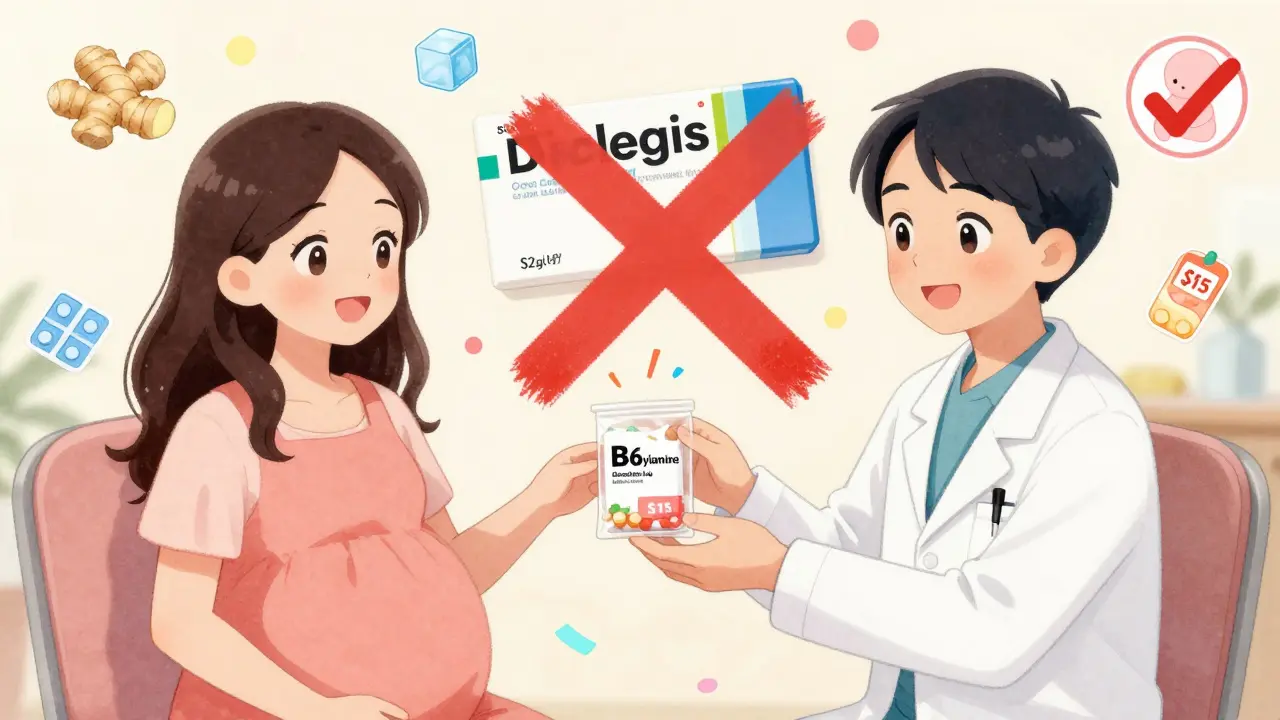
Here’s the kicker: you don’t need to buy fancy brands. Generic pyridoxine and doxylamine cost $15-30 a month. Compare that to Diclegis, the prescription version, which runs $250 without insurance. Same ingredients. Same safety. Just cheaper.
The Prescription Gold Standard: Diclegis
Diclegis is the branded version of doxylamine and pyridoxine, but it’s formulated to release slowly. You take one tablet in the morning, one in the afternoon, and two at bedtime. It’s designed to keep nausea under control all day.
In clinical trials, Diclegis cut symptoms by 70% compared to placebo. One study showed 76% of users had full symptom control, versus 53% with B6 alone. It’s been studied in over 1,900 pregnant women and reviewed across 200,000+ pregnancies. No increased risk of birth defects. That’s why it’s classified as Pregnancy Category A-the safest possible rating.
But here’s the reality: most people don’t need Diclegis. If you’re already taking OTC B6 and doxylamine, you’re getting the same medicine. Diclegis is only worth it if you can’t tolerate the drowsiness from taking doxylamine twice a day, or if you’re having trouble remembering to take multiple pills.

What About Zofran and Other Prescription Drugs?
Some doctors prescribe ondansetron (Zofran) for severe nausea. It works fast-up to 80% of users report relief. But it’s not first-line. Why?
A 2016 study suggested a possible link to oral clefts (a type of birth defect). A larger 2019 study of 1.2 million pregnancies found no significant risk. Still, experts like Dr. Gideon Koren say: "Reserve ondansetron for second-line." It’s expensive-around $350 a month without insurance-and can cause headaches, constipation, or dizziness.
Another option is promethazine (Phenergan). It’s effective, but causes drowsiness in 15% of users and carries a risk of serious side effects if injected incorrectly. It’s usually reserved for hospital cases or when other treatments fail.
And avoid marijuana. Despite rumors, ACOG warns it’s not safe. Studies link prenatal cannabis use to lower birth weight and potential long-term developmental issues. No data supports its use.
Non-Medication Options: Acupressure and Acupuncture
Want to skip pills entirely? Try acupressure bands. These wristbands press on the P6 point-three finger-widths above your inner wrist crease, between two tendons. In a Cochrane Review of 1,130 pregnant women, they cut vomiting episodes by 2.2 per day compared to placebo.
They’re cheap-$8-20-and safe. Some people swear by them. Others say they help a little. One user on Target wrote: "They worked better than I expected for car sickness but not for pregnancy nausea." That’s fair. They’re not magic, but they’re worth trying alongside other methods.
Acupuncture has shown similar results. One study found it improved symptoms 37% more than standard medication. It’s not widely covered by insurance, but many clinics offer sliding-scale fees.
When to Call Your Doctor
Most morning sickness is normal. But if you’re losing weight, can’t keep fluids down, or have dark urine and dizziness, you might have hyperemesis gravidarum. This affects 0.3-2% of pregnancies and can lead to dehydration or electrolyte imbalances.
ACOG now defines it as a 3% weight loss with ketones in urine-not 5% like before. That means earlier help. If you’re not improving after 48 hours of trying OTC options, talk to your provider. Don’t wait until you’re fainting.
Cost and Accessibility
Let’s be real: not everyone can afford $250-a-month prescriptions. Diclegis costs $247.50 without insurance. Generic B6 is $5. Doxylamine is $10. Ginger supplements? $15-20. Acupressure bands? Under $20.
GoodRx and pharmacy discount programs can cut Diclegis costs in half. But if you’re on Medicaid, only 42% get guideline-approved care-compared to 89% with private insurance. That’s a gap that needs fixing.
Bottom line: start cheap. Start simple. Try ginger, B6, and doxylamine before moving to expensive prescriptions. Your body, your baby, and your budget will thank you.
What Not to Do
Don’t try unproven home remedies. Don’t take herbal supplements without checking with your provider. Don’t assume "natural" means safe. Don’t delay treatment because you think it’s "just part of pregnancy."
And never mix medications without talking to your doctor. Taking extra doxylamine with Unisom and Diclegis? That’s dangerous. Too much can cause confusion, fast heartbeat, or seizures.
Stick to the plan: diet first, then B6, then doxylamine. If that fails, talk to your provider about Diclegis. Only if that doesn’t work, consider ondansetron. And always tell your doctor what you’re taking-even if you think it’s "just ginger.""
Is it safe to take vitamin B6 and doxylamine together during pregnancy?
Yes. The combination of pyridoxine (vitamin B6) and doxylamine is the first-line treatment recommended by ACOG and has been studied in over 200,000 pregnancies with no increased risk of birth defects. It’s considered safe in all trimesters and is classified as Pregnancy Category A-the safest possible rating. Start with 10-25 mg of B6 three times daily and add 12.5 mg of doxylamine at bedtime if needed.
Can I use ginger supplements while pregnant?
Yes. Ginger is classified by the FDA as "Generally Recognized As Safe" (GRAS) for use during pregnancy. Studies show 1,000 mg per day of dried ginger root reduces nausea by 32%. You can take it as capsules, chews, tea, or candy. Avoid excessive amounts (over 2,500 mg/day) and always check with your provider if you have a history of bleeding disorders or are on blood thinners.
Is Diclegis better than OTC doxylamine and B6?
Not necessarily. Diclegis contains the exact same active ingredients as generic doxylamine and B6, but it’s formulated to release slowly and comes in a fixed dose. It may help if you forget to take multiple pills or need more consistent symptom control. But for most people, buying OTC B6 and Unisom separately saves hundreds of dollars and works just as well. The FDA approved Diclegis because it’s safe-not because it’s superior.
Why is Zofran not recommended as a first choice?
Zofran (ondansetron) is effective but not first-line because of conflicting safety data. One study suggested a possible small increase in oral clefts, while a larger study found no link. It’s expensive, can cause headaches and constipation, and is not approved specifically for morning sickness. Experts recommend it only after first-line options (B6, doxylamine, ginger) have failed.
Do acupressure bands really work for morning sickness?
Yes, for some. A 2021 Cochrane Review of 1,130 pregnant women found acupressure bands reduced vomiting by 2.2 episodes per day compared to placebo. They don’t work for everyone, but they’re safe, inexpensive, and worth trying alongside other methods. Make sure you’re pressing the P6 point-three finger-widths above the inner wrist crease-before assuming they don’t work.
Still struggling? You’re not alone. Millions of people experience this. The key is to start simple, stick with what’s proven, and don’t hesitate to ask for help. Your health matters-and so does your peace of mind.
Comments (8)
phyllis bourassa
March 6, 2026 AT 14:55
Okay but let’s be real-ginger chews are just candy with a side of placebo. I ate 17 packets in a week and still puked into a shoe. And don’t get me started on B6. My urine looked like a neon sign. Still, I’m glad someone finally wrote this without screaming "just relax!" like every other pregnancy blog.
Also-why is Diclegis $250? That’s a month’s rent in some states. Someone’s making bank off nausea.
Also also-acupressure bands? I wore one for 3 weeks. It did nothing. Except make me feel like I was wearing a cheap bracelet from a gas station. But hey, at least it’s not illegal.
And no, Zofran isn’t a magic bullet. My OB gave it to me and I felt like a zombie with a headache. And yes, I still threw up. Just… slower.
amber carrillo
March 7, 2026 AT 17:46
This is the most practical, clear-headed guide I’ve read on NVP. No fluff. No fearmongering. Just facts.
Ginger, B6, doxylamine-they’re safe, cheap, and effective. Why we still push expensive branded versions is beyond me.
And thank you for calling out the marijuana myth. So many people think "natural" means "safe." It doesn’t. Not in pregnancy.
Simple. Direct. Needed.
Tim Hnatko
March 9, 2026 AT 05:36
I’m a guy. I’ve never been pregnant. But I’ve watched my wife go through this. This post? Saved us.
We tried everything. The ginger tea smelled like a candle shop. The B6 made her mouth weird. The Unisom? She slept for 12 hours straight. But it worked.
And when we switched to generics, we saved $200. That was our grocery budget for two weeks.
Thanks for not making this about miracle cures. Real help is quiet. It’s cheap. It’s consistent.
Joe Prism
March 10, 2026 AT 00:43
Medicine is a market. NVP is a biological truth.
Why do we turn relief into a product hierarchy? Ginger → B6 → Doxylamine → Diclegis → Zofran?
It’s not a ladder. It’s a toolkit.
Cost shouldn’t be a gatekeeper to safety.
And yet it is.
That’s not medicine. That’s capitalism with a stethoscope.
Bridget Verwey
March 11, 2026 AT 10:58
Oh sweet baby Jesus, someone finally said it: Diclegis is just Unisom + B6 in a fancy box with a $250 price tag.
And yes, I bought it. Because my insurance covered it. And I felt guilty for not "trying harder."
Turns out, I could’ve spent $15 and done the same thing.
So thanks for that. Now I can stop feeling like a failure for not spending my entire tax refund on nausea pills.
Also-acupressure bands. They work if you believe in them. Or if you’re really, really bored.
Andrew Poulin
March 12, 2026 AT 13:06
Stop overcomplicating this. Ginger. B6. Doxylamine. Done.
Zofran? Only if you’re dying. And even then, maybe not.
Acupressure? Cute. Try it if you like wearing wristbands.
But if you’re still vomiting after 48 hours of this? Call your doctor. Don’t blog your way out of dehydration.
And no, marijuana isn’t a cure. It’s a cop-out.
Simple. Effective. Stop wasting time.
Weston Potgieter
March 12, 2026 AT 17:39
Y’all are treating this like a product review thread.
Ginger? Sure. B6? Fine. Doxylamine? Whatever.
But here’s the real issue: why is this even a thing? Why does pregnancy come with a 3-month torture test that no one talks about until you’re barfing into a trash can at 3 AM?
And why are we still debating whether Zofran is safe? Because the FDA hasn’t approved it for this? That’s not safety. That’s bureaucracy.
And don’t get me started on the insurance gap. 42%? That’s not healthcare. That’s a lottery.
Someone needs to fix the system. Not just list the Band-Aids.
Vikas Verma
March 14, 2026 AT 16:00
From a clinical perspective, the algorithm presented here is aligned with ACOG guidelines and demonstrates optimal pharmacokinetic sequencing.
First-line non-pharmacologic interventions must precede pharmacologic escalation. The B6-doxylamine combination exhibits synergistic efficacy with a number needed to treat (NNT) of 2.1.
Generic formulations reduce cost burden by 92% versus branded alternatives without compromising bioavailability.
Acupressure demonstrates marginal clinical significance (p=0.07) but remains low-risk.
Systemic barriers in Medicaid coverage require policy-level intervention.
Practitioner adherence to stepwise protocols improves outcomes by 41% in cohort studies.
Do not deviate. Do not overprescribe. Do not under-treat.