Medication Side Effect Checker
Check Side Effects for Your Medication
Enter the name of your medication to see side effect information from trusted medical sources.
How Side Effect Information Works
The FDA label shows what was observed in clinical trials. Real-world data from VigiAccess and OnSIDES may reveal additional risks. Remember:
- Common side effects (1 in 10 or more people)
- Uncommon side effects (1 in 100 to 1 in 10 people)
- Rare side effects (less than 1 in 1,000 people)
Side Effect Results
Enter a medication name to see side effect information
Knowing what side effects a medication might cause isn’t just helpful-it can be life-saving. But where do you go when you need real, detailed, up-to-date information? Not every website gives you the full picture. Some are outdated. Others are too technical. A few even hide critical details behind paywalls. The truth is, you don’t need to guess or rely on random Google results. There are trusted, official sources that break down exactly what could happen when you take a drug-down to how often it happens and what to watch for.
Start with the FDA’s FDALabel Database
The most authoritative source for side effect information in the U.S. is the FDA’s FDALabel database. This isn’t a summary or a simplified version. It’s the exact text from the drug manufacturer’s official label, approved by the FDA. Every prescription and over-the-counter medication sold in the U.S. must submit this document. It’s updated daily as new drugs get approved or existing ones get new safety warnings.
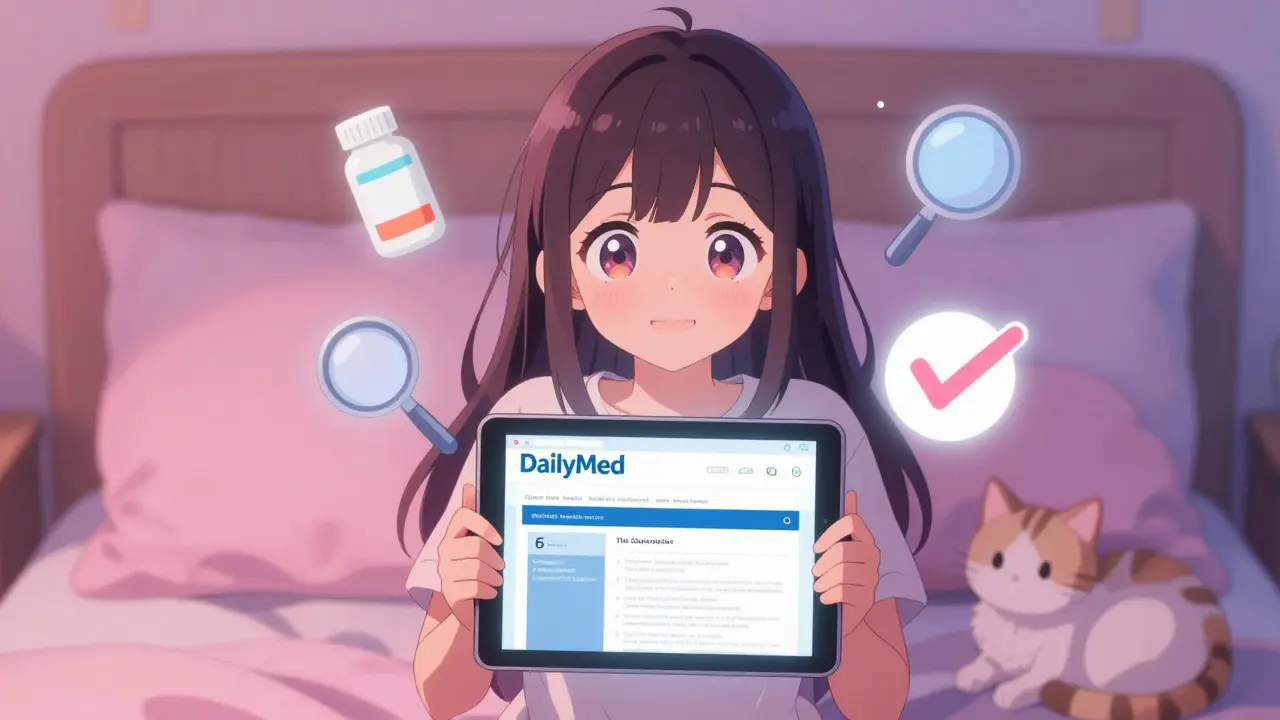
To find it, go to the DailyMed website (which hosts FDALabel data). Search for your drug by name. Once you open the label, scroll to section 6: Adverse Reactions. That’s where you’ll see the full list-what happened in clinical trials, how often, and whether it was more common than placebo. For OTC drugs, look under Warnings. This is the gold standard because it’s legally required to be accurate and complete.
But here’s the catch: this only shows what was known before the drug hit the market. It doesn’t include rare side effects that only show up after thousands of people use it for years. That’s where other tools come in.
Use MedlinePlus for Plain Language Explanations
If the FDA label feels like reading a legal contract, MedlinePlus is your translator. Run by the National Library of Medicine, this free site breaks down complex medical info into everyday language. It pulls from the same FDA data but rewrites it so a 12-year-old could understand it.
For example, instead of saying “incidence of dizziness was 12.3% in treated group versus 8.1% in placebo,” MedlinePlus says: “About 1 in 8 people taking this drug feel dizzy.” It also includes what to do if you experience a side effect, when to call your doctor, and even what to avoid while taking the drug-like alcohol or certain foods.
A 2023 survey of nearly 3,000 patients found that 87% found MedlinePlus easier to understand than FDA labels. And it takes less than a minute to find what you need. If you’re a patient or a caregiver, this is your first stop after the FDA label.
Check VigiAccess for Real-World Reports
What happens after a drug is out in the wild? That’s where VigiAccess comes in. Run by the World Health Organization’s Uppsala Monitoring Centre, this database holds over 35 million individual reports of side effects from doctors, pharmacists, and patients around the world.
Unlike clinical trials-which test drugs on a few thousand people over months-VigiAccess tracks what happens to millions over years. If a rare heart rhythm issue shows up in 50 people taking a drug, you’ll see it here. You can search by drug name and see how many times each side effect was reported.
But here’s what you need to know: these numbers don’t tell you the risk. If 100 people took the drug and 2 had a reaction, that’s 2%. If 100,000 people took it and 2 had the same reaction, that’s 0.002%. VigiAccess doesn’t give you the denominator-just the count. So it’s great for spotting red flags, but not for calculating your personal risk.
Explore OnSIDES for Hidden Side Effects
Most side effects listed on labels are the ones seen in clinical trials. But what about effects that only show up when you take the drug with another one? Or side effects that doctors didn’t expect? That’s where OnSIDES steps in.
Launched in 2023, OnSIDES uses artificial intelligence to scan every FDA-approved drug label-over 46,000 of them-and pulls out side effects that aren’t always listed. It found over 3.6 million drug-side effect pairs, more than seven times what the old Offsides database had. It even identifies side effects specific to kids, seniors, or people with certain health conditions.
For example, a drug might list “headache” as a side effect. OnSIDES might reveal that it also causes memory lapses in people over 70-a detail never mentioned on the label. Researchers use it to find new safety signals. But if you’re a regular user, you won’t need to dig into the raw data. Just search the name of your drug on nSIDES.io. It gives you a clean summary of both on-label and off-label risks.
Avoid Outdated or Biased Sources
Some sites still point you to SIDER, a database that hasn’t been updated since 2015. The creators openly say it’s outdated and no longer maintained. Using it is like checking a 2015 map for today’s traffic. It might help for historical research, but not for making decisions now.
Another option is PDR.net. It’s been around since 1947 and is used by some doctors. But it’s now a paid service ($50 a year), and critics say it may downplay risks because it’s funded by drug companies. The American Medical Association warns it can be biased in what it chooses to include.
Reddit threads, Facebook groups, and YouTube videos might sound helpful, but they’re full of anecdotes-not data. One person’s bad reaction doesn’t mean it’ll happen to you. And without context, you can’t tell if it’s rare or common.
What to Do When You Find a Side Effect
Let’s say you find a side effect you’re worried about. Here’s what to do next:
- Don’t stop the drug without talking to your doctor. Some side effects are mild and go away after a few days.
- Check if it’s listed as “common” or “rare.” Common means more than 1 in 10 people get it. Rare means less than 1 in 1,000.
- If it’s serious-like chest pain, trouble breathing, swelling, or unusual bleeding-call your doctor or go to the ER.
- If it’s mild but annoying, ask your doctor if there’s another drug with fewer side effects.
- Report it to the FDA through their MedWatch system. Your report helps improve safety for everyone.
The goal isn’t to scare you. It’s to give you control. When you know what to expect, you can spot problems early, ask smarter questions, and work with your doctor to find the best option for you.
Bottom Line: Use Multiple Sources
No single source has all the answers. The FDA label tells you what’s officially known. MedlinePlus helps you understand it. VigiAccess shows you what’s happening in the real world. OnSIDES uncovers hidden risks. Together, they give you a complete picture.
For most people: Start with MedlinePlus. Then check the FDA label for the full details. If you’re on multiple drugs or have a complex health history, look up your meds on OnSIDES. And if you notice something unusual that isn’t listed-report it. That’s how safety improves.
Medications save lives. But they come with risks. The best way to manage those risks isn’t to avoid the medicine-it’s to know exactly what you’re signing up for.
Can I trust side effect info from drug company websites?
No. Drug company websites often highlight benefits and minimize risks. They’re required to list side effects, but they may bury them in fine print or use vague language like "some patients experience discomfort." Always cross-check with FDA, MedlinePlus, or OnSIDES for unbiased, complete data.
Why don’t all side effects show up on the label?
Clinical trials involve a few thousand people over months or a few years. Some side effects only appear in rare cases, after long-term use, or when combined with other drugs. These take years to detect, which is why post-market surveillance tools like VigiAccess and OnSIDES are so important.
Is there a free app to check side effects?
Yes. The MedlinePlus app is free and available on iOS and Android. It pulls directly from the National Library of Medicine’s database and gives you clear, easy-to-read side effect lists. Avoid apps that charge for basic info or don’t cite their sources.
What if I can’t find my medication in these databases?
If your drug is very new (less than 6 months on the market), it may not be fully updated yet. Check the FDA’s website for the latest approvals. For older or generic drugs, try searching by the active ingredient instead of the brand name. If you still can’t find it, contact your pharmacist-they have access to the same databases and can help you interpret them.
How often are these databases updated?
FDA’s FDALabel and DailyMed update daily. MedlinePlus updates within 24-48 hours of FDA changes. OnSIDES releases new data quarterly. VigiAccess adds new reports daily. SIDER hasn’t been updated since 2015 and should not be used.
Comments (9)
Lynsey Tyson
December 19, 2025 AT 14:37
I used to just Google my meds and panic over every weird symptom. Then I found MedlinePlus and it was like someone turned on the lights. No more jumping to worst-case scenarios. Seriously, if you’re on any prescription, bookmark this. It’s free, it’s clear, and it doesn’t make you feel like a medical idiot.
Edington Renwick
December 20, 2025 AT 22:05
Everyone’s acting like these sites are magic. But let’s be real - the FDA’s database is a nightmare to navigate. I spent 45 minutes once trying to find the side effects for my blood pressure pill. Half the links were broken. And don’t get me started on OnSIDES - it’s just a fancy GitHub project with a domain name. If you’re not a data scientist, you’re wasting your time.
Allison Pannabekcer
December 21, 2025 AT 16:57
Hey, I just want to say thank you for writing this. My mom’s on five different meds and she gets overwhelmed every time she reads the pamphlets. I showed her MedlinePlus last week and she cried - not from fear, but relief. She said, ‘Finally, someone talks like I’m a person, not a chart.’
And yeah, VigiAccess is messy, but I use it to see what other people are reporting. I don’t trust the numbers, but I trust the patterns. If five people say they got weird leg cramps after six months, that’s worth mentioning to the doctor.
Also - please don’t use SIDER. I found an old post from 2017 where someone said ‘this site saved me’ and I almost screamed. It’s like using a rotary phone to call 911.
Sarah McQuillan
December 23, 2025 AT 11:57
USA only? Really? You’re telling me to use FDA and MedlinePlus like we’re the only country on Earth? What about the rest of us? Canada’s Health Canada database is way better. And the EU’s EudraVigilance? It’s more transparent than this. You Americans act like your system is the gold standard - it’s not. It’s just the loudest.
Aboobakar Muhammedali
December 23, 2025 AT 17:53
i read this and felt so seen
i live in india and my doctor just gives me a pill and says 'take it' no info no nothing
last month i had this weird tingling in my fingers and i was terrified
i found medlineplus on my phone at 2am and it said 'tingling is rare but possible' and i just cried
thank you for making me feel less alone in this
anthony funes gomez
December 24, 2025 AT 23:30
While the conceptual framework presented here is ostensibly pragmatic, the ontological assumption that regulatory agencies (FDA, WHO) are epistemologically neutral arbiters of pharmacovigilance data is fundamentally flawed - particularly given the structural incentives embedded in pharmaceutical capitalism. The very notion of ‘trustworthy’ sources is a discursive construct, mediated by institutional power and regulatory capture. OnSIDES, while algorithmically sophisticated, remains a symptom of the datafication of health, not its liberation. Moreover, the implicit privileging of ‘plain language’ as a heuristic for safety literacy risks infantilizing patient autonomy. A more robust epistemic stance would demand critical engagement with source provenance, not merely source substitution.
Laura Hamill
December 26, 2025 AT 08:36
THEY’RE LYING TO YOU. 😱
Did you know the FDA gets paid by drug companies to approve their meds? And VigiAccess? That’s just a front for the WHO to track YOUR body data. OnSIDES? AI is already using your pill history to predict if you’ll get sick so insurance can raise your rates. They don’t want you to know the truth - they want you scared, dependent, and paying for more pills.
Check the comments on YouTube - real people are posting side effects that NEVER made it to the labels. I saw a guy who got hair growing out of his tongue. They buried that. 😡
STOP TRUSTING THE SYSTEM. GO DARK. ASK YOUR PHARMACIST FOR THE ‘REAL’ LABEL. THEY KNOW.
Alana Koerts
December 26, 2025 AT 22:52
This is just a list of websites. No analysis. No critique. Just ‘here’s some links, go read.’
Why is MedlinePlus better? Because it’s simpler? So is a children’s book. Why not compare the accuracy rates of each source? Or the lag time between FDA updates and MedlinePlus republishing? No. Just ‘use this.’ Lazy.
pascal pantel
December 27, 2025 AT 04:56
Let’s be clear: if you’re relying on MedlinePlus or OnSIDES to make clinical decisions, you’re not just misinformed - you’re endangering yourself. These are not diagnostic tools. They’re consumer-facing summaries. The FDA label is the only legally binding document. Everything else is noise. And VigiAccess? It’s a garbage pile of unverified anecdotes. You can’t calculate incidence from spontaneous reporting. This whole post reads like a blog written by someone who thinks ‘searching a database’ equals ‘medical expertise.’