
Accommodation Impact Calculator
Medication Side Effects Assessment
Recommended Accommodations
Impact Analysis
More than half of Americans take at least one prescription medication. For many, these drugs are life-changing - but they also come with side effects that can make work difficult. Drowsiness from blood pressure meds, nausea from chemotherapy, brain fog from antidepressants, or dizziness from pain relievers aren’t just inconveniences. They can affect focus, reaction time, and safety on the job. The good news? The law requires employers to make reasonable adjustments so you can still do your job - if you need them.
What Counts as a Legal Accommodation?
Under the Americans with Disabilities Act (ADA), an employer must provide accommodations when medication side effects substantially limit a major life activity - like concentrating, standing, or staying awake. It doesn’t matter if the medication is for a physical or mental health condition. What matters is how the side effects impact your ability to work.Common accommodations include:
- Flexible start and end times to manage drowsiness or nausea
- Extra or longer breaks to take medication or rest
- Permission to have water or snacks at your desk to reduce stomach upset
- Temporary remote work or hybrid schedules
- Reduction of environmental triggers (like bright lights or loud noises) that worsen side effects
- Temporary reassignment to a less demanding or safety-sensitive role
These aren’t perks. They’re legal rights. The Equal Employment Opportunity Commission (EEOC) confirmed in its 2022 guidance that side effects from legally prescribed medications can qualify as disabilities under the ADA - even if the underlying condition doesn’t.
How the Interactive Process Works
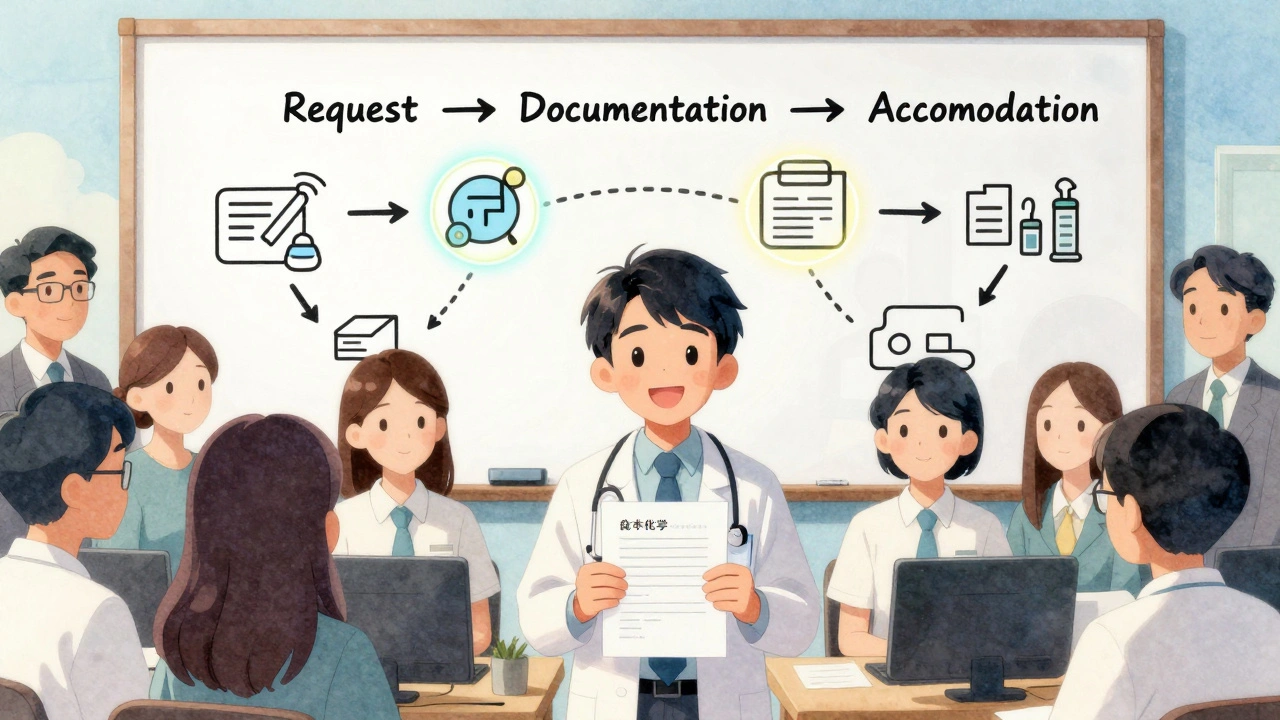
You don’t just ask and get approved. There’s a process - called the interactive process - that both you and your employer must follow.Step 1: You request an accommodation. You don’t need to say “I’m requesting an ADA accommodation.” You just say something like, “I’m experiencing side effects from my new medication that make it hard to stay alert after lunch. Can we talk about adjusting my schedule?”
Step 2: Your employer asks for medical documentation. They can’t ask for your full medical history or the name of your medication. But they can ask for a note from your doctor that explains:
- What side effects you’re experiencing
- How those side effects affect your ability to do your job
- What kind of accommodation would help
Step 3: You and your employer talk. This isn’t a one-time meeting. It’s a conversation. If your boss says no, they have to explain why - and offer alternatives. Maybe your requested schedule change isn’t possible, but a modified break pattern is.
Step 4: The accommodation is tried. Many accommodations are temporary. If you’re adjusting to a new drug, you might need a two-week schedule shift. Once your body adapts, the accommodation can end. But if side effects are long-term, the adjustment stays.
Companies that follow this process see 89% success rates in resolving accommodation requests, according to the Job Accommodation Network. Those that skip it? Nearly half of those cases end in complaints or lawsuits.
Safety-Sensitive Jobs: The Gray Area
Not all jobs are the same. If you work in transportation, healthcare, manufacturing, or any role where a mistake could hurt someone, your employer has more concerns.But here’s the key: They can’t say “no” just because you’re on medication. They have to prove you’re a direct threat - and that’s not easy.
The EEOC says employers must use objective medical evidence, not assumptions. For example:
- Can you show you’ve been on the same dose for months with no incidents?
- Do you have a clean safety record?
- Has your doctor confirmed your side effects are minimal?
In 2023, a warehouse worker in California won his case after being denied accommodation for opioid side effects. The court ruled that his employer didn’t gather enough individualized evidence - they just assumed all opioid users were unsafe. That’s not legal.
Still, safety-sensitive jobs have lower approval rates. Only 62% of accommodation requests in these fields are approved, compared to nearly 90% in office roles. Why? Because courts are more likely to side with employers when public safety is involved. But that doesn’t mean you lose your rights. It just means you need stronger documentation.

What Employers Can’t Do
There are hard limits. Even with good intentions, employers cross the line when they:- Require you to disclose your exact medication name
- Lower your performance standards
- Eliminate essential job duties (like a nurse being told they don’t have to stand for long shifts anymore)
- Fire you because you’re on medication - unless they’ve exhausted all other options
- Ask you to work while impaired or ignore signs of unsafe behavior
Also, illegal drug use isn’t protected. If you’re taking opioids without a prescription, or using cannabis where it’s still federally illegal, you’re not covered. But if your doctor prescribed it, and it’s legal in your state, the ADA still applies.
What to Do If Your Request Is Denied
If your employer refuses without good reason, don’t just accept it. Here’s what to do:- Document everything. Save emails, notes from meetings, and your medical documentation.
- Ask for a written explanation of why your request was denied.
- File a complaint with the EEOC. You have 180 days from the denial date.
- Consider contacting the Job Accommodation Network (JAN). They offer free, confidential advice.
Between 2019 and 2022, EEOC charges involving medication side effects rose by over 22%. More people are standing up - and winning. One truck driver, denied flexible hours for blood pressure meds, won his case after his doctor proved his medication caused minimal drowsiness at his dosage. He returned to work with his schedule adjusted - and his employer had to pay $85,000 in damages.
Why This Matters for Employers Too
This isn’t just about employee rights. It’s about retention and productivity.Companies with formal accommodation policies see 19% lower turnover among employees managing medication side effects. Why? Because people stay when they feel supported. They’re more loyal, more focused, and less likely to quit.
On the flip side, poorly handled requests cost money. The average settlement for a denied accommodation case is $68,400. Add in legal fees, lost productivity, and reputational damage - and the price climbs.
Employers who train their managers on ADA rules reduce accommodation complaints by 42%. Simple training - even just one hour a year - makes a huge difference.
What’s Changing in 2025
The landscape is shifting. More people are on mental health medications - antidepressants, ADHD drugs, anti-anxiety meds - and side effects from these are now the fastest-growing category of accommodation requests. By 2026, requests tied to psychiatric meds are expected to rise 15% annually.Remote work has also changed the game. Nearly 44% of accommodation requests now involve hybrid or fully remote setups - up from just 12% before the pandemic. That’s not going away.
And in early 2024, the EEOC is expected to release new guidance on accommodations for ADHD medications and cannabis-based treatments. That means even more clarity - and more protection - for employees.
Real Stories, Real Results
One nurse in Texas started a new migraine medication that made her dizzy and nauseated. She asked for a two-week adjustment: no night shifts, no standing for long periods. Her employer agreed. Within a week, her error rate dropped by 37%. She didn’t miss a single shift. The accommodation ended after two weeks - and she’s been fine ever since.Another warehouse worker in Ohio was on pain medication that made him slow to react. His boss wanted to fire him. Instead, they moved him to inventory sorting - a quieter, less physically demanding role. He stayed for five more years. The company saved on hiring and training costs.
These aren’t rare cases. They’re the norm when the system works.
Final Thoughts
Medication side effects aren’t weakness. They’re a medical reality. And the law recognizes that. You don’t have to suffer in silence. You don’t have to choose between your health and your job.If you’re struggling, speak up. Get your doctor’s note. Ask for what you need. If you’re an employer, listen. Train your team. Don’t assume. Don’t guess. Work with your employees - because the right accommodation doesn’t just help them. It helps your whole team.
The goal isn’t perfection. It’s fairness. And the system is built to make sure that’s possible.
Comments (15)
Jennifer Anderson
December 6, 2025 AT 20:55
just asked my boss for a 2pm start time cuz my anxiety med makes me feel like a zombie before noon. he said sure. no paperwork, no drama. why is this even a thing we have to fight for?
Sadie Nastor
December 7, 2025 AT 15:33
i’m on chemo and my manager let me work from the break room with a pillow and a snack drawer. i cried. not because i was sad, but because someone actually saw me. 🥹
Nicholas Heer
December 9, 2025 AT 11:24
so now the government’s telling us we gotta baby every person on pills? next they’ll mandate nap pods and free CBD lattes. this is socialism with a side of pharmaceuticals. 🇺🇸
Sangram Lavte
December 11, 2025 AT 06:11
in india, we don’t talk about meds at work. but i’ve seen people adjust quietly-early arrivals, extra tea breaks. no forms, no lawsuits. just human decency.
Oliver Damon
December 12, 2025 AT 15:14
the ADA’s interactive process isn’t bureaucracy-it’s systems thinking. it forces employers to move from assumption to evidence. that’s not a loophole, that’s due process. the real failure is when managers treat it as a hurdle instead of a collaboration.
Stacy here
December 14, 2025 AT 06:09
they’re coming for your job next. first it’s meds, then it’s ‘mental health days,’ then you’re not allowed to fire anyone ever again. wake up! this is the slippery slope to zero accountability. they want you weak, dependent, and silent.
Ernie Blevins
December 15, 2025 AT 01:27
my coworker takes Adderall and says she’s ‘medicated.’ she’s always late, always tired, always ‘needing space.’ she’s not disabled. she’s just lazy with a prescription.
Helen Maples
December 15, 2025 AT 14:05
If your employer denies a reasonable accommodation, document it. Then file with the EEOC. Do not wait. Do not hope. Do not negotiate. The law is your tool. Use it. They will not give you rights-you must claim them.
Ashley Farmer
December 17, 2025 AT 10:31
i’ve worked with people on everything from insulin to SSRIs. the ones who felt safe asking for help? they stayed. they thrived. they became our best employees. kindness isn’t a cost. it’s a multiplier.
Kurt Russell
December 18, 2025 AT 23:03
you think this is hard? try being the manager who didn’t know what to do. i learned the hard way. now i have a one-page cheat sheet for every new hire on meds. simple. clear. no drama. it’s not magic-it’s just done right.
Olivia Hand
December 20, 2025 AT 18:44
why do we assume side effects are temporary? what if my brain fog from antidepressants lasts 5 years? does my right to work expire after 90 days? the system’s built for short-term fixes, not chronic reality.
Louis Llaine
December 21, 2025 AT 15:28
so let me get this straight… if i take a pill, i get a free pass to nap at my desk? cool. next thing you know, the whole office will be on disability and we’ll just be paying people to scroll TikTok.
Jane Quitain
December 23, 2025 AT 12:55
i was scared to ask for a break to take my med… but my boss said ‘do what you need.’ i didn’t even know that was an option. thank you for writing this. i’m sharing it with everyone.
Ryan Sullivan
December 23, 2025 AT 15:10
the ADA was never meant to be a pharmaceutical entitlement program. the expansion of ‘disability’ to include pharmacological side effects is a legal overreach disguised as compassion. the courts are now functionally rewriting statutes via case law.
Wesley Phillips
December 24, 2025 AT 04:38
my boss didn’t even know the ADA applied to meds. i showed him the EEOC 2022 memo. he just said ‘ohhhhh’ and gave me a standing desk and extra breaks. no big deal. but now he’s training the whole team. small wins, right?