When a brand-name drug’s patent is about to expire, you might expect generic versions to flood the market right away. But that’s not what usually happens. In fact, the first generic company to challenge the patent often gets a 180-day exclusivity window - a legal monopoly that blocks every other generic from entering. This isn’t a reward for innovation. It’s a strategic tool built into U.S. drug law, and it’s had a massive impact on how quickly patients can access cheaper medicines.
How the 180-Day Exclusivity Rule Works
The rule comes from the Hatch-Waxman Act of 1984, a law designed to balance two goals: protecting drug companies that invest in new medicines, and speeding up access to affordable generics. The system lets generic manufacturers file what’s called an Abbreviated New Drug Application (ANDA). Instead of redoing all the clinical trials, they just prove their version is the same as the brand drug. But here’s the catch: if they want to file before the patent expires, they must say - in writing - that the patent is either invalid or won’t be infringed. That’s called a Paragraph IV certification. The first company to file that certification gets 180 days of exclusive rights to sell the generic. No other generic can get FDA approval during that time. That’s the incentive. Without it, companies wouldn’t risk the cost and uncertainty of patent lawsuits. A single legal battle can cost tens of millions. But if you win, you get a six-month monopoly on a drug that might be selling for billions a year.When Does the Clock Start?
The 180-day clock doesn’t start when the FDA approves the drug. It starts on the earliest of two events:- The date the generic drug is first sold commercially
- The date a court rules the patent is invalid or not infringed
Who Gets to Be the "First Applicant"?
It’s not enough to just file early. The ANDA must be "substantially complete." That means all the data, forms, and certifications are in order. The FDA doesn’t accept sloppy submissions. Courts have ruled on this before - like in Granutec, Inc. v. Shalala - and made it clear: if your paperwork is incomplete, you don’t qualify as the first applicant, even if you were the first to file. Sometimes, multiple companies file on the same day. The FDA has rules to break the tie. Usually, it’s based on which application was received first by the system timestamp. But in practice, it’s messy. Companies hire teams of lawyers and regulatory experts just to win this race. There have been lawsuits, citizen petitions, and even FDA hearings over who got there first.
The Forfeiture Trap
The 180-day exclusivity isn’t guaranteed. The 2003 Medicare Modernization Act added forfeiture rules. If the first applicant doesn’t start selling within 75 days of getting FDA approval - or if they delay commercialization for more than 30 days after a court decision - they can lose their exclusivity. The FDA clarified this in a 2018 letter about buprenorphine/naloxone, making it clear: failure to market = loss of exclusivity. But here’s the problem: the rules are vague. What counts as "commercial marketing"? Does a single shipment count? What if the company can’t get enough supply? The FDA hasn’t fully defined it. That uncertainty scares off smaller generic companies. Big players can afford to wait and litigate. Smaller ones can’t.Why This System Fails Patients
The original idea was to encourage patent challenges and get generics to market faster. But in practice, it often does the opposite. There are documented cases where the first generic company delays launch for years - sometimes with secret deals from the brand-name company. These are called "pay-for-delay" settlements. The brand pays the generic to stay out of the market. The FDA has called these "anti-competitive," and courts have struck some down. But they still happen. The result? A drug might have its patent expire in 2020. The first generic files in 2018. But the company doesn’t launch until 2024. For four years, patients pay full price. Other generics sit idle. The 180-day clock hasn’t even started yet. That’s not competition. That’s a legal delay tactic.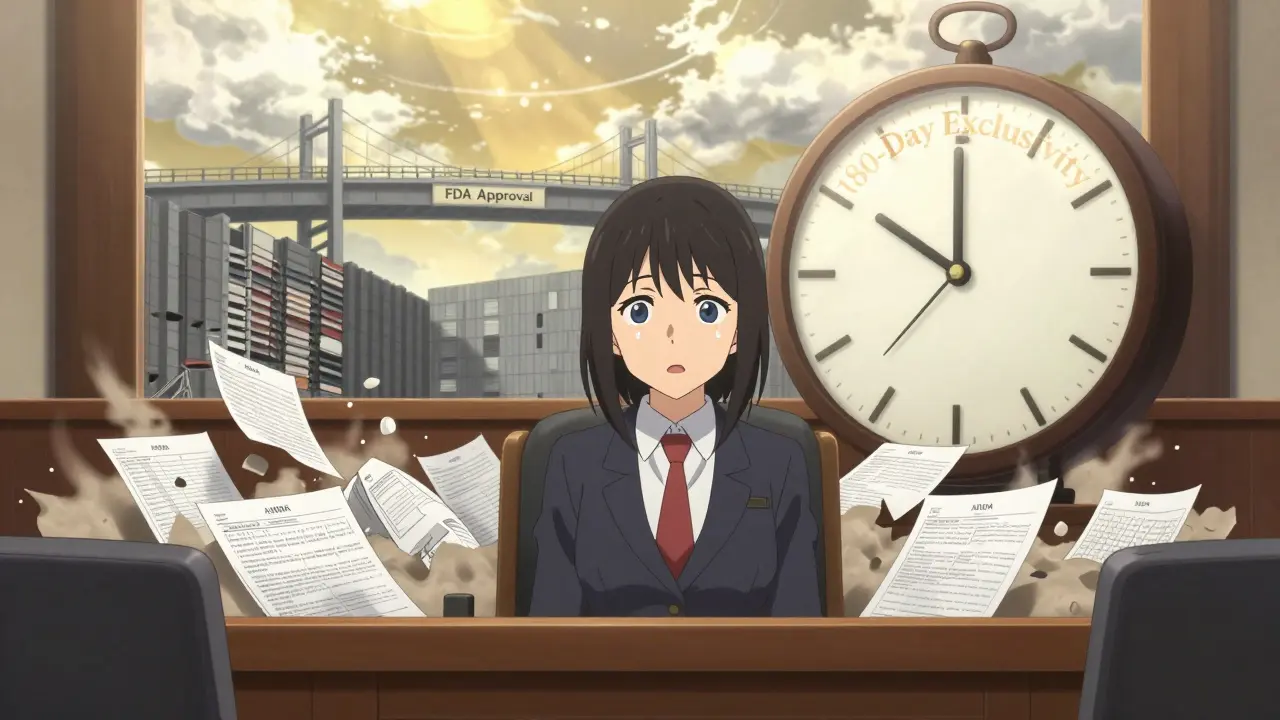
What’s Changing?
In March 2022, the FDA proposed major changes. They want the 180-day exclusivity to actually last 180 days - from the day the first generic starts selling, not from the day a court rules. Right now, a company could win a patent case in 2021 and sit on exclusivity until 2026. Under the new rule, exclusivity would begin when sales start. That would force faster market entry. They also proposed a new 270-day window for companies that launch more than five years before the patent expires. And if multiple companies file on the same day, only one gets the first 90 days. The rest have to wait. These changes aim to close loopholes and reduce gaming of the system.How This Affects Real People
You don’t need to understand patent law to feel the impact. If you take a daily medication - for diabetes, high blood pressure, or depression - the cost of that pill can drop by 80% once generics arrive. But if the 180-day exclusivity is being abused, that price drop could be delayed for years. In 2023, a single generic drug with exclusivity was estimated to generate over $1 billion in revenue for the first company. Meanwhile, thousands of patients paid hundreds more per month than they should have. The system was meant to help. It did - by making generics 90% of all prescriptions today. But the 180-day exclusivity has become a tool for delay, not competition. Until the rules are fixed, patients will keep paying more than they need to.Can a generic company lose its 180-day exclusivity after it’s been granted?
Yes. Under the Medicare Modernization Act of 2003, a company can forfeit its exclusivity if it fails to market the drug within 75 days of FDA approval or delays commercialization for more than 30 days after a court ruling. The FDA clarified this in a 2018 letter, making it clear that exclusivity isn’t automatic - it’s conditional on timely action.
What happens if two companies file a Paragraph IV certification on the same day?
The FDA uses system timestamps to determine who filed first. If both applications are substantially complete, the first one received gets the exclusivity. But if one application is incomplete, the second one may qualify instead. This has led to legal battles, with companies disputing what counts as "substantially complete." The FDA has issued guidance to standardize this, but ambiguity still exists.
Does the 180-day exclusivity apply to all generic drugs?
No. It only applies to drugs where a generic company files a Paragraph IV certification challenging a patent. It doesn’t apply to drugs that are off-patent or where no patent challenge was made. It also doesn’t apply to biosimilars, which follow a different rule under the BPCIA with a 12-month exclusivity period.
How does 180-day exclusivity differ from other types of FDA exclusivity?
Other types - like 5-year exclusivity for new chemical entities or 3-year exclusivity for new clinical studies - prevent generic applications from being filed at all. The 180-day exclusivity only blocks other generics from being approved after the first one. It doesn’t stop applications. It blocks approvals. It’s the only exclusivity tied to patent litigation, not data submission.
Why hasn’t the FDA fixed this system sooner?
The system is legally complex and deeply tied to patent law. The FDA doesn’t have authority to rewrite the law - only to interpret it. Changes require either new legislation or court rulings. The 2022 proposal was a step toward clarity, but Congress has not acted. Meanwhile, legal battles continue, and patients wait.
Comments (13)
Chris Crosson
March 23, 2026 AT 13:00
So let me get this straight - the system was designed to speed up generics, but now it’s being used to delay them? That’s like building a highway to reduce traffic, then putting up toll booths every mile. The 180-day exclusivity is supposed to be an incentive, but it’s become a weapon. And the worst part? Patients are the ones stuck in gridlock.
Caroline Bonner
March 23, 2026 AT 23:13
Oh my god, this is such a critical issue and I’m so glad someone broke it down like this. I’ve been on insulin for 12 years, and I remember when my generic switched from $45 to $300 because the first generic company delayed launch for two years - they were waiting for a court ruling, and then they just… didn’t sell. Meanwhile, the brand kept charging $400 a vial. I had to ration. I’m not exaggerating. People die from this. The FDA’s 2022 proposal is a start, but it needs to be mandatory, not optional. If you win the patent challenge, you have 30 days to launch - no exceptions. No loopholes. No ‘waiting for manufacturing.’ That’s not innovation - that’s exploitation. And let’s be real: big pharma and big generics are in cahoots more often than not. Pay-for-delay isn’t some obscure loophole - it’s the business model. I’m screaming into the void here, but someone has to.
Linda Foster
March 25, 2026 AT 17:58
While the intent of the Hatch-Waxman Act was commendable, the implementation has undeniably deviated from its original purpose. The current regulatory framework, as described, introduces significant market distortions that may not align with public health objectives. A more transparent, time-bound mechanism for exclusivity, coupled with enforceable penalties for non-commercialization, would likely yield more equitable outcomes. Further legislative clarity is warranted.
Rama Rish
March 26, 2026 AT 16:04
this is wild. why is it so hard to just let people get cheap meds? 🤦♀️
Seth Eugenne
March 27, 2026 AT 19:05
Reading this made me so frustrated but also kind of hopeful. It’s clear the system is broken, but I’m glad the FDA is finally trying to fix it. People don’t realize how much this affects real lives - not just numbers on a balance sheet. Thank you for sharing this. 💙
Chris Farley
March 27, 2026 AT 21:08
Let me guess - this is just another socialist plot to destroy American innovation. You know what? Patents exist for a reason. If you can’t afford your meds, maybe you shouldn’t be taking them. The market decides what’s valuable. If you want cheap drugs, move to India. We don’t owe you a free ride just because you can’t handle capitalism. 💪🇺🇸
Sean Bechtelheimer
March 29, 2026 AT 21:16
THIS ISN'T A COINCIDENCE. The FDA, Big Pharma, and the DOJ are ALL connected through shell companies. The 180-day rule? It's a cover for the deep state to control the drug supply. Look at the funding sources of the people writing these regulations. They all went to the same Ivy League school. They all donate to the same PACs. They're all part of the Pharma Illuminati. 🕵️♂️👁️🗨️
Kevin Siewe
March 30, 2026 AT 23:43
It’s easy to get angry about this, but I think we need to remember that the system wasn’t created to hurt people - it was created to balance competing interests. The problem is that the balance got lost over time. Maybe instead of just yelling at the FDA, we should be calling our reps and asking them to support the 2022 reforms. It’s not glamorous, but it’s how change actually happens. Small steps.
Blessing Ogboso
March 31, 2026 AT 20:20
As someone from Nigeria where generic drugs are often the only option for millions, this hits differently. In my country, we don’t have patent litigation - we have shortages. We don’t have 180-day exclusivity - we have 180-day waits for any medicine at all. I’ve seen mothers split pills in half because the pharmacy ran out. I’ve seen children with asthma using expired inhalers because the new ones never arrived. The U.S. system is broken, yes - but it’s still better than what we have. That doesn’t mean we shouldn’t fix it. It means we need to fix it with the global patient in mind. This isn’t just an American problem. It’s a human one. And if we can’t see that, we’ve lost something deeper than patents.
Jefferson Moratin
April 1, 2026 AT 08:46
The 180-day exclusivity provision constitutes a perverse inversion of the economic principle of first-mover advantage. Rather than incentivizing innovation, it incentivizes strategic delay - a form of regulatory arbitrage predicated upon legal ambiguity. The original legislative intent, as articulated in the Hatch-Waxman Act, presumed a dynamic equilibrium between intellectual property rights and public access. What we now observe is a static equilibrium of rent-seeking behavior, wherein the legal mechanism designed to accelerate market entry instead functions as a barrier to entry. The proposed FDA reforms represent a necessary correction - not merely procedural, but ontological - restoring the normative structure of competition to its intended function.
winnipeg whitegloves
April 3, 2026 AT 01:18
Man, I live in Winnipeg and we pay the same prices as you guys - but we don’t even have the same access to generics. Our pharmacists are basically smuggling pills from the States. I’ve got a buddy who drives to North Dakota just to fill his blood pressure med because it’s $80 here and $12 in Bismarck. The whole system is a dumpster fire wrapped in a patent lawyer’s tie. I say we scrap the 180-day thing and just say: ‘First to file, first to sell. No exceptions. No drama. No lawsuits.’ Let the market do its thing. If you’re smart enough to file early and make the product, you deserve to profit. But don’t sit on it. That’s not capitalism - that’s just being a jerk.
Brandon Shatley
April 3, 2026 AT 09:52
i read this and i just felt so tired. like why is this so hard? people just need meds. why do we need all this legal junk? i hope they fix it soon.
rebecca klady
April 5, 2026 AT 07:09
My dad’s on a generic for his heart condition. He paid $15 a month. Then the first generic delayed, and it jumped to $210. He skipped doses. He didn’t tell anyone. We found out because he passed out at the grocery store. This isn’t policy. This is personal.