
Have you ever noticed a bump on your lip and panicked? Is it just another annoying pimple from that late-night snack, or is it a cold sore about to ruin your week? It’s a nightmare scenario for anyone who cares about their appearance. The problem is, they look shockingly similar in the early stages. But here is the catch: treating a cold sore like a pimple doesn’t just fail-it can actually make things worse by spreading the virus.
Getting this wrong means using harsh acne creams on sensitive viral blisters or popping an infectious lesion and passing it to someone else. You need to know exactly what you are dealing with before you reach for any product. Let’s break down the real differences between these two common skin issues so you can treat them correctly and get back to normal life faster.
The Root Cause: Virus vs. Clogged Pore
To understand how to treat them, you first have to understand what they are. They are completely different beasts biologically.
A cold sore, medically known as herpes labialis or oral herpes, is caused by the herpes simplex virus type 1 (HSV-1). This isn’t a one-time infection; once you have the virus, it stays in your body forever, hiding in your nerve cells. According to the World Health Organization, about 67% of people under age 50 globally carry this virus. It lies dormant until something triggers it-like stress, sunlight, or a weakened immune system-and then it wakes up to cause an outbreak.
On the other hand, a pimple is simply a clogged hair follicle. It belongs to the broader category of acne lesions. When excess oil (sebum), dead skin cells, and bacteria (specifically Cutibacterium acnes) get trapped in a pore, inflammation happens. There is no virus involved. It’s a mechanical blockage issue, not an infectious disease. While acne affects millions annually, it is not contagious. You cannot catch a pimple from kissing someone.
Visual Clues: What to Look For
If you’re staring in the mirror trying to figure out what that bump is, look closely at these specific details. Your eyes can tell you a lot if you know where to look.
| Feature | Cold Sore (HSV-1) | Pimple (Acne) |
|---|---|---|
| Location | Almost always on the vermilion border (where lip meets skin). Rarely inside the mouth. | Anywhere on the face, including directly on the lip surface, cheeks, chin, or forehead. |
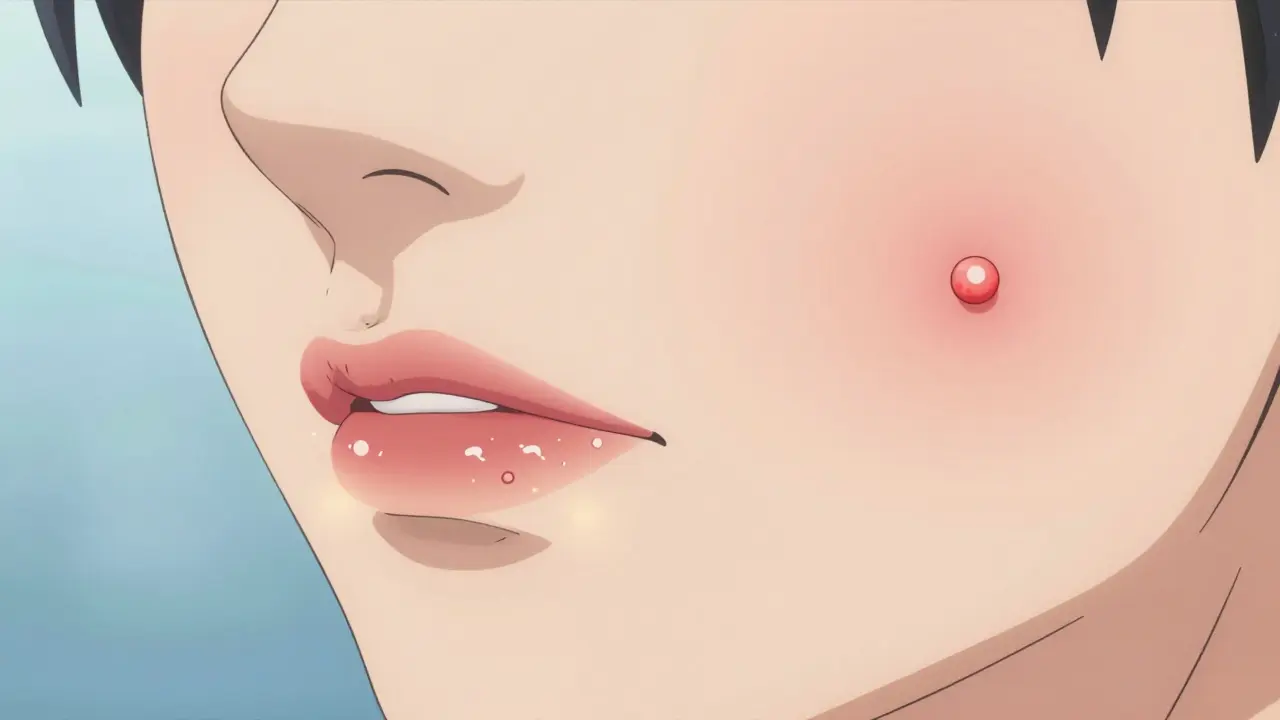
| Appearance | Clusters of tiny, fluid-filled blisters. They often merge into one larger sore. | Single raised bump. May have a white or yellow pus-filled head. |
| Sensation | Tingling, burning, or itching before the bump appears (prodrome phase). | Pain or tenderness when touched. No warning signs before it shows up. |
| Contagious? | Yes. Highly contagious through direct contact. | No. Not infectious. |
| Healing Time | 7-14 days without treatment. Goes through distinct stages (blister → ulcer → scab). | 3-7 days for mild cases. Can last weeks if cystic. |
The most telling sign is the "tingle." If you feel a weird prickling or burning sensation on your lip border before you see anything, it’s almost certainly a cold sore. This is called the prodrome phase. Pimples don’t give you a heads-up; they just appear overnight after a bad meal or a hormonal spike.
Why Misdiagnosis Makes It Worse
You might think, "It’s just a bump, I’ll put some acne cream on it." Stop right there. Using the wrong treatment is one of the biggest mistakes people make.
If you apply benzoyl peroxide or salicylic acid (common acne ingredients) to a cold sore, you risk rupturing the delicate blisters. These creams are designed to dry out and exfoliate skin. On a viral blister, this causes stinging, irritation, and premature bursting. When a cold sore bursts, it releases viral fluid. If that fluid touches other parts of your face or gets on your hands, you can spread the HSV-1 virus to new areas or to other people.
Conversely, if you treat a pimple with antiviral medication meant for cold sores, nothing will happen. Antivirals like acyclovir target viruses, not bacteria or clogged pores. You’ll waste money and time while the pimple continues to fester.
Treatment Paths: Do It Right
Once you’ve identified the culprit, the treatment strategy changes completely. Here is how dermatologists recommend handling each condition.
Treating Cold Sores
Speed is everything with cold sores. The goal is to stop the virus from replicating as much as possible.
- Catch it early: Apply treatment during the tingling phase. Prescription antivirals like valacyclovir (Valtrex) or acyclovir (Zovirax) work best when taken within 48 hours of symptoms starting. They can shorten the outbreak by 1-2 days.
- Over-the-counter options: Docosanol (Abreva) is an FDA-approved OTC cream. It needs to be applied five times a day for several days to reduce healing time by about 50%.
- Keep it clean: Don’t pick at the scab. Let it heal naturally. Picking increases healing time by 3-5 days and raises the risk of bacterial infection.
- Prevent spread: Wash your hands immediately after touching your face. Avoid sharing lip balm, towels, or utensils. Kissing should be off the table until the sore is fully healed.
Treating Pimples
For pimples, consistency is key. You aren’t fighting a virus; you’re managing oil and bacteria.
- Spot treatments: Benzoyl peroxide (2.5% to 10%) kills acne-causing bacteria. Salicylic acid (0.5% to 2%) helps unclog pores by exfoliating dead skin cells.
- Hydrocolloid patches: These little stickers absorb pus and protect the pimple from being touched. They are great for preventing picking and speeding up healing.
- Don’t pop it: We know it’s tempting, but squeezing a pimple pushes bacteria deeper into the skin, leading to more inflammation and potential scarring.
- Gentle cleansing: Use a non-comedogenic cleanser twice daily. Over-washing can strip your skin barrier, causing it to produce even more oil.
Common Mistakes to Avoid
I’ve seen plenty of bad advice online. Here are the traps you need to avoid to keep your skin healthy.
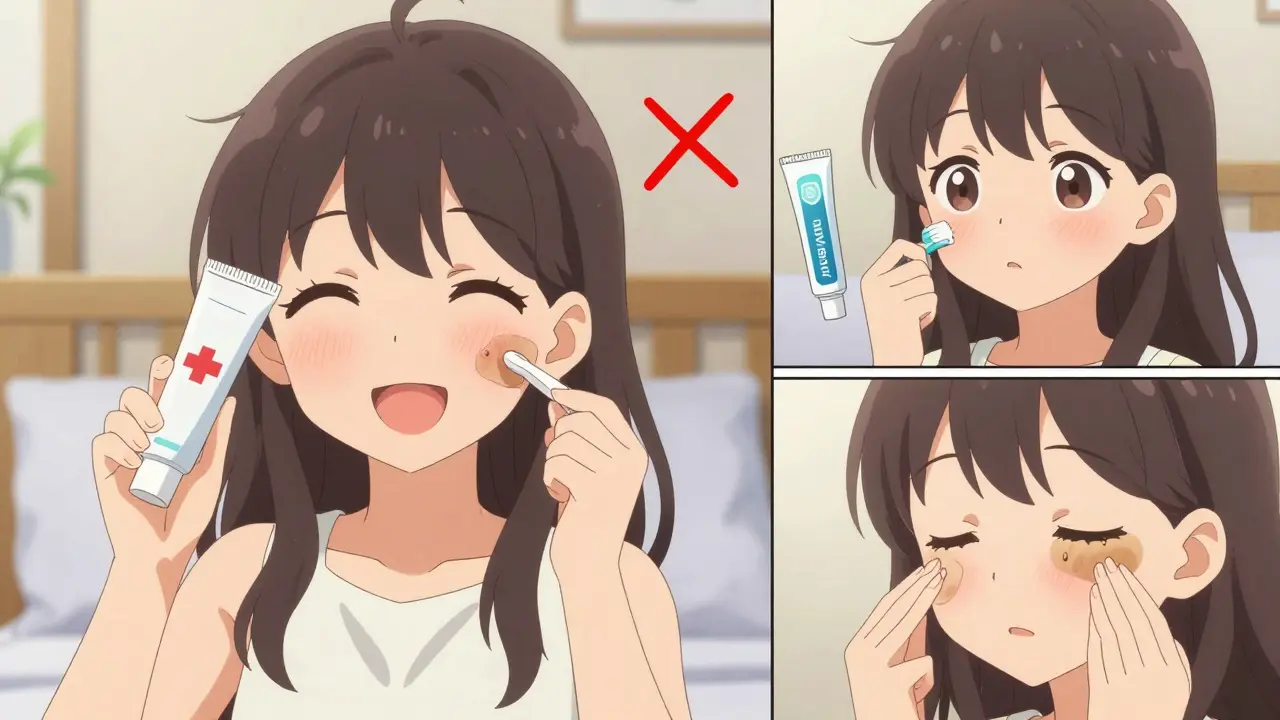
The Toothpaste Myth: People often slap toothpaste on cold sores or pimples because it dries things out. Skip this. Toothpaste contains menthol and baking soda, which irritate the skin, cause redness, and delay healing for both conditions.
Sharing Lip Products: If you have an active cold sore, do not share lipstick, gloss, or chapstick. HSV-1 survives on surfaces for short periods. You could easily pass it to a partner or family member. Replace your lip products after the outbreak heals to avoid reinfecting yourself.
Ignoring Triggers: If you get frequent cold sores, track what happens before they appear. Sun exposure, stress, and lack of sleep are major triggers. Wearing sunscreen with SPF on your lips can prevent UV-induced outbreaks. Managing stress through sleep and exercise helps keep the virus dormant.
When to See a Doctor
Most cold sores and pimples resolve on their own with proper care. However, there are times when professional help is necessary.
See a dermatologist or primary care provider if:
- Your cold sore lasts longer than two weeks.
- You experience severe pain, fever, or swelling around the eye (this can indicate a serious complication).
- You have outbreaks frequently (more than six times a year), which may warrant daily suppressive therapy.
- Your acne is cystic, painful, or leaving scars, indicating a need for prescription-strength treatments like retinoids or antibiotics.
Knowing the difference between a cold sore and a pimple saves you time, money, and embarrassment. Pay attention to the location, the sensation, and the appearance. Treat the virus with antivirals, and treat the clogged pore with acne-specific ingredients. Your skin will thank you.
Can a cold sore turn into a pimple?
No, a cold sore cannot turn into a pimple because they have different causes. A cold sore is viral (HSV-1), while a pimple is a clogged pore. However, a cold sore can become secondarily infected with bacteria if picked at, which might make it look more inflamed or pus-like, but it remains a viral lesion underneath.
Is it safe to kiss someone with a cold sore?
No, you should avoid kissing when you have an active cold sore. HSV-1 is highly contagious through direct contact with the blister fluid. Even if the sore has scabbed over, the virus can still shed. Wait until the skin is completely healed before engaging in close facial contact.
What is the fastest way to get rid of a cold sore?
The fastest way is to start antiviral treatment during the prodrome phase (the tingling stage). Prescription medications like valacyclovir can significantly shorten the duration. Over-the-counter docosanol cream also helps if applied consistently multiple times a day.
Can I use acne cream on a cold sore?
No, you should not use acne cream on a cold sore. Ingredients like benzoyl peroxide can irritate the blister, cause it to burst prematurely, and increase the risk of spreading the virus. Use antiviral treatments specifically designed for cold sores instead.
Are cold sores permanent?
The virus itself (HSV-1) is lifelong and cannot be cured. Once infected, it remains in your nerve cells. However, the visible sores are temporary and heal within 7-14 days. Many people find that outbreaks become less frequent and less severe over time.
Comments (8)
AnneKatherine Stiekes
June 13, 2026 AT 02:49
i totally get why people mix them up since they look so similar at first glance but honestly just taking a second to check if its tingling or just painful makes all the difference in how you handle it without stressing out too much about it
Hailey Dunston
June 13, 2026 AT 20:30
Oh, please. The notion that one must rigorously distinguish between a mere clogged pore and a viral outbreak is frankly pedestrian. Most individuals lack the dermatological acumen to discern the subtle prodromal tingling from simple inflammation, rendering these distinctions moot for the layperson. Furthermore, the stigma attached to HSV-1 is vastly overstated; it is merely a biological reality, not a moral failing. One should simply apply a high-end emollient and ignore the fuss. :-)
Glenn Davis
June 14, 2026 AT 21:10
Weakness causes outbreaks. Strong immune systems don't get cold sores. Stay strong.
rebecca torres
June 16, 2026 AT 17:56
everyone knows benzoyl peroxide kills bacteria so obviously it wont work on a virus but people still try it because they refuse to read labels or understand basic biology which is hilarious really
Christina S.
June 17, 2026 AT 04:14
You've got this! Remember that identifying the trigger early is half the battle. If you feel that tingle, reach for the antiviral cream immediately. Consistency is key here, just like with any skincare routine. Don't be hard on yourself if you slip up, just learn from it and keep your lip balm stocked up for next time.
Sherry Wheeler
June 18, 2026 AT 12:52
Oh my goodness, the pain of a cold sore is truly a test of one's spiritual endurance! It forces us to confront our vulnerability in a world obsessed with perfection. I remember when I had one before my wedding day; it felt like the universe was screaming at me to slow down and breathe. But through that pain came clarity. We must embrace the scabbing phase as a metaphor for healing, allowing nature to do its work without interference. It is a journey of self-discovery wrapped in discomfort!
Emily Barnhill
June 20, 2026 AT 12:49
Listen to me closely because I am going to say this once and only once: if you touch your face and then touch someone else's face, you are a menace to society. Stop sharing your lipstick with your sister. Stop kissing your partner when you have an open lesion. Boundaries exist for a reason. Protect your community by protecting yourself. Do not make excuses for poor hygiene practices under the guise of affection.
Cici arya Arya
June 21, 2026 AT 07:40
I just want to know if you personally have ever popped a pimple and regretted it because my life is falling apart right now and I need someone to tell me exactly what happened to their skin barrier after they used toothpaste on a blister last week did it burn did it peel did you cry?