
Statins & Grapefruit Interaction Checker
Select your statin medication to see if it interacts dangerously with grapefruit and other citrus fruits.
If you take a statin for high cholesterol and enjoy grapefruit in the morning, you might be at risk for something serious - and most people have no idea. This isn’t a myth or a warning from a scaremongering website. It’s backed by decades of clinical research, FDA alerts, and real cases of hospitalization. The interaction between grapefruit and certain statins isn’t just a minor inconvenience. It can push your medication levels into the dangerous zone, turning a routine heart drug into a silent threat to your muscles - and your kidneys.
Why Grapefruit Turns Statins Into a Hidden Overdose
Grapefruit doesn’t just taste tangy. It contains chemicals called furanocoumarins, naturally occurring compounds in grapefruit, Seville oranges, and pomelos that block a key enzyme in your gut. That enzyme, called CYP3A4, normally breaks down statins before they enter your bloodstream. When furanocoumarins shut it down, your body absorbs way more of the drug than it should. It’s like taking two or three pills at once - without knowing it.This isn’t theoretical. A landmark 1998 study found that just 200 mL of grapefruit juice - about one small glass - taken with simvastatin increased the drug’s concentration in the blood by up to 16 times. That’s not a typo. Sixteen times. The effect lasts for days because the enzyme doesn’t just slow down - it gets permanently damaged. It takes about 72 hours for your gut to rebuild enough CYP3A4 to handle statins normally again. So even if you eat grapefruit at breakfast and take your statin at night, you’re still in danger.
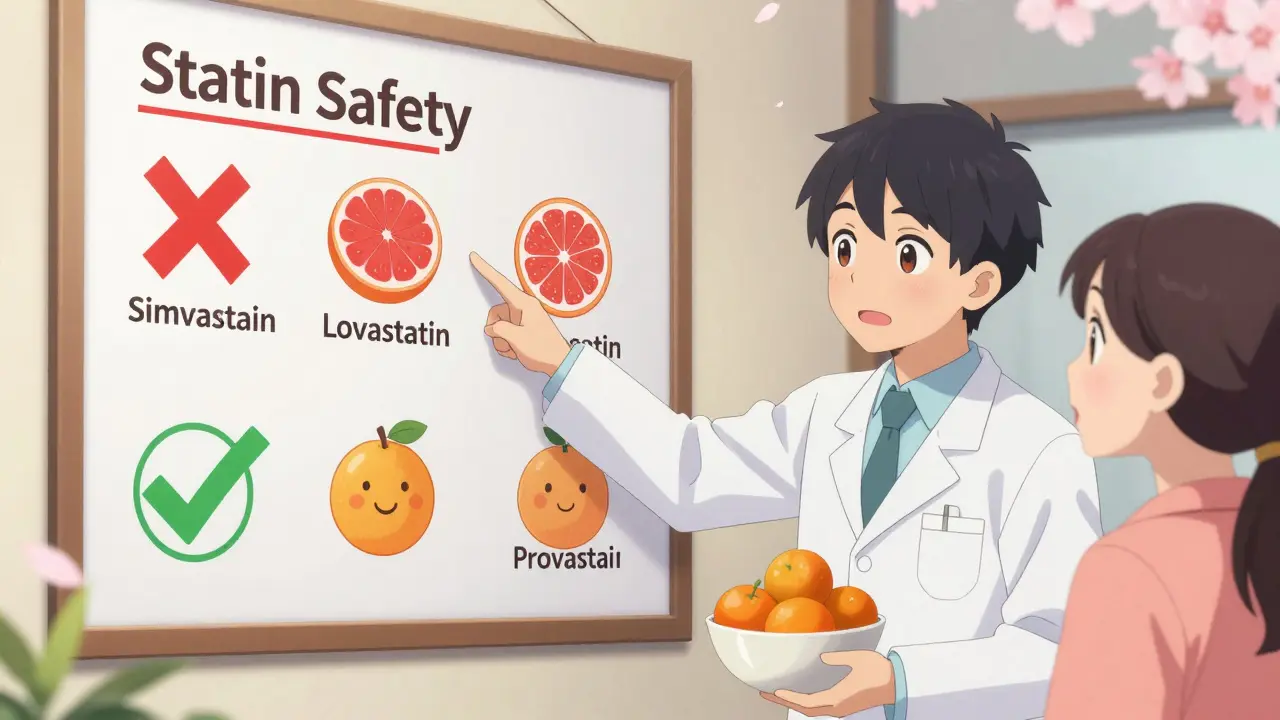
Which Statins Are Safe? Which Are Not?
Not all statins react the same way. The risk depends entirely on how your body processes the drug.| Statin | Interaction Risk | Why? |
|---|---|---|
| Simvastatin (Zocor) | Very High | Almost entirely broken down by CYP3A4. One grapefruit can push levels 16x higher. |
| Lovastatin (Mevacor) | Very High | Similar metabolism to simvastatin. FDA lists it as contraindicated. |
| Atorvastatin (Lipitor) | Moderate | Partly metabolized by CYP3A4. Small amounts of grapefruit may be okay, but not daily. |
| Pravastatin (Pravachol) | Low | Processed by different enzymes. Safe to eat grapefruit with. |
| Rosuvastatin (Crestor) | Low | Minimal CYP3A4 involvement. Considered safe even with regular grapefruit. |
| Fluvastatin (Lescol) | Low | Mainly metabolized by CYP2C9. Not affected by grapefruit. |
| Pitavastatin (Livalo) | Low | Uses alternative pathways. Minimal interaction risk. |
That means if you’re on simvastatin or lovastatin, you should stop eating grapefruit - period. No exceptions. If you’re on atorvastatin, occasional small amounts might be okay, but daily consumption is risky. The safest bet? Switch to pravastatin, rosuvastatin, or fluvastatin. These drugs don’t care about grapefruit.
What Happens When Your Statin Levels Go Too High?
The most common symptom is muscle pain - the kind that doesn’t go away after a workout. It’s not just soreness. It’s deep, persistent aching, often in your thighs, shoulders, or lower back. This is called myalgia, and it affects 5-10% of people who combine grapefruit with high-risk statins.But muscle pain is just the warning sign. The real danger is rhabdomyolysis, a rare but life-threatening condition where muscle tissue breaks down and floods your bloodstream with toxic proteins. When that happens, your kidneys can’t filter out the debris fast enough. Myoglobin - the protein from muscle breakdown - clogs the filters. That leads to acute kidney failure.
A documented case from 2020 involved a 40-year-old woman who ate half a grapefruit every day for 10 days while taking simvastatin. She woke up with severe muscle pain, couldn’t lift her arms, and her urine turned dark brown. She was hospitalized with kidney damage. She survived, but it took weeks of dialysis and physical therapy.
While rhabdomyolysis affects less than 1 in 10,000 statin users per year, that number jumps dramatically with grapefruit. The FDA estimates that the risk multiplies by 5-10 times in people who regularly consume grapefruit while on simvastatin or lovastatin.
Why Don’t More People Know About This?
You’d think every doctor would ask about grapefruit before prescribing a statin. But they don’t. A 2021 survey found that only 42% of primary care doctors routinely ask patients if they eat grapefruit. Even fewer - just 28% - give clear advice.Patients aren’t to blame. Most don’t know the difference between grapefruit and other citrus. They think, "It’s just fruit. How bad can it be?" But here’s the twist: oranges, lemons, and limes are fine. Only grapefruit, Seville oranges (used in marmalade), and pomelos contain enough furanocoumarins to cause trouble.
Pharmacists are often the first line of defense. A 2021 study showed that when pharmacists reviewed prescriptions and flagged grapefruit-statin combos, they cut dangerous combinations by 78% in just six months. That’s because they know the data - and they talk to patients.

What Should You Do Right Now?
If you take a statin and eat grapefruit, here’s what to do:- Check your statin name. Look at the prescription bottle. Is it simvastatin, lovastatin, or atorvastatin? If yes, stop eating grapefruit immediately.
- Don’t wait for symptoms. Muscle pain doesn’t always come before serious damage. Prevention beats treatment.
- Ask your doctor about switching. If you love grapefruit, ask if you can switch to pravastatin or rosuvastatin. These work just as well for lowering cholesterol - without the risk.
- Talk to your pharmacist. They’re trained to catch these interactions. Ask them to review all your medications - not just the statin.
- Read labels. Some packaged juices say "100% grapefruit juice." Others are blends. If it says "grapefruit," avoid it. Even grapefruit-flavored sodas or candies can contain traces.
Stopping your statin because you’re scared of grapefruit is worse than eating the fruit. Statins prevent heart attacks and strokes. The goal isn’t to quit the drug - it’s to avoid the grapefruit.
What’s Next? A Grapefruit Without the Danger?
Scientists are working on a solution. Researchers at the University of Florida are breeding furanocoumarin-free grapefruit, a genetically modified variety that retains flavor and nutrients but removes the compounds that block CYP3A4. Early trials show promising results. In five years, you might be able to enjoy grapefruit with your statin - safely.Until then, knowledge is your best defense. This isn’t about fear. It’s about control. You can manage your cholesterol. You can enjoy citrus. You just need to know which ones are safe - and which ones could cost you your health.
Comments (13)
Judith Manzano
March 9, 2026 AT 18:57
I’ve been on rosuvastatin for years and still eat grapefruit every morning. I didn’t know about the enzyme thing until now, but honestly? This post saved me from a potential disaster. Thanks for breaking it down so clearly. I’m telling all my friends.
Also, side note: my pharmacist flagged this when I got my script. She’s a legend. Pharmacists deserve way more credit.
PS: I used to take simvastatin. Never again. That stuff gave me leg cramps like I was training for a marathon I never signed up for.
rafeq khlo
March 11, 2026 AT 04:41
It is a well documented fact that pharmaceutical companies suppress information regarding drug interactions to maximize profit. The FDA is complicit in this. The grapefruit interaction is not a medical concern but a corporate one. Why else would they allow such a dangerous combination to remain on the market for decades?
Furthermore the fact that only 42 percent of doctors ask about grapefruit suggests systemic negligence. This is not incompetence. This is intentional.
Do not trust institutions. Do not trust your doctor. Do not trust the FDA. Only trust yourself and your research.
And yes I have read the 1998 study. I have also read the 2020 case report. I have cross referenced with Pubmed. The data is undeniable. The system is broken.
Morgan Dodgen
March 11, 2026 AT 13:19
Bro this is just Big Pharma flexing again. Who even invented grapefruit? Some guy in a lab with a Bunsen burner and a bad attitude? I bet it was a chemist trying to make statins more dangerous so they could sell more kidney meds.
Also why is no one talking about the fact that oranges are fine? That’s literally a racial profiling thing. Grapefruit is the black sheep of citrus. It’s being targeted. I’m not even mad. I’m just disappointed.
Also I’ve been eating grapefruit with my simvastatin for 7 years and I’m still here. So either I’m immune or the whole thing is a lie. My money’s on lie.
Also I saw a TikTok that said grapefruit juice is just water with vibes. Sooo… 🤷♂️
Philip Mattawashish
March 12, 2026 AT 21:15
Let me be clear: if you’re taking simvastatin and eating grapefruit, you’re not just being careless-you’re actively choosing to sabotage your own body. You think you’re being smart by eating "natural" foods? Natural doesn’t mean safe. Poison ivy is natural too. Botulism is natural. This isn’t a diet tip. It’s a death sentence with a side of zest.
And don’t even get me started on people who say "I’ve done it for years and nothing happened." That’s not proof. That’s just bad luck holding out. One day your kidneys will stop working and you’ll wonder why no one warned you. Spoiler: they did. You just didn’t listen.
You want to live? Stop being a stubborn idiot. Switch meds. Or stop the fruit. Pick one. Not both.
Tom Sanders
March 13, 2026 AT 06:39
So like… grapefruit is bad for some statins but fine for others? Okay. But why can’t they just make one statin that works for everyone? Why do we need six different ones? This feels like a scam. Like, "Hey, we made this drug that’s dangerous with fruit. But don’t worry! We’ve got another one that’s not! Here’s another prescription!"
Also I hate reading labels. I just take the pill. I don’t care what’s in it. I just want it to work. Why is this so complicated?
Jazminn Jones
March 14, 2026 AT 04:35
It is profoundly disconcerting that the general public remains so cavalier regarding pharmacokinetic interactions. The CYP3A4 enzyme system is not a suggestion-it is a biological imperative. The notion that "I’ve been fine for years" constitutes valid risk mitigation is not only statistically unsound but epistemologically reckless.
Furthermore, the suggestion that one might "switch" to pravastatin or rosuvastatin presupposes a healthcare system that prioritizes patient safety over profit margins-a fantasy, not a policy.
One must question the integrity of a medical paradigm that allows for such variable risk profiles to exist under the same therapeutic umbrella. This is not medicine. This is pharmacological roulette.
Stephen Rudd
March 15, 2026 AT 05:13
Everyone’s acting like this is some groundbreaking revelation. Newsflash: I’ve been telling people this for years. I work in pharmacy. I’ve seen three people end up in ICU over this. And guess what? They all said "I didn’t know."
Meanwhile, the same people who panic about grapefruit will happily chug energy drinks with caffeine and ephedrine and say "it’s natural."
Double standard much? You’re more afraid of a fruit than a chemical cocktail in a can. That’s not logic. That’s fear-based marketing.
Also I live in Australia. We don’t even eat grapefruit here. We have limes. And we’re fine.
Erica Santos
March 15, 2026 AT 20:25
So let me get this straight: we’re supposed to be terrified of a fruit that tastes like a citrusy middle finger… but we’re fine with swallowing a synthetic molecule designed to lower cholesterol by brute force? What a time to be alive.
Also I love that the solution is "switch to a different statin"-like we’re ordering off a menu. "I’ll have the grapefruit-safe one, no sauce, and make it a double."
Meanwhile, the real question is: why are we even taking statins? Is it medicine? Or are we just medicating our way out of a society that makes us sit still, eat processed food, and stare at screens all day?
Just saying. I’m not judging. I’m just… curious. 🤔
George Vou
March 16, 2026 AT 20:40
ok but like i read this and i was like wait i eat grapefruit every day and i take atorvastatin so i went and checked my bottle and it says lipitor and then i googled it and it said moderate risk so i was like okay maybe i should stop but then i thought wait what if i just eat half instead and then i remembered i also take melatonin and i think melatonin is also processed by cyp3a4 so now i dont know what to do and also my dog licked my plate last night so idk if he’s gonna die
Scott Easterling
March 16, 2026 AT 20:50
Okay, I’m sorry, but this whole thing is ridiculous. First, you have to read labels? What year is this? 2003? And you’re telling me I need to know which enzyme metabolizes which statin? I don’t even know what an enzyme is. I thought it was a type of cheese.
Also, I’ve been eating grapefruit with my statin since 2018. I’m 54. I’ve had two heart attacks. I’m still here. So either I’m invincible… or this whole thing is a scare tactic to sell more drugs.
And why is the FDA even involved? Who gave them the right to tell me what I can eat? I’m not a child. I’m an adult. I can make my own decisions.
Also, I think the real problem is that we’re all too lazy to exercise. Grapefruit has nothing to do with it.
Mantooth Lehto
March 17, 2026 AT 05:50
I was on simvastatin for 3 years and I ate grapefruit every day. I didn’t even know this was a thing until my mom sent me this article. I almost cried. I thought I was being healthy.
Now I switched to rosuvastatin and I’m back to my grapefruit routine. No guilt. No fear. Just vibes.
Also, my pharmacist gave me a free tote bag that says "I ♥ My Enzymes." I wear it to the grocery store. People stare. I don’t care. I’m a warrior.
PS: I made a playlist. It’s called "Statins & Citrus." You should listen. Track 3 is "Grapefruit Sunrise" by The Mellow Doses. 🎧🍊
Melba Miller
March 17, 2026 AT 18:03
This country is falling apart. We’re so obsessed with pills and labels and enzymes that we forgot how to live. I grew up in the 70s. We ate grapefruit with our eggs. We took aspirin. We didn’t have a list of 200 contraindications. We just lived.
Now? You can’t even drink orange juice with your blood pressure med without signing a waiver. What happened to us?
My dad took simvastatin for 12 years. He ate grapefruit. He lived to 89. He never had a stroke. He never went to the hospital. He died of old age. Not because of fruit. Not because of drugs.
Maybe we need to stop overthinking everything. Maybe we need to trust our bodies a little more.
Just saying.
Katy Shamitz
March 18, 2026 AT 02:56
Oh honey, I’m so glad you wrote this. I’ve been telling my sister for months that she needs to stop eating grapefruit with her statin. She said I was being dramatic. Now she’s calling me to say she’s switching to pravastatin. I’m so proud of her.
Also, I told my book club about this last week. We all checked our meds. Three of us were on risky statins. We had a group Zoom with our pharmacists. It was beautiful. We cried. We hugged. We bought grapefruit-free juice.
Love wins. Knowledge wins. And grapefruit? Well… it’s still delicious. Just not with your pills. 💕