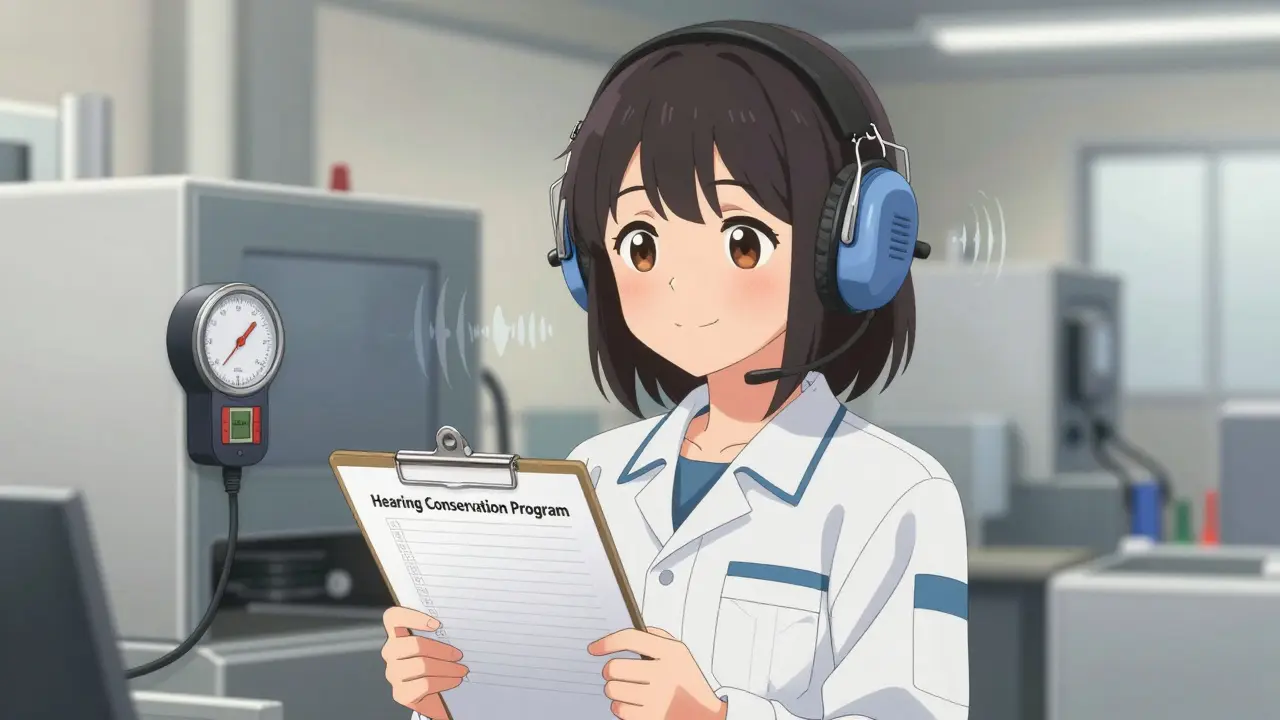
Every year, hearing conservation programs save thousands of workers from permanent hearing damage-but too many workplaces still skip the basics. If you work in manufacturing, construction, or any noisy environment, your ears are at risk. The good news? The rules are clear, the tools exist, and the science is solid. The bad news? Most companies don’t get it right.
When Does Your Workplace Need a Hearing Conservation Program?
It’s not about how loud it feels. It’s about numbers. If your employees are exposed to noise at or above 85 decibels (dBA) averaged over an 8-hour workday, federal law requires a Hearing Conservation Program (HCP). This is called the action level, and it’s not a suggestion-it’s OSHA’s 29 CFR 1910.95 regulation. That’s about the noise of a lawnmower or a busy city street. You don’t need to hear jackhammers to be at risk.
NIOSH estimates 22 million American workers are exposed to dangerous noise levels every year. That’s one in seven workers. And 22 million is just the reported number. Many more go unmeasured. Noise-induced hearing loss (NIHL) is the most common work-related illness in the U.S., and it’s 100% preventable-if you do the right things.
The Five Required Components of a Hearing Conservation Program
OSHA doesn’t leave room for guesswork. A valid HCP must include five core parts. Missing even one makes your program non-compliant-and puts your workers at risk.
- Noise Monitoring: You can’t protect what you don’t measure. Employers must use calibrated noise dosimeters or sound level meters to identify areas where exposure hits or exceeds 85 dBA. This isn’t a one-time check. Every time you change equipment, add a machine, or reconfigure a line, you must retest. Skipping this step is like driving blindfolded.
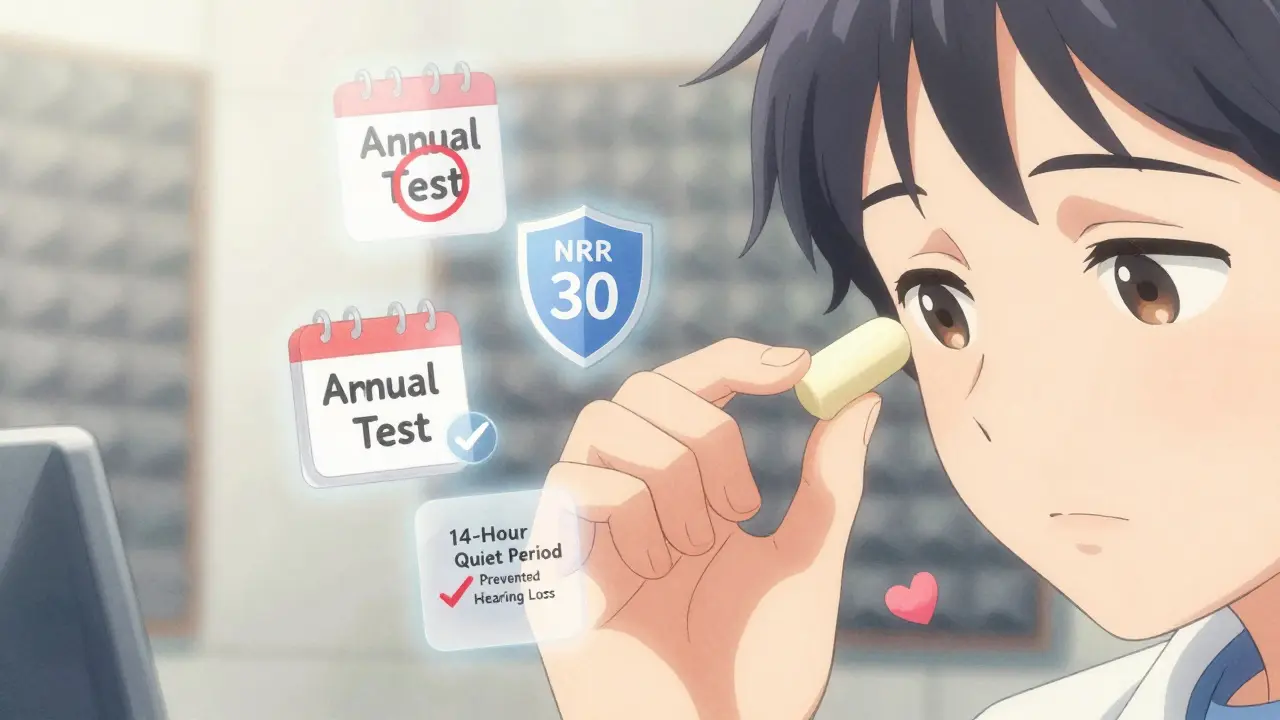
- Audiometric Testing: This is the heartbeat of the program. Every employee exposed to 85 dBA or more must get a baseline hearing test within six months of starting. The test must happen after at least 14 hours without workplace noise. After that, annual tests are mandatory. The frequencies tested? At minimum: 500, 1000, 2000, and 3000 Hz. But new standards are pushing for 4000 and 6000 Hz too. Tests must be done in soundproof booths that meet OSHA Appendix C standards, using audiometers calibrated to ANSI S3.6-2018 (not the outdated 1969 version).
- Hearing Protection: Earplugs and earmuffs aren’t optional. Employers must provide at least two types of hearing protection and train workers on how to use them. The goal? Reduce exposure to 90 dBA or lower. But here’s the catch: many workers get the wrong fit. A poorly inserted earplug can cut attenuation by 50%. That’s why fit testing is now a critical part of good programs. And yes-you have to replace worn-out protectors. Old earplugs lose their seal. Old earmuffs crack and leak sound.
- Training: Annual training isn’t a checkbox. It’s a lifeline. Workers need to understand why noise is dangerous, how hearing protectors actually work, and why their annual test matters. Training should be interactive, not a PowerPoint slideshow. Show them real audiograms. Let them try different protectors. Ask them to explain the risks in their own words. If they don’t understand, they won’t use the gear.
- Recordkeeping: Keep noise exposure records for at least two years. Audiometric test results? Keep them for the entire time the employee works there. These aren’t just paperwork-they’re legal proof you’re doing your job. OSHA auditors will ask for them.

What Happens When Hearing Loss Is Detected?
Not all hearing loss is permanent-but once it happens, you can’t undo it. That’s why early detection matters. If an employee’s hearing shifts by 10 dB or more at 2000, 3000, and 4000 Hz compared to their baseline, that’s called a Standard Threshold Shift (STS). When this happens, you have 30 days to act.
First, you must notify the employee in writing within 21 days. No email. No group text. A formal letter or documented notice. Second, you must refit their hearing protection and retrain them. Third, if their current protectors aren’t enough, you must offer ones with higher noise reduction ratings (NRR). And fourth-if there’s any sign of infection, trauma, or medical issue-you refer them for a clinical audiological evaluation. This isn’t optional. It’s the law.
And here’s something many don’t know: you can update the baseline audiogram if the shift is confirmed as permanent. But you can’t keep resetting the baseline to hide the problem. A professional supervisor of audiometry must approve any change.
Why Most Programs Fail (And How to Fix It)
OSHA’s 2021 data showed 62% of violations were due to bad audiometric testing. Another 28% came from poor training. That’s not luck-it’s negligence.
One common mistake? Testing employees right after their shift. Noise exposure doesn’t vanish when the clock hits 5 PM. Your ears need 14 quiet hours to reset. If you test them at 4:30 PM, your results are garbage. Another? Forgetting to calibrate the audiometer. If the machine is off by 5 dB, you’re misdiagnosing hearing loss.
Small businesses struggle the most. OSHA data shows 37% of companies with under 50 employees don’t comply. Why? Cost. A full HCP runs $250-$400 per employee a year. Audiometric testing alone makes up half that. But here’s the truth: workplaces with solid HCPs see 5-10% higher productivity and 15-20% fewer absences. That’s not a cost-it’s a return.
Successful programs use mobile testing units. These are vans or trailers with built-in sound booths that come to the site. They cut employee downtime by 60%. They reduce no-show rates. They make testing convenient. And they’re used by 73% of compliant companies. If you’re still sending workers to clinics, you’re making it harder than it needs to be.
What’s Changing in 2024 and Beyond
OSHA is updating the rules. The proposed changes, expected to finalize in late 2024, include:
- Mandatory use of ANSI S3.6-2018 for audiometer calibration (replacing the 1969 standard)
- Adding 4000 Hz and 6000 Hz to required test frequencies
- Requiring hearing protectors with higher NRR for exposures over 100 dBA (not just 90 dBA)
These aren’t just bureaucratic tweaks. They’re based on science. Studies show that even at 85 dBA, 8-12% of workers still develop hearing loss over a lifetime. The current 90 dBA permissible exposure limit hasn’t changed since 1983. Experts agree: it’s outdated.
Dr. Thais C. Morata from NIOSH says early detection and proper protection can prevent permanent damage in 75% of at-risk workers. That’s not a guess-it’s data. And if you implement the program correctly, you can cut hearing loss by 30-50%.
The Bottom Line
Hearing loss doesn’t happen overnight. It creeps in. A worker might not notice they’re missing high-pitched sounds until they can’t hear their grandchild say “I love you.” By then, it’s too late.
There’s no excuse for not having a solid HCP. The tools are available. The rules are clear. The cost of compliance is far less than the cost of lawsuits, workers’ compensation claims, and lost productivity. And above all-it’s the right thing to do.
If your workplace has noise, you have a responsibility. Start with monitoring. Test every year. Train like their lives depend on it. And don’t wait for OSHA to show up.
What noise levels require a Hearing Conservation Program?
A Hearing Conservation Program is required when employees are exposed to noise at or above an 8-hour time-weighted average of 85 decibels (dBA). This is known as the OSHA action level. Even if the noise doesn’t feel loud, if it meets or exceeds this level over a workday, the program must be implemented.
How often must audiometric testing be done?
Employees must receive a baseline audiogram within six months of first exposure at or above 85 dBA. After that, annual audiograms are required for all affected workers. The test must be conducted in a quiet room, with the employee free from workplace noise for at least 14 hours before the test.
What happens if an employee has a Standard Threshold Shift (STS)?
If an employee shows a 10 dB or greater average shift in hearing at 2000, 3000, and 4000 Hz compared to their baseline, the employer must notify them in writing within 21 days, refit and retrain them on hearing protection, provide better protectors if needed, and refer them for a clinical evaluation if a medical issue is suspected. The baseline can be revised only if a professional determines the shift is permanent.
Can I use any earplugs or earmuffs for hearing protection?
No. Employers must provide a variety of hearing protection options and ensure they reduce noise exposure to at least 90 dBA. The devices must have a Noise Reduction Rating (NRR) appropriate for the noise level. Fit testing is critical-poorly fitted protectors can cut effectiveness by half. Workers must be trained on proper insertion and maintenance.
Are small businesses exempt from Hearing Conservation Programs?
No. OSHA rules apply to all employers, regardless of size. However, small businesses with fewer than 50 employees have a 37% non-compliance rate, often due to cost and lack of resources. Mobile testing units and partnerships with occupational health providers can help reduce costs and improve compliance.
Comments (12)
jared baker
March 17, 2026 AT 15:33
Just want to say this post is spot on. I’ve worked in manufacturing for 12 years and saw guys lose their hearing because management thought ‘it’s just noise.’ No one trained them. No one tested them. Just handed out cheap foam plugs and called it a day. It’s heartbreaking. The science is clear. The tools exist. If your company isn’t doing this right, they’re gambling with people’s lives. Start with monitoring. Do it right. Every. Single. Time.
Michelle Jackson
March 18, 2026 AT 11:01
Wow. So basically if your boss ignores this, they’re breaking the law and putting workers at risk. And yet somehow, every place I’ve worked skips the baseline test or does it right after shift. I’m not surprised. They’d rather save $200 than keep someone from going deaf. Sad. But not shocking.
becca roberts
March 19, 2026 AT 07:57
Let me get this straight - we live in a country where a lawnmower is considered dangerous, but companies still treat hearing protection like an optional accessory? And we wonder why people think safety protocols are just paperwork? The real tragedy isn’t the hearing loss - it’s that we’ve normalized ignoring it.
Nicole Blain
March 19, 2026 AT 21:21
Mobile testing vans are genius. Why are we still making people go to clinics? Imagine if we did blood pressure checks the same way - ‘Hey, take a 3-hour bus ride to get screened for heart disease.’ 🤦♀️
Kathy Underhill
March 21, 2026 AT 00:54
It’s not about compliance. It’s about dignity. If someone spends 8 hours a day in noise, they deserve to hear their child laugh at 60. Not just survive. But live. The numbers don’t lie. The cost is real. But so is the consequence. We owe them better.
Stephen Habegger
March 21, 2026 AT 03:06
Good stuff. I’ve seen HCPs turn around whole teams. Morale goes up. Fewer injuries. Less turnover. It’s not a cost center. It’s a culture builder. Start small. Test one line. Show the data. Let it speak.
Robin Hall
March 22, 2026 AT 17:59
Let’s be honest - OSHA doesn’t care. They’re underfunded and overworked. The real enforcers? Insurance companies. They audit your records. If you don’t have proper audiometric logs, your premiums spike. That’s why some companies finally act - not because they care, but because their profits are bleeding out. This isn’t about safety. It’s about risk management disguised as ethics.
Suchi G.
March 23, 2026 AT 11:37
I just want to say, hearing loss doesn’t just affect the worker. It affects their family. I have a cousin who worked in a steel mill for 20 years. He couldn’t hear his daughter’s voice on the phone. Couldn’t hear the doorbell. Couldn’t hear his wife say ‘I love you’ when she was crying. He thought it was normal. He thought everyone went deaf eventually. No one told him. No one trained him. No one tested him. And now? He’s 52, uses hearing aids, and still feels like he’s underwater. I wish someone had told him earlier. I wish someone had cared enough to do the right thing.
gemeika hernandez
March 25, 2026 AT 04:45
Wait so you're saying if I use earplugs wrong I lose half the protection? Like if I don't roll them right? That's wild. I thought it was just plug and go. My cousin works in a factory and he just shoves them in. No wonder he says he can't hear his own alarm clock anymore. This whole thing is a mess. Why don't they just make everyone wear earmuffs? Simpler. Less guesswork.
cara s
March 26, 2026 AT 02:38
While I appreciate the thoroughness of this post, I must point out that the reliance on ANSI S3.6-2018 calibration standards is still insufficient. The true standard should be ISO 8253-1, which accounts for ambient noise variability across industrial environments. Furthermore, the 85 dBA action level is archaic. Recent studies from the Journal of Occupational and Environmental Medicine (2023) suggest that 80 dBA should be the new threshold, especially for long-term exposure in repetitive tasks. The current guidelines were established before the widespread use of high-frequency industrial tools - tools that emit energy beyond 8 kHz. We are decades behind in policy, not just in equipment.
Amadi Kenneth
March 26, 2026 AT 19:40
...And who really controls the audiometers? Who calibrates them? Who audits the auditors? I’ve seen reports where the same machine was used for 3 years without calibration - and the ‘results’ were signed off by someone who didn’t even attend the training. This isn’t about hearing loss - this is about a system that lets corporations falsify compliance while pretending to care. The government? They’re in bed with the testing vendors. The real solution? Community-led noise monitoring. Citizen science. We need whistleblowers. We need audits from outside. Because the system is rigged.
jared baker
March 27, 2026 AT 12:00
Replying to @8099 - you’re not wrong. But don’t underestimate the power of small wins. I helped set up a mobile unit at my plant last year. We tested 120 people. Found 17 with STS. 12 of them had never been told. We got them new protectors. Retrained them. One guy cried because he finally understood why he couldn’t hear his granddaughter. That’s the real change. Not the conspiracy. The human.